lovethailand home >Northeastern Travel Attractions >Chaiyaphum Travel Attractions >Khon San >Khon San > Wat Chedi
TL;DR: Wat Chedi is located at Ban Na Khoen, Village No. 1, Khon San Subdistrict, Khon San District, Chaiyaphum Province, open Daily, hours 07.00 – 18.00.

Chaiyaphum

Wat Chedi

Wat Chedi

Open Days: Daily
Opening Hours: 07.00 – 18.00
 
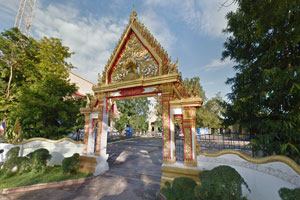
Wat Chedi is located at Ban Na Khoen, Village No. 1, Khon San Subdistrict, Khon San District, Chaiyaphum Province. It is one of the oldest and most respected temples in Khon San and is deeply revered by local people. The temple is associated with the early history of Khon San, the discovery of an abandoned ancient temple site, and the preservation of important sacred objects. Its most important image is Luang Por Phra Prathan, also known as Phra Phuttha Chai Saramuni or Luang Por 700 Pi, a laterite Buddha image in the Mara Vijaya posture believed to be about 700 years old. The temple also preserves a twelve-indented-corner chedi, an old Sri Maha Bodhi tree, and mural paintings inside the ordination hall.
 
Wat Chedi was formerly known as Wat Pho. It once stood as an abandoned temple in a dense forest before being restored during the early development of Khon San. Local history relates that Luang Phichit Songkhram, also known as Muen Aram Kamhaeng, the first ruler of Khon San, together with Khun Chong Asa, Phran Thong Daeng, and their followers, discovered the abandoned temple area. They found old Buddha images, a chedi, and sacred trees in the forest. The temple was then restored and became an important Buddhist center of the local community.
 
The central focus of faith at Wat Chedi is Luang Por Phra Prathan, or Phra Phuttha Chai Saramuni. Local people commonly call the image Luang Por 700 Pi, meaning the 700-year-old Buddha image. It is a laterite Buddha image in the Mara Vijaya posture, enshrined inside the ordination hall. For generations, the people of Khon San have regarded the image as a sacred guardian and spiritual anchor of the town. Visitors come to pay respect, ask for blessings, and find peace of mind in front of the ancient image.
 
Luang Por Phra Prathan has several distinctive features. The image is made of laterite, has a large and graceful form, and faces west. One of its most famous characteristics is the red color of the Buddha’s lips, which makes the image immediately memorable. The image measures approximately 3 sok across the lap and about 8 sok in height. It was registered as an important antiquity in the Royal Gazette on 2 August 1936, confirming its national cultural value as well as its deep local importance.
 
The age and artistic character of Luang Por 700 Pi make Wat Chedi an important place for understanding Buddhist art in Khon San. Laterite Buddha images of this kind reflect ancient craftsmanship, local materials, and religious devotion. The image is not merely a sacred object for worship. It is also evidence of the skill, faith, and historical memory of the people who created and preserved it. Standing before the image inside the ordination hall gives visitors a strong sense of calm and reverence.
 
Another important feature of the temple is the twelve-indented-corner chedi. This chedi is closely connected with the temple’s name and history. Its form reflects refined religious architecture and the long tradition of building sacred monuments to preserve faith, memory, and religious meaning. Local accounts describe the chedi as one of the ancient structures found together with the Buddha image in the old abandoned temple area. It therefore remains an important part of the temple’s historical landscape.
 
The chedi is also interesting from an artistic perspective. Local descriptions connect its form with the style of Sipsongpanna and Chinese-influenced civilization. This gives Wat Chedi an additional cultural dimension. The temple shows that the artistic history of Khon San was shaped by multiple cultural currents, not only by one single tradition. Visitors interested in religious architecture should take time to observe the form, base, corners, and placement of the chedi within the temple grounds.
 
The old Sri Maha Bodhi tree inside the temple is another meaningful element. In Buddhism, the Bodhi tree is closely connected with the enlightenment of the Buddha. The presence of a Bodhi tree believed to be about 300 years old adds spiritual depth to the temple environment. The tree offers shade and creates a calm atmosphere, while also standing as a living witness to the temple’s long history and the changing generations of the Khon San community.
 
The mural paintings inside the ordination hall add further cultural value to Wat Chedi. Buddhist murals are not only decoration. They are visual teachings that communicate stories of the Buddha, Jataka tales, moral lessons, and traditional Buddhist worldviews. Visitors should observe the murals respectfully and slowly, because the images help reveal how local communities used art as a language of faith, teaching, and memory.
 
Wat Chedi is not a very large temple, but its spiritual and historical value is considerable. It stands in the Khon San community and preserves some of the most important sacred objects in the district. Its value does not depend on scale or grandeur. Instead, it comes from the presence of Luang Por 700 Pi, the ancient chedi, the old Bodhi tree, the murals, and the living faith of people who continue to care for the temple.
 
As an active community Buddhist temple, Wat Chedi continues to support religious life. Monks reside at the temple, chant, study Dhamma, perform religious duties, and lead ceremonies. Local Buddhists come to offer food, make merit, listen to Dhamma, observe precepts, and join annual ceremonies. The temple is therefore not only a historical site. It remains a living Buddhist space where faith is practiced in daily life.
 
Recent Kathin-related temple information lists 5 resident monks at Wat Chedi and names Phra Khru Nantha Chediyaphirak as the abbot. Phra Khru Nantha Chediyaphirak also has an important role in the Khon San monastic community. This continuing monastic leadership helps the temple maintain its religious activities, care for sacred objects, and serve the needs of local devotees.
 
The temple’s major annual tradition is the gilding ceremony for Luang Por Phra Prathan, together with Bun Phawet or the Mahachat sermon and the procession celebrating newly ordained monks. This annual event is held around the waxing 13th to 15th days of the third lunar month. During this period, local people and visitors gather to pay respect to Luang Por 700 Pi, apply gold leaf, listen to Dhamma, and join the procession. The event shows the strength of faith and community unity in Khon San.
 
The gilding ceremony has deep meaning for the local community. Applying gold leaf to the sacred Buddha image is an act of merit and reverence. The Mahachat sermon connects the community with the story of Vessantara Jataka and the practice of generosity. The procession for newly ordained monks brings families and villagers together in pride and joy. These elements make the annual event one of the most important expressions of Buddhist culture in Khon San.
 
Wat Chedi is also suitable for meditation and quiet reflection. Visitors can worship, chant, sit quietly, observe the ancient Buddha image, or walk slowly around the temple grounds with mindfulness. Being in front of an image that has been revered for centuries naturally encourages humility and awareness of impermanence. The temple therefore offers both merit-making and inner reflection.
 
The temple serves as a spiritual center for the people of Khon San. Many villagers come to ask for blessings related to family, work, education, health, and peace of mind. For people facing anxiety or suffering, paying respect to Luang Por 700 Pi and sitting quietly in the ordination hall can bring a sense of steadiness. The temple continues to function as a place of emotional and spiritual support for the community.
 
Culturally, Wat Chedi transmits Buddhist manners and local knowledge from one generation to the next. Children who come with their families learn how to pay respect to Buddha images, bow to monks, dress modestly, behave calmly, and help with merit-making activities. Adults and elderly people use the temple as a place for merit-making, Dhamma listening, and social connection. Through these ordinary practices, Buddhist culture remains alive in the community.
 
Wat Chedi is also an important local history classroom. Visitors can learn about the early development of Khon San, the discovery of the abandoned temple, the restoration led by the first ruler of Khon San, the registration of the temple under the Department of Religious Affairs, the official registration of Phra Phuttha Chai Saramuni as an antiquity, and the temple’s continuing role in annual ceremonies. These stories make a visit to Wat Chedi more meaningful than a simple stop for worship.
 
The temple grounds can be understood through several important zones: the ordination hall housing Luang Por Phra Prathan, the twelve-indented-corner chedi area, the old Sri Maha Bodhi tree area, the mural painting area, the temple courtyard, the ceremony area, the monks’ residence area, the annual festival area, and quiet spaces for meditation. Each zone supports a different aspect of temple life. The ordination hall is the heart of devotion, the chedi preserves historical memory, and the courtyard supports community activities.
 
Visitors should begin by paying respect to Luang Por Phra Prathan inside the ordination hall. After that, they can walk around the temple to observe the ancient chedi, the Bodhi tree, and the murals. They should dress modestly, keep quiet, avoid touching ancient objects unnecessarily, avoid climbing on old structures, and ask permission before photographing monks or community ceremonies. Proper behavior helps preserve the sacred atmosphere and protects the temple’s cultural heritage.
 
Getting There is most convenient by private car. Travelers should first reach Khon San District in Chaiyaphum Province, then continue to Ban Na Khoen, Village No. 1, Khon San Subdistrict. The temple is located within the Khon San community and is easy to combine with nearby attractions. From Chaiyaphum city, the distance to Khon San is about 120 kilometers. Visitors using public transportation should first travel to Khon San town and then arrange local transport to the temple.
 
A half-day visit can focus on paying respect to Luang Por 700 Pi, viewing the twelve-indented-corner chedi, observing the old Bodhi tree, and seeing the murals in the ordination hall. After that, visitors can stop for food or coffee in Khon San town. A full-day route can add Wat Phra That Kaeng Koi, Nam Phut Thap Lao, Chulabhorn Dam, or other natural attractions in Khon San District.
 
Wat Phra That Kaeng Koi is a nearby sacred site that can be combined with Wat Chedi. Visiting both temples allows travelers to see two important expressions of faith in Khon San: an ancient laterite Buddha image at Wat Chedi and an old Lan Xang-influenced stupa at Wat Phra That Kaeng Koi. This route is suitable for those interested in religion, history, and local heritage in Chaiyaphum.
 
Nam Phut Thap Lao and Chulabhorn Dam are natural attractions that can be added after visiting Wat Chedi. Nam Phut Thap Lao offers a cool and refreshing natural water atmosphere, while Chulabhorn Dam provides mountain and reservoir scenery. Combining Wat Chedi with these places creates a trip that includes Dhamma, local history, and nature in one route.
 
Visitors coming during the annual gilding ceremony for Luang Por 700 Pi should plan ahead because many people attend. They should dress modestly, allow time for parking, and behave respectfully inside the ordination hall and festival area. The ceremony should be experienced with calmness and respect, not treated merely as a photo opportunity.
 
Historically, Wat Chedi is important because it helps explain the formation of Khon San. From an abandoned temple in the forest to a restored sacred site associated with the first ruler of Khon San, the temple is a key historical landmark. The discovery of the ancient Buddha image, old chedi, Bodhi tree, and later restoration makes Wat Chedi one of the most meaningful historical sites in the district.
 
Culturally, Wat Chedi keeps local traditions alive. The gilding ceremony, Mahachat sermon, procession for newly ordained monks, Buddhist holy days, and merit-making activities continue to bring people together. Tradition is not merely remembered; it is practiced through temple work, worship, Dhamma listening, and community participation.
 
Spiritually, Wat Chedi is a place where people return for calm and inner stability. Paying respect to a 700-year-old Buddha image, sitting quietly inside the ordination hall, seeing the old Bodhi tree, and walking around the ancient chedi help visitors reflect on faith and time. The temple gives people a place to pause from daily life and reconnect with inner peace.
 
Overall, Wat Chedi is one of the most important ancient temples in Khon San District, Chaiyaphum Province. It preserves Luang Por Phra Prathan or Phra Phuttha Chai Saramuni, a laterite Buddha image in the Mara Vijaya posture believed to be about 700 years old, together with a twelve-indented-corner chedi, an old Sri Maha Bodhi tree, and mural paintings inside the ordination hall. The temple is a place for merit-making, meditation practice, local history, Buddhist art, and community faith. A visit to Wat Chedi offers a meaningful encounter with the sacred heritage of Khon San.
 
NameWat Chedi
LocationBan Na Khoen, Village No. 1, Khon San Subdistrict, Khon San District, Chaiyaphum Province
AddressNo. 6, Village No. 1, Rat Chedi Road, Khon San Subdistrict, Khon San District, Chaiyaphum Province 36180, Thailand
Place TypeCommunity Buddhist Temple, Ancient Monument, And Sacred Heritage Site Of Khon San
HighlightsLuang Por Phra Prathan or Phra Phuttha Chai Saramuni, a 700-year-old laterite Buddha image; twelve-indented-corner chedi; old Sri Maha Bodhi tree; and mural paintings inside the ordination hall
History / PeriodBelieved to date back to the Sukhothai period. In 1794, Luang Phichit Songkhram, the first ruler of Khon San, together with Khun Chong Asa and Phran Thong Daeng, found the abandoned temple, Buddha image, and ancient chedi, then restored the site
Former NameWat Pho / Wat That
Key EvidencePhra Phuttha Chai Saramuni or Luang Por 700 Pi, twelve-indented-corner chedi, old Sri Maha Bodhi tree, mural paintings in the ordination hall, and the 1936 antiquity registration of the principal Buddha image
Sacred ObjectLuang Por Phra Prathan, also known as Phra Phuttha Chai Saramuni, a laterite Buddha image in the Mara Vijaya posture and the sacred Buddha image of Khon San
Principal Buddha ImageA laterite Buddha image in the Mara Vijaya posture, believed to be about 700 years old, approximately 3 sok wide across the lap and 8 sok high, with red lips and facing west
Important ArchitectureA twelve-indented-corner chedi locally described as being related to Sipsongpanna and Chinese-influenced artistic tradition
Important TreeSri Maha Bodhi tree believed to be about 300 years old within the temple grounds
MuralsMural paintings inside the ordination hall that communicate Buddhist stories and the cultural value of the local community
Main TraditionAnnual gilding ceremony for Luang Por Phra Prathan, Bun Phawet or Mahachat sermon, and procession celebrating newly ordained monks, held around the waxing 13th–15th days of the third lunar month
Travel InformationTravel to Khon San District in Chaiyaphum Province, then continue to Village No. 1, Khon San Subdistrict. A private car is most convenient; public transport users should reach Khon San town first and arrange local transport to the temple
Current StatusAn active community Buddhist temple open for merit-making, worship of Luang Por 700 Pi, visits to ancient structures, and community Buddhist activities
Open DaysDaily
Ordination Hall Opening Hours07.00 – 18.00
FacilitiesOrdination hall, worship area, temple courtyard, religious ceremony area, monks’ residence area, annual festival area, and quiet space for meditation
Main Areas / ZonesOrdination hall and Luang Por Phra Prathan zone, twelve-indented-corner chedi zone, Sri Maha Bodhi tree area, mural painting area, temple courtyard, annual gilding and Bun Phawet festival area, and quiet mindfulness space
Abbot / CaretakerPhra Khru Nantha Chediyaphirak
Resident Monks5 Monks
Nearby Tourist Attractions1. Luang Por Phra Prathan 700-Year-Old Buddha Image, inside Wat Chedi ordination hall
2. Twelve-Indinated-Corner Chedi, within Wat Chedi
3. Wat Phra That Kaeng Koi, Ban Non Khun, about 12 km
4. Old Khon San Community And Rat Chedi Road Area, about 1 km
5. Nam Phut Thap Lao, Khon San District, about 12 km
6. Chulabhorn Dam, Khon San District, about 34 km
7. Khon San–Phu Pha Man Nature Route, about 40 km
8. Nam Phong National Park, Chaiyaphum–Khon Kaen connected area, about 55 km
Nearby Restaurants1. Krua Khun Jaew 1 Khon San, about 2 km, Tel. 094-675-9898
2. Tiao Nuea Tun Khon San, about 2 km, Tel. 089-924-1452
3. Ban Aree Khon San, about 3 km, Tel. 087-457-7556
4. Celeb Cafe Khonsan, about 3 km, Tel. 091-886-7702
5. Montra House Bar & Restaurant, about 4 km, Tel. 082-854-1830
6. Meta Cafe Cake Khon San, about 10 km, Tel. 061-112-4949
Nearby Accommodations1. Khon San Homestay, about 2 km, Tel. 087-996-7275
2. Saeng Chan Resort Khon San, about 6 km, Tel. 082-393-0544
3. Modern Home Resort Khon San, about 8 km, Tel. 094-984-4255, 085-636-1412
4. Ruean Kluai Mai Resort Khon San, about 8 km, Tel. 087-877-8072
5. Manorom Resort Khon San, about 10 km, Tel. 087-878-8104
6. Chulabhorn Dam Guesthouse, about 34 km, Tel. 043-384-969, 085-419-4464, 087-951-8308
 
Frequently Asked Questions (FAQ)
Q: Where is Wat Chedi located?
A: Wat Chedi is located at Ban Na Khoen, Village No. 1, Khon San Subdistrict, Khon San District, Chaiyaphum Province.
 
Q: Why is Wat Chedi important?
A: Wat Chedi is one of the oldest and most respected temples in Khon San. It enshrines Luang Por Phra Prathan or Phra Phuttha Chai Saramuni, a laterite Buddha image believed to be about 700 years old.
 
Q: What are the distinctive features of Luang Por Phra Prathan?
A: The image is a laterite Buddha image in the Mara Vijaya posture, approximately 3 sok wide and 8 sok high, with red lips, facing west. It was registered as an antiquity in 1936.
 
Q: What can visitors see inside Wat Chedi?
A: Visitors can see Luang Por Phra Prathan, the twelve-indented-corner chedi, an old Sri Maha Bodhi tree, mural paintings inside the ordination hall, and sacred areas linked to Khon San history.
 
Q: What important annual tradition is held at Wat Chedi?
A: The temple holds the annual gilding ceremony for Luang Por Phra Prathan, Bun Phawet or Mahachat sermon, and procession celebrating newly ordained monks around the waxing 13th–15th days of the third lunar month.
 
Q: Who is the abbot or caretaker of Wat Chedi?
A: Phra Khru Nantha Chediyaphirak is listed as the abbot of Wat Chedi, with 5 resident monks at the temple.
 
Q: What are the opening hours of the ordination hall at Wat Chedi?
A: The ordination hall is open daily from 07.00 to 18.00 for visitors to pay respect to Luang Por Phra Prathan.
 
Q: What nearby places can be combined with a visit to Wat Chedi?
A: Visitors can combine the temple with Wat Phra That Kaeng Koi, Nam Phut Thap Lao, Chulabhorn Dam, and natural attractions in Khon San District.

Places of WorshipCategory: ●Places of Worship

TempleGroup: ●Temple

Last Update : 4 WeekAgo

Vote for us - Review and rate Love Thailand
Historical Sites and Monuments Historical Sites and Monuments(1)
Landmarks and Memorials Landmarks and Memorials(3)
Royal Palace Royal Palace(1)
Art, Craft Centres, Tradition Art, Craft Centres, Tradition(3)
Educational Gardens, Farm Educational Gardens, Farm(1)
Temple Temple(141)
Other Sacred Sites Other Sacred Sites(7)
Village, Community Village, Community(4)
National Parks and Marine Reserves National Parks and Marine Reserves(7)
Mountain (Doi) Mountain (Doi)(5)
Dam, Reservoir, Lake Dam, Reservoir, Lake(10)
Waterfalls Waterfalls(15)
Caves Caves(5)
River, Canal River, Canal(4)
Other natural attractions Other natural attractions(1)
Farms, Parks and Ecotourism Farms, Parks and Ecotourism(2)