
lovethailand home >Northeastern Travel Attractions >Chaiyaphum Travel Attractions >Khon Sawan >Khok Mang Ngoi > Wat Chom That
TL;DR: Wat Chom That is located at Ban Khok Mang Oi, Village No. 3, Khok Mang Ngoi Subdistrict, Khon Sawan District, Chaiyaphum Province, open Daily, hours 08.00 – 17.00.
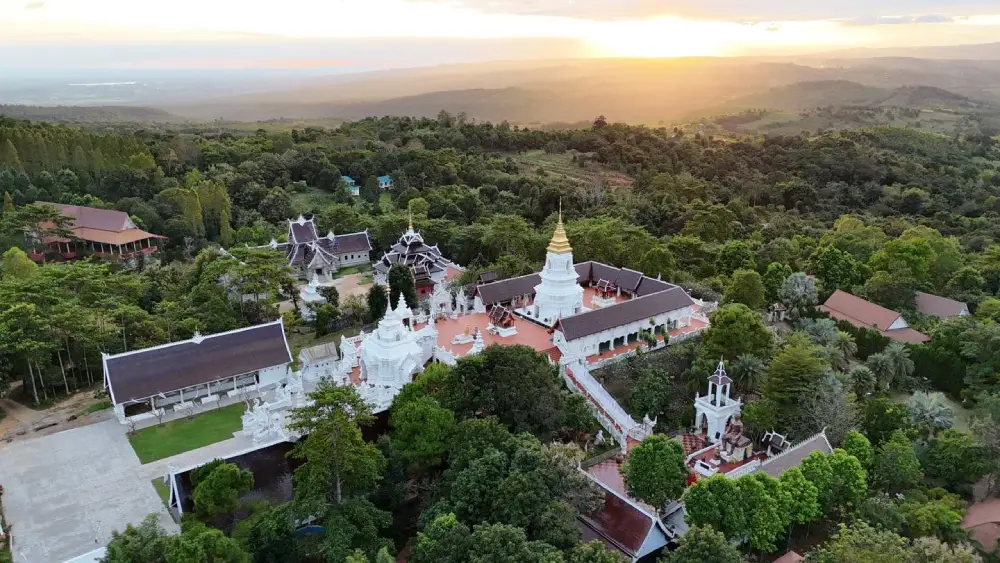
Wat Chom That
Open Days: Daily
Opening Hours: 08.00 – 17.00
Wat Chom That is located in Ban Khok Mang Oi, Village No. 3, Khok Mang Ngoi Subdistrict, Khon Sawan District, Chaiyaphum Province. It is a local Buddhist temple under the Mahanikaya order and serves as an important religious and cultural center for monks, Buddhist devotees, villagers, and general visitors. The temple is used for religious ceremonies, meditation, traditional activities, community gatherings, and Buddhist merit-making. For travelers who want to understand the quieter and more local side of Chaiyaphum, Wat Chom That offers a meaningful view of how Buddhism remains closely connected with village life in northeastern Thailand.
Wat Chom That is situated in Ban Khok Mang Ngoi, a rural community in Khok Mang Ngoi Subdistrict. The village is known as an old local community with a strong Buddhist way of life and inherited traditions. The temple is not only a religious place; it is also a shared community space where people gather for annual merit-making events, Dhamma practice, Buddhist holy days, and local cultural ceremonies. This makes Wat Chom That a living temple rather than a purely historical attraction.
The temple occupies 14 rai and 57 square wah of land. Its monastic buildings include an ordination hall, a large sermon hall, and monk residences. The ordination hall measures 9 meters wide and 12 meters long and was built in B.E. 2485. The sermon hall measures 20 meters wide and 76 meters long and was built in B.E. 2519. There are also two monk residences, one wooden building and one half-concrete, half-wooden building. These structures show that Wat Chom That has the essential facilities of a functioning Thai Buddhist community temple.
Historically, Wat Chom That was established as a temple in B.E. 2473 and received its royal consecrated boundary, known in Thai as Wisungkhamsima, on 9 February B.E. 2489. The consecrated boundary measures 9 meters wide and 12 meters long. In Thai Buddhist tradition, receiving Wisungkhamsima is significant because it allows a temple to conduct formal monastic rites within the designated sacred boundary. This makes the ordination hall not only an architectural feature but also a spiritually and ritually important area.
The name “Chom That” carries a strong Buddhist meaning. “Chom” suggests a summit, peak, or something elevated, while “That” refers to a relic, sacred element, or religious object connected with Buddhist devotion. Together, the name evokes a place of reverence and spiritual height. For local villagers, the temple’s name reflects its role as a place of faith, calmness, and respect. Visitors should therefore approach Wat Chom That not as a casual sightseeing stop, but as a sacred place that remains meaningful to the people of Ban Khok Mang Ngoi.
The ordination hall is one of the most important areas within the temple. Built in B.E. 2485, it is the sacred space used for formal monastic activities and Buddhist rites. Even though Wat Chom That is a community temple rather than a large royal temple, the ordination hall carries deep religious significance. Visitors should treat this area with special respect by dressing modestly, speaking quietly, removing shoes where required, and avoiding behavior that may disturb religious practice.
The sermon hall is another central part of Wat Chom That. Its large size, 20 meters wide and 76 meters long, reflects the temple’s role in accommodating villagers during religious gatherings. In rural Isan communities, the sermon hall often functions as the main shared space for Dhamma listening, Buddhist holy day observances, Kathin ceremonies, robe offerings, village meetings, and annual merit-making events. At Wat Chom That, this hall supports both religious life and community life, making it one of the most practical and meaningful spaces within the temple grounds.
The monk residences also show that Wat Chom That continues to support monastic life. Resident monks maintain daily Buddhist practice, receive offerings, guide religious activities, and provide spiritual support to villagers. Current temple records identify Phra Khru Prathip Chetiyarak as the abbot of Wat Chom That, and the temple has resident monks during the Buddhist rains retreat. This continued monastic presence helps keep the temple active as a religious center throughout the year.
Ban Khok Mang Ngoi is a Buddhist community, and Wat Chom That functions as its spiritual center. The temple is closely connected with the village’s annual traditions and cultural calendar. Local traditions include New Year merit-making, Bun Phra Wet or the Mahachat sermon, Bun Khao Chi, Songkran, Bun Boek Ban, ancestor-related ceremonies, Bun Bang Fai, Buddhist Lent, Bun Khao Pradap Din, Bun Khao Sak, the end of Buddhist Lent, Kathin, Loy Krathong, and year-end community activities. These traditions keep the relationship between the temple and the village alive throughout the year.
Bun Phra Wet, or the Mahachat sermon tradition, is one of the important merit-making events in many Isan communities. It involves listening to the story of Vessantara Jataka and gathering as a community for religious merit. When such events are held at the temple, villagers work together to prepare the venue, food, offerings, and ceremonial arrangements. This shows how Wat Chom That functions as a space where Buddhist teachings and community cooperation are closely linked.
Bun Khao Chi is another tradition that reflects the warmth and simplicity of Isan culture. Villagers prepare grilled sticky rice, often coated with egg, and offer it to monks as an act of merit. This tradition connects food, faith, generosity, and community identity. A temple like Wat Chom That allows such traditions to remain part of real community life rather than becoming only a cultural memory.
Bun Bang Fai and ancestor-related ceremonies also reveal the relationship between local beliefs, agriculture, and Buddhism. These traditions are connected with requests for rain, fertility, protection, and seasonal abundance. In Isan villages, temples often help provide a shared space where Buddhist practice and local cultural beliefs coexist in an accepted community framework. Wat Chom That therefore plays a role in preserving both Buddhist faith and local identity.
The Buddhist Lent period is especially important for the temple. During the beginning of Lent, villagers often make offerings, present candles, observe moral discipline, and listen to Dhamma teachings more frequently. At the end of Buddhist Lent, merit-making and Kathin ceremonies bring the community together again. These events strengthen the relationship between monks and laypeople, while also encouraging younger generations to learn temple etiquette and Buddhist values through direct participation.
For foreign travelers, Wat Chom That is valuable because it shows the everyday role of temples in Thailand. Many visitors know famous temples in Bangkok, Chiang Mai, or Ayutthaya, but community temples like Wat Chom That reveal how Buddhism functions at the village level. The temple is where people make merit, mark important life events, gather during annual festivals, and maintain shared cultural memory. Visiting this kind of temple provides a more grounded understanding of Thai society.
The atmosphere of Wat Chom That is peaceful and modest. It is suitable for travelers who appreciate slow cultural travel, local temples, rural communities, and quiet merit-making. The temple does not need grand decoration to be meaningful. Its value lies in its history, its role as a community center, its monastic buildings, and the continuing faith of the villagers who use it. Visitors should take time to observe the temple grounds respectfully and understand its function within local life.
Temple etiquette is important when visiting Wat Chom That. Visitors should dress modestly, covering shoulders and knees. Shoes should be removed before entering sacred buildings or designated areas. Voices should be kept low, and visitors should avoid disturbing monks, villagers, or ceremonies. If photography is desired, it should be done respectfully, especially when people or religious activities are present. The temple remains an active place of worship, so the needs of the local community should always come first.
Wat Chom That can be included in a broader cultural route around Khok Mang Ngoi Subdistrict and Khon Sawan District. Nearby local sites include Wat Nong Bua Loi, Wat Ko Kaew Nong No, the local public parks in Khok Mang Ngoi, Bueng Waeng or Nong Waeng, Wat Khon Sawan, and the Dvaravati Buddha image at Wat Khon Sawan. These places allow travelers to experience a mix of village temples, Buddhist heritage, nature, and local community spaces within the same area.
Bueng Waeng, also known as Nong Waeng, is one of the important natural attractions in Khon Sawan District. It is a natural lake located near the district office and is known as a habitat for waterbirds, especially during the cool season from November to April. Visitors can drive around the lake, enjoy the natural scenery, and watch birds in the evening. Combining Wat Chom That with Bueng Waeng gives travelers a balanced route that includes both Buddhist culture and local nature.
Wat Khon Sawan is another meaningful nearby destination. It is associated with an important Dvaravati-period Buddha image and reflects the deeper Buddhist history of the district. A route from Wat Chom That to Wat Khon Sawan helps visitors see both the living role of a community temple and the historical depth of Buddhism in the area. This makes the route suitable for travelers interested in temples, history, local culture, and rural Chaiyaphum.
Within Khok Mang Ngoi Subdistrict, other local places such as Wat Nong Bua Loi, Wat Ko Kaew Nong No, public parks, and community areas help provide a broader picture of local life. These places may not be large tourist attractions, but they are meaningful for understanding the social landscape around Wat Chom That. Travelers who enjoy local exploration will find that the value of the area lies in its quietness, authenticity, and community rhythm.
Wat Chom That is also an important place for preserving community memory. Many villagers have grown up with the temple through annual festivals, sermons, offerings, funerals, family ceremonies, and Buddhist holidays. The temple holds memories that are passed down not only through documents, but also through repeated practices, sounds, spaces, and acts of devotion. This is why the temple remains important even when it is not a famous landmark on a national travel list.
For visitors who want to take photographs, it is best to focus on the temple atmosphere, buildings, landscape, and respectful details rather than intruding on private ceremonies. Community temples are active spaces of worship, and photography should never interfere with religious practice. A respectful approach allows travelers to document their visit while honoring the sacred and social role of the temple.
The best time to visit Wat Chom That is during the daytime between 08.00 and 17.00. Daytime travel makes navigation easier and is more appropriate for visiting a local temple. Visitors who come during Buddhist holidays or annual merit-making events may see more community activity, but should allow extra time and behave with particular respect. Those looking for a quiet visit may prefer ordinary weekdays or non-ceremonial periods.
Wat Chom That is best reached by private car or rental car. Travelers can set the destination to Wat Chom That, Ban Khok Mang Oi, Village No. 3, Khok Mang Ngoi Subdistrict, Khon Sawan District, Chaiyaphum Province, or use the coordinates 15.931905, 102.242063. From Chaiyaphum town, follow the route toward Khon Sawan District and continue to Khok Mang Ngoi Subdistrict according to the navigation system. Public transport users should first reach Chaiyaphum town or Khon Sawan District, then arrange a local vehicle to the temple.
Overall, Wat Chom That is a meaningful community temple in Chaiyaphum Province. It has 14 rai and 57 square wah of temple land, an ordination hall built in B.E. 2485, a large sermon hall built in B.E. 2519, monk residences, a long community role, and an active connection with the traditions of Ban Khok Mang Ngoi. For travelers seeking a quiet, respectful, and authentic Buddhist temple experience in northeastern Thailand, Wat Chom That is a worthwhile stop in Khon Sawan District.
Getting There is most convenient by private car or rental car. Use the destination name Wat Chom That, Ban Khok Mang Oi, Khok Mang Ngoi Subdistrict, Khon Sawan District, Chaiyaphum Province, or enter the coordinates 15.931905, 102.242063 in your navigation system. If traveling by public transport, reach Chaiyaphum town or Khon Sawan District first, then arrange a local ride to the temple because village transport may not operate frequently throughout the day.
Visitors can combine Wat Chom That with nearby attractions such as Wat Nong Bua Loi, Wat Ko Kaew Nong No, Bueng Waeng, Wat Khon Sawan, and the Dvaravati Buddha image at Wat Khon Sawan. This route is suitable for travelers who want to experience local Buddhism, community traditions, and the rural atmosphere of Chaiyaphum in one day.
| Name | Wat Chom That |
| Location | Ban Khok Mang Oi, Village No. 3, Khok Mang Ngoi Subdistrict, Khon Sawan District, Chaiyaphum Province |
| Address | Ban Khok Mang Oi, Village No. 3, Khok Mang Ngoi Subdistrict, Khon Sawan District, Chaiyaphum 36140, Thailand |
| Coordinates | 15.931905, 102.242063 |
| Place Type | Local Buddhist Temple, Mahanikaya Order |
| Land Area | 14 Rai, 57 Square Wah |
| Highlights | A community temple of Ban Khok Mang Ngoi used for Buddhist activities, meditation, local traditions, cultural events, and village gatherings |
| History | Established in B.E. 2473, granted Wisungkhamsima on 9 February B.E. 2489, with an ordination hall built in B.E. 2485 and a sermon hall built in B.E. 2519 |
| Name Origin | The name suggests a sacred and elevated Buddhist place connected with the idea of relics and spiritual reverence |
| Distinctive Features | A rural Isan community temple closely connected with religious practice, annual merit-making traditions, Dhamma listening, and village life |
| Temple Buildings | Ordination hall 9 m x 12 m, sermon hall 20 m x 76 m, and 2 monk residences including 1 wooden building and 1 half-concrete, half-wooden building |
| Travel Information | Best reached by private car or rental car. Use Wat Chom That, Ban Khok Mang Oi, Khok Mang Ngoi Subdistrict, or coordinates 15.931905, 102.242063 for navigation. Public transport users should connect from Khon Sawan District or Chaiyaphum town. |
| Current Status | Active as a local Buddhist temple with resident monks and ongoing religious and community activities |
| Open Days | Daily |
| Opening Hours | 08.00 – 17.00 |
| Main Areas / Zones | Ordination Hall, Sermon Hall, Monk Residences, Religious Activity Area, Meditation Area, and Community Activity Area |
| Abbot / Caretaker | Phra Khru Prathip Chetiyarak |
| Nearby Tourist Attractions | 1. Wat Nong Bua Loi, about 7 km 2. Wat Ko Kaew Nong No, about 8 km 3. Khok Mang Ngoi Public Park / Chaloem Phra Kiat Public Park, about 8 km 4. Bueng Waeng / Nong Waeng, about 11 km 5. Wat Khon Sawan, about 11 km 6. Dvaravati Buddha Image at Wat Khon Sawan, about 11 km 7. Wat Phra Phutthabat Phu Faet, about 33 km |
| Nearby Restaurants | 1. Khun Ngoen Restaurant, about 5 km, Tel. 091-017-2256 2. Bowwy Mookata, about 6 km, Tel. 098-935-9618 3. Jungle Cafe Khon Sawan Chaiyaphum Branch, about 11 km, Tel. 095-660-9498 4. 13 Cafe, about 11 km, Tel. 062-662-9563 5. Rim Bueng Korean BBQ, about 12 km, Tel. 084-826-3438 6. Im Aroi by Je Kai Restaurant, about 17 km, Tel. 093-327-6866 |
| Nearby Accommodations | 1. Nonna Resort, about 4 km, Tel. 062-905-0145 2. Wassanadee Resort, about 6 km, Tel. 064-454-3945 3. Phrutsakan Resort, about 9 km, Tel. 096-469-8645, 044-100-096, 099-359-3597 4. Ban Poo Nim Resort, about 11 km, Tel. 089-932-7390 5. Nithinat Resort, about 18 km, Tel. 081-790-5186 6. Khun Ngoen Restaurant Rooms, about 5 km, Tel. 091-017-2256 |
Frequently Asked Questions (FAQ)
Q: Where is Wat Chom That located?
A: Wat Chom That is located in Ban Khok Mang Oi, Village No. 3, Khok Mang Ngoi Subdistrict, Khon Sawan District, Chaiyaphum Province 36140, Thailand.
Q: What are the opening days and hours of Wat Chom That?
A: Wat Chom That is open daily from 08.00 to 17.00, making daytime visits the most convenient for merit-making and temple visits.
Q: Why is Wat Chom That important to the local community?
A: It is a community temple used for Buddhist ceremonies, meditation, local traditions, cultural activities, and as a spiritual center for Ban Khok Mang Ngoi.
Q: What is the historical background of Wat Chom That?
A: Wat Chom That was established in B.E. 2473 and received Wisungkhamsima on 9 February B.E. 2489. Its ordination hall was built in B.E. 2485, and its sermon hall was built in B.E. 2519.
Q: Who is the abbot of Wat Chom That?
A: The abbot of Wat Chom That is Phra Khru Prathip Chetiyarak.
Q: What important buildings are found inside Wat Chom That?
A: The temple includes an ordination hall, a large sermon hall, and two monk residences.
Q: What is the best way to get to Wat Chom That?
A: The most convenient way is by private car or rental car. Visitors can use the coordinates 15.931905, 102.242063 or search for Wat Chom That, Khok Mang Ngoi Subdistrict, Khon Sawan District, Chaiyaphum Province.
Q: What nearby attractions can travelers visit after Wat Chom That?
A: Nearby attractions include Wat Nong Bua Loi, Wat Ko Kaew Nong No, Bueng Waeng, Wat Khon Sawan, the Dvaravati Buddha image at Wat Khon Sawan, and Wat Phra Phutthabat Phu Faet.
 Category: ●Places of Worship
 Group: ●Temple
Last Update : 3 MonthAgo
 Last Update : 3 MonthAgo
 Click to Access the Navigation Map GPS
 Art, Culture and Heritage
 Historical Sites and Monuments(1)
 Landmarks and Memorials(3)
 Royal Palace(1)
 Art, Craft Centres, Tradition(3)
 Educational Places
 Educational Gardens, Farm(1)
Temple(141)
Educational Gardens, Farm(1)
Temple(141)
 Other Sacred Sites(7)
 Suburban Living
 Village, Community(4)
 Nature and Wildlife
 National Parks and Marine Reserves(7)
 Mountain (Doi)(5)
 Dam, Reservoir, Lake(10)
 Waterfalls(15)
 Caves(5)
 River, Canal(4)
 Other natural attractions(1)
 Entertainment and Agricultural
 Farms, Parks and Ecotourism(2)


