
lovethailand home >Northeastern Travel Attractions >Chaiyaphum Travel Attractions >Kaset Sombun >Non Kok > Wat Bun Rueang
TL;DR: Wat Bun Rueang is located at Ban Non Het Khai, Moo 5, Non Kok Subdistrict, Kaset Sombun District, Chaiyaphum Province, open Daily, hours 08.00 – 17.00.
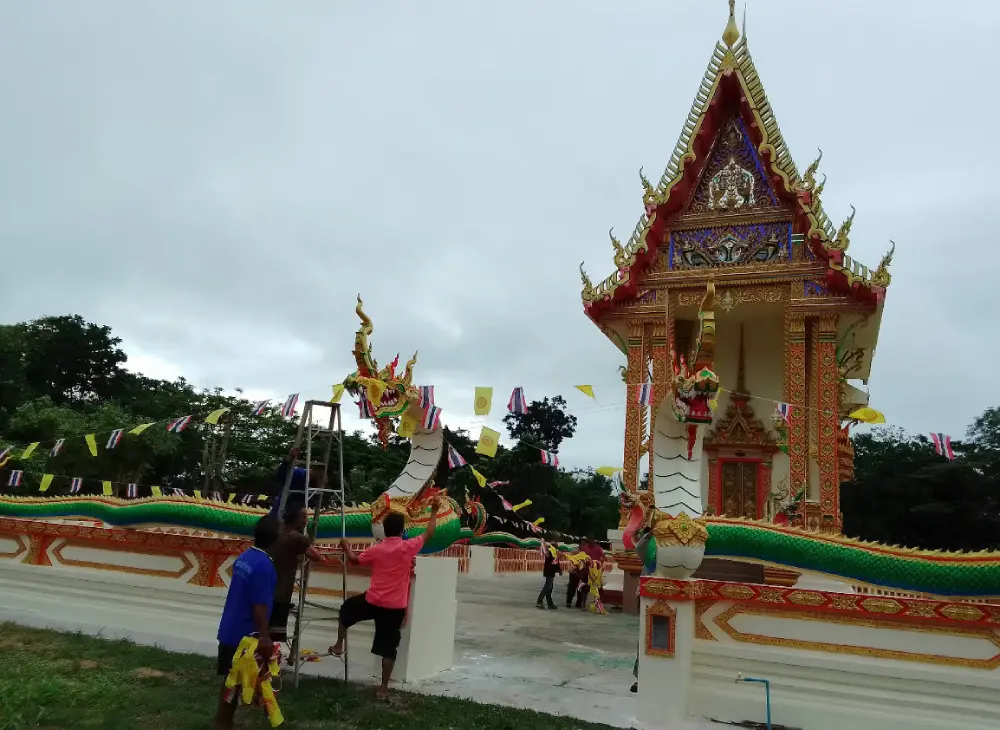
Wat Bun Rueang
Open Days: Daily
Opening Hours: 08.00 – 17.00
Wat Bun Rueang is a local Buddhist temple in Ban Non Het Khai, Moo 5, Non Kok Subdistrict, Kaset Sombun District, Chaiyaphum Province. Established in 1938 and later granted its consecrated monastic boundary on 22 December 2017, the temple belongs to the Mahanikaya monastic order and remains an important spiritual center for villagers, monks, and Buddhist visitors in this rural part of northeastern Thailand. For foreign travelers who want to understand Thai temples beyond famous tourist landmarks, Wat Bun Rueang offers a quiet and authentic view of village Buddhism, community faith, and Isan culture.
Wat Bun Rueang is not a large commercial tourist attraction. Its value lies in its role as a living village temple that continues to serve Ban Non Het Khai and nearby communities. The temple is used for merit-making, Buddhist ceremonies, meditation, local traditions, cultural activities, and community gatherings. It is a place where religion, family life, moral learning, and rural identity meet naturally in everyday community life.
The temple is located along Rural Road 4005 in Non Kok Subdistrict, Kaset Sombun District, Chaiyaphum Province. The surrounding area is rural, with villages, agricultural land, local roads, schools, and community spaces nearby. This setting gives Wat Bun Rueang the character of a true village temple. It is part of the local landscape, passed by residents in daily life and used by the community during Buddhist holy days, annual festivals, and important family ceremonies.
The official history of Wat Bun Rueang begins in 1938. During that period, rural temples in northeastern Thailand were more than places of worship. They often served as centers of learning, public life, moral guidance, and community unity. The establishment of Wat Bun Rueang reflects the faith of the villagers of Ban Non Het Khai, who needed a local temple for religious ceremonies, merit-making, Buddhist observances, and the preservation of community traditions.
Although Wat Bun Rueang may not be an ancient archaeological site, its importance comes from continuity. For decades, the temple has provided a place where families come to make merit, elders listen to Dhamma, children learn temple manners, and villagers gather during seasonal festivals. This kind of continuity is essential to understanding rural Thai Buddhism. The temple is not only a religious compound; it is a shared memory space for the community.
The name “Wat Bun Rueang” has an auspicious meaning. In Thai, “bun” means merit, virtue, or wholesome action, while “rueang” suggests brightness, prosperity, and flourishing. Together, the name conveys the idea of merit that brings light and spiritual growth to the community. This meaning fits the temple’s function as a place where villagers create merit, cultivate generosity, and strengthen their shared moral life.
The temple grounds cover 6 rai, 3 ngan, and 25 square wah. Its boundaries adjoin local private land, public land, and a public road. This shows how closely the temple is embedded in the village environment. A community temple in such a setting is not separated from everyday life. It stands among the homes, farms, and roads of the local people, making it easily accessible for worship, ceremonies, and community activities.
Wat Bun Rueang received its Wisungkhamasima, or consecrated monastic boundary, on 22 December 2017. In Thai Buddhism, this boundary is significant because it defines the sacred area where important monastic ceremonies can be performed properly according to Buddhist discipline. The granting of a consecrated boundary marks an important stage in the temple’s development and strengthens its role as a formal Buddhist institution within the local community.
The temple has also been associated with a Phatthasima ceremony and the gilding and burying of sacred boundary stones. Such ceremonies are major events in Thai Buddhist communities. They gather monks, villagers, donors, and visitors in a shared act of merit. For many Buddhists, participating in a boundary-stone ceremony is considered highly meaningful because it supports the long-term establishment of the temple and the continuity of the Sangha.
Wat Bun Rueang functions as a venue for the religious activities of monks, local Buddhists, and the wider public. These activities include Buddhist holy day observances, alms-giving, chanting, Dhamma listening, meditation, Kathin robe offering, forest robe offering, ordination-related ceremonies, funerals, and merit-making for ancestors. The temple is therefore connected with many stages of community life, from family ceremonies to annual religious events.
In the context of Isan culture, Wat Bun Rueang helps preserve the relationship between Buddhism and local traditions. Temples in Non Kok Subdistrict support seasonal merit-making and community ceremonies such as Bun Khao Chi, Bun Phawet, Songkran merit-making, Buddhist Lent activities, the end of Lent, Kathin, and other village festivals. These events are not only rituals; they are occasions for people to meet, help one another, share food, and renew social bonds.
Bun Khao Chi is one example of how Isan culture connects food, faith, and merit-making. Sticky rice is shaped, grilled, sometimes coated with egg, and offered to monks as an act of merit. Such traditions show why village temples remain deeply important. They provide the space where everyday food, religious devotion, and community cooperation become part of a shared cultural practice. Wat Bun Rueang belongs to this living cultural landscape.
During Buddhist Lent and the end of Lent, Wat Bun Rueang becomes a meaningful place for villagers to return to religious practice. Local people may offer candles, listen to sermons, observe precepts, join chanting, or help with temple activities. These periods strengthen the connection between the temple and the community. They also allow younger generations to see how Buddhist values are practiced in real village life.
Beyond its religious role, Wat Bun Rueang also functions as a social space for Ban Non Het Khai. In rural communities, temples are often used for meetings, school-related activities, elderly group gatherings, women’s group activities, public health events, and other community projects. The temple is a familiar and accessible place where villagers can come together for both spiritual and civic purposes.
The atmosphere at Wat Bun Rueang is simple, peaceful, and local. Visitors should not expect crowds, ticket booths, or large-scale tourist facilities. Instead, the temple offers the quiet authenticity of a village Buddhist site that still serves local people first. This is precisely what makes it meaningful for travelers interested in community-based cultural travel and faith-based travel in Chaiyaphum Province.
A visit to Wat Bun Rueang is best approached slowly and respectfully. Visitors can pay respect in appropriate areas, make merit, walk around the temple grounds, and observe the relationship between the temple and its surrounding village. The experience is not about spectacle. It is about understanding how Buddhism remains part of ordinary life in rural northeastern Thailand.
Within the local history of Non Kok Subdistrict, Wat Bun Rueang forms part of a wider network of village temples, including Wat Non Sai, Wat Phra Chao Ui, Wat Buppharam, Wat Phakaram, and Wat Thaksin. Each temple serves its own village community while also contributing to the broader religious and cultural landscape of the subdistrict. Wat Bun Rueang is one of these important community temples, anchoring the faith and identity of Ban Non Het Khai.
For travelers planning a cultural route around Kaset Sombun District, Wat Bun Rueang can be combined with nearby temples and local attractions. Visitors may begin with merit-making at Wat Bun Rueang, then continue to Wat Buppharam, Wat Phra Chao Ui, Wat Non Sai, Phu Kum Khao, Phra That Nong Sam Muen, or other sites in the area. This route is suitable for travelers who want a slower, deeper journey through local culture rather than only visiting mainstream tourist spots.
Getting There is easiest by private car. From Chaiyaphum city, travelers can drive toward Kaset Sombun District, then continue into Non Kok Subdistrict and Ban Non Het Khai using local roads. The temple is located near Rural Road 4005, but visitors unfamiliar with the area should use a digital map before departure. Daytime travel is recommended because village roads and local signs are easier to navigate in daylight.
Travelers coming from Phu Khiao District or nearby areas can also reach Non Kok Subdistrict through local district roads. If the plan includes several stops in one day, such as Wat Bun Rueang, nearby temples, cafes, and accommodation around Kaset Sombun, a private car or rental car is the most practical option. It allows better control of timing and makes rural travel more convenient.
Public transport may bring visitors to Kaset Sombun District or nearby local centers first, but onward travel to Ban Non Het Khai may require a local vehicle, hired transport, or help from residents familiar with the route. Travelers relying on public transport should plan carefully, especially if returning on the same day or continuing to accommodation outside the village.
The best time to visit Wat Bun Rueang is during the morning or late afternoon, especially within the usual visiting period of 08.00 to 17.00. On Buddhist holy days and major festivals, the temple may be livelier with merit-making, sermons, and community participation. Visitors who prefer a quieter experience may choose an ordinary weekday, while those interested in local religious life may find festival periods more culturally meaningful.
Proper temple etiquette is important. Visitors should dress modestly, speak quietly, avoid disturbing monks or worshippers, and respect sacred areas within the temple. If a ceremony or community event is taking place, it is best to follow the guidance of local residents. Respectful behavior helps protect the temple’s role as a sacred place and supports responsible cultural travel.
Photography should be done with sensitivity. General photographs of the temple atmosphere and surrounding areas are usually appropriate, but visitors should avoid taking close photographs of monks, elderly villagers, or people performing religious acts without permission. In a community temple, rituals are sincere expressions of faith rather than performances for tourism.
For faith-based travelers, Wat Bun Rueang is meaningful because it shows how Buddhism works in everyday village life. The temple is not only a place for formal ceremonies, but also a place where people help one another, create merit, preserve traditions, and return to spiritual balance. This makes the temple an important cultural and emotional center for Ban Non Het Khai.
Socially, the temple connects different generations. Elderly villagers come to make merit and preserve traditions. Working adults return during festivals and family ceremonies. Children and young people learn how to behave in sacred spaces, how to show respect, and how to participate in community life. Wat Bun Rueang therefore functions as a cultural classroom for the village.
Spiritually, Wat Bun Rueang provides a calm place for reflection. Making merit, chanting, listening to Dhamma, or simply spending time in the temple atmosphere can help visitors understand why temples remain central to rural Thai communities. They are places of peace, memory, gratitude, and shared meaning.
In the wider context of Chaiyaphum Province, Wat Bun Rueang adds cultural depth to a destination often known for mountains, national parks, flower fields, and natural scenery. Visiting a local temple like Wat Bun Rueang helps travelers understand the province through its people, beliefs, and village institutions. It is especially suitable for those who prefer community-based cultural travel.
Travelers staying in or around Kaset Sombun District can use Wat Bun Rueang as a morning stop before continuing to cafes, restaurants, nearby temples, or accommodations in surrounding subdistricts such as Ban Yang, Ban Pao, Nong Kha, and Kut Lo. Distances are manageable by private car, but planning ahead is recommended because rural roads may take longer than expected, especially during the rainy season.
Wat Bun Rueang is suitable for local residents, merit-makers, cultural travelers, and visitors who want to understand the quieter side of Chaiyaphum. Its importance does not come from grandeur, but from continuity, simplicity, and its real role in the life of Ban Non Het Khai. It is a temple where faith, community, and everyday rural culture remain closely connected.
In summary, Wat Bun Rueang is a local Buddhist temple in Ban Non Het Khai, Non Kok Subdistrict, Kaset Sombun District, Chaiyaphum Province. Established in 1938, granted its consecrated boundary on 22 December 2017, and affiliated with the Mahanikaya monastic order, the temple continues to serve as a place for religious activities, meditation, traditions, cultural events, and community gatherings. For foreign travelers, it offers a quiet and authentic opportunity to experience local Buddhist life in northeastern Thailand.
| Name | Wat Bun Rueang |
| Location | Ban Non Het Khai, Moo 5, Non Kok Subdistrict, Kaset Sombun District, Chaiyaphum Province |
| Address | Rural Road 4005, Non Kok Subdistrict, Kaset Sombun District, Chaiyaphum Province 36120, Thailand |
| Coordinates | 16.208596, 101.948994 |
| Highlights | A local village temple established in 1938, serving as a spiritual and community center of Ban Non Het Khai in Non Kok Subdistrict |
| History | Established in 1938, affiliated with the Mahanikaya monastic order, and granted its consecrated boundary on 22 December 2017 |
| Name Origin | The name “Bun Rueang” has an auspicious meaning, suggesting merit, brightness, and spiritual prosperity for the community |
| Distinctive Features | A peaceful village temple covering 6 rai, 3 ngan, and 25 square wah, used for merit-making, meditation, religious activities, and community traditions |
| Consecrated Boundary | Granted Wisungkhamasima on 22 December 2017 |
| Travel Information | Private car is the most convenient option. From Chaiyaphum city, travel toward Kaset Sombun District, then continue to Non Kok Subdistrict and Ban Non Het Khai. A digital map is recommended |
| Current Status | An active local Buddhist temple under the Mahanikaya order, used for religious activities, meditation, traditions, cultural events, and community gatherings |
| Open Days | Daily |
| Opening Hours | 08.00 – 17.00 |
| Main Areas / Zones | Religious Activity Area, Meditation Area, Community Courtyard, Merit-Making Area, And Festival Activity Space |
| Nearby Tourist Attractions | 1. Wat Buppharam, Non Kok Subdistrict, About 3 km 2. Wat Phra Chao Ui, Non Kok Subdistrict, About 7 km 3. Wat Non Sai, Non Kok Subdistrict, About 8 km 4. Phu Kum Khao, About 13 km 5. Phra That Nong Sam Muen, Phu Khiao District, About 30 km |
| Nearby Restaurants | 1. Fah Cafe, Kut Lo Subdistrict, About 8 km, Tel. 097-320-5496 2. No Nu Cafe Kaset Sombun, About 15 km, Tel. 086-543-2422, 095-665-1723 3. Jungle Cafe Kaset Sombun Branch, About 18 km, Tel. 094-294-7913 4. P-Cottage Riverside, About 20 km, Tel. 081-426-6663 5. Tiwpha Cafe, About 24 km, Tel. 099-292-9898 |
| Nearby Accommodations | 1. Namfon Resort, Kut Lo Subdistrict, About 9 km 2. Ban Pao Garden Home Resort, About 17 km, Tel. 082-882-6535 3. KS Resort, About 22 km, Tel. 080-828-5361 4. Ban Khao Rao Suk Resort, About 25 km, Tel. 089-779-1867 5. Mueang Mai Resort Hotel, About 31 km, Tel. 091-834-9716 |
Frequently Asked Questions (FAQ)
Q: Where is Wat Bun Rueang located?
A: Wat Bun Rueang is located in Ban Non Het Khai, Moo 5, Non Kok Subdistrict, Kaset Sombun District, Chaiyaphum Province, Thailand.
Q: When was Wat Bun Rueang established?
A: Wat Bun Rueang was established in 1938 and received its consecrated monastic boundary on 22 December 2017.
Q: Which Buddhist order does Wat Bun Rueang belong to?
A: Wat Bun Rueang is a local Buddhist temple under the Mahanikaya monastic order.
Q: What type of travel is Wat Bun Rueang suitable for?
A: It is suitable for merit-making, temple visits, meditation, local history, and cultural travel in Ban Non Het Khai and Non Kok Subdistrict.
Q: What are the opening hours of Wat Bun Rueang?
A: Wat Bun Rueang is open daily from 08.00 to 17.00, which is suitable for worship and a quiet temple visit.
Q: How can travelers get to Wat Bun Rueang?
A: Traveling by private car is the most convenient option. From Chaiyaphum city, drive toward Kaset Sombun District, then continue to Non Kok Subdistrict and Ban Non Het Khai.
Q: Are there attractions near Wat Bun Rueang?
A: Nearby attractions include Wat Buppharam, Wat Phra Chao Ui, Wat Non Sai, Phu Kum Khao, and Phra That Nong Sam Muen.
Q: Is there an admission fee at Wat Bun Rueang?
A: Wat Bun Rueang is a community temple for merit-making and religious activities. Visitors should dress respectfully and may make donations according to personal faith.
 Category: ●Places of Worship
 Group: ●Temple
Last Update : 2 MonthAgo
 Last Update : 2 MonthAgo
 Click to Access the Navigation Map GPS
 Art, Culture and Heritage
 Historical Sites and Monuments(1)
 Landmarks and Memorials(3)
 Royal Palace(1)
 Art, Craft Centres, Tradition(3)
 Educational Places
 Educational Gardens, Farm(1)
Temple(141)
Educational Gardens, Farm(1)
Temple(141)
 Other Sacred Sites(7)
 Suburban Living
 Village, Community(4)
 Nature and Wildlife
 National Parks and Marine Reserves(7)
 Mountain (Doi)(5)
 Dam, Reservoir, Lake(10)
 Waterfalls(15)
 Caves(5)
 River, Canal(4)
 Other natural attractions(1)
 Entertainment and Agricultural
 Farms, Parks and Ecotourism(2)


