
lovethailand home >Northeastern Travel Attractions >Chaiyaphum Travel Attractions >Sap Yai >Tako Thong > Wat Nong Yang Phatthana
TL;DR: Wat Nong Yang Phatthana is located at Ban Nong Yang Phatthana, Moo 7, Tako Thong Subdistrict, Sap Yai District, Chaiyaphum Province, open Daily, hours 08.00 – 17.00.
Wat Nong Yang Phatthana
Open Days: Daily
Opening Hours: 08.00 – 17.00
Wat Nong Yang Phatthana in Tako Thong Subdistrict, Sap Yai District, Chaiyaphum Province, is an important community Buddhist temple of Ban Nong Yang Phatthana. The temple was established on 12 October 2001, with Nai Phairoj Tangphairojwong receiving permission to build the temple on an area of 9 rai and 4 ngan. Today, it continues to serve as a religious, cultural, and spiritual center for monks, Buddhist devotees, local villagers, and visitors. It is a place for merit-making, Buddhist ceremonies, meditation, local traditions, cultural activities, and community gatherings.
For international travelers who want to understand Chaiyaphum beyond famous tourist attractions, Wat Nong Yang Phatthana offers an authentic view of a rural northeastern Thai temple. This is not a large commercial tourist attraction. It is a living community temple that remains closely connected with the everyday life of Ban Nong Yang Phatthana. Its value lies in its quiet atmosphere, its role as a center of faith, its connection with local traditions, and its continuing importance as a gathering place for villagers.
Ban Nong Yang Phatthana is located in Moo 7, Tako Thong Subdistrict, Sap Yai District, Chaiyaphum Province. In some older Thai sources, Sap Yai may appear as a minor district because of its former administrative status, but in present usage it is Sap Yai District. The temple stands within a rural community landscape of village roads, agricultural fields, local waterways, and closely connected households. It is therefore part of the everyday structure of the village rather than a separate tourist site.
The establishment of Wat Nong Yang Phatthana on 12 October 2001 marked an important moment for the local community. A village temple gives residents a nearby place for merit-making, Buddhist rituals, Dhamma listening, community traditions, and shared gatherings. Although this temple is relatively recent compared with many older temples in Chaiyaphum, its community role is highly meaningful because it grew from the local need for a stable religious and cultural center.
The temple area of 9 rai and 4 ngan allows Wat Nong Yang Phatthana to support religious and community activities throughout the year. The compound includes spaces for worship, merit-making, temple gatherings, monastic life, and annual village events. In a community temple, the size of the compound is important because it must serve both daily religious practice and larger ceremonies when villagers, relatives, and supporters return to the temple together.
The name “Wat Nong Yang Phatthana” directly reflects the identity of the village where the temple is located. “Nong Yang” refers to Ban Nong Yang Phatthana, while “Phatthana” means development or improvement. Together, the name carries the idea of a community that wishes to grow in faith, social cooperation, and cultural strength. For local people, the temple’s name represents home, shared merit-making, and the continuity of village life.
Wat Nong Yang Phatthana is a community-supported temple under the Mahanikaya order. Temples of this kind in rural Isan often serve many roles at once. They are places for Buddhist ceremonies, moral learning, merit-making, annual festivals, community cooperation, and emotional support. Wat Nong Yang Phatthana is therefore meaningful not only to monks, but also to villagers who use the temple throughout the year for both religious and community purposes.
The temple hosts Buddhist activities for monks, villagers, and general devotees. These include merit-making on Buddhist holy days, food offerings, chanting, Dhamma listening, robe-offering ceremonies, Kathin, and observances on major Buddhist dates. Such activities keep Buddhism close to daily life. For villagers, the temple is not merely a place visited occasionally, but part of the rhythm of the year.
Wat Nong Yang Phatthana also serves as a place for Buddhist practice. In a community temple, meditation and spiritual cultivation do not always appear as formal retreats. They may take the form of chanting, observing precepts, listening to sermons, making offerings, helping with temple work, and cultivating generosity. Through these ordinary actions, the temple becomes a living school of Buddhist values where people train the mind through practice, respect, and service.
The temple is used by people of different generations. Elders come to make merit, listen to Dhamma, and find peace. Working adults come to renew the mind and support community ceremonies. Children and young people learn manners, respect for monks, how to behave in a sacred place, and how to participate in local traditions. In this way, Wat Nong Yang Phatthana helps pass on cultural values through real participation rather than through written instruction alone.
Local traditions and culture are central to the temple’s importance. In Tako Thong Subdistrict, important community traditions include New Year merit-making and alms-giving, Songkran, candle processions for Buddhist Lent, and Loy Krathong. These traditions allow villagers to come together, make merit, honor elders, support monks, and preserve community identity. Wat Nong Yang Phatthana is part of this local cultural landscape and supports the continuity of Buddhist and community traditions.
Songkran is one example of a tradition in which temples and communities often work together. During Songkran, families return home, elders receive blessings, villagers make merit, and the community gathers in a respectful atmosphere. A temple helps keep the festival connected with gratitude, generosity, and moral reflection rather than allowing it to become only a holiday celebration.
The Buddhist Lent candle procession is another tradition that shows the connection between temple and community. Villagers offer candles and necessities to support monks during the rainy-season retreat. This event teaches younger generations about Buddhist discipline, generosity, and the rhythm of the religious calendar. Through such activities, the temple becomes a place where faith is learned by doing.
Loy Krathong in a rural community context connects people with water, gratitude, and local identity. While the festival is often known for its beauty, the presence of temples and community leaders helps keep it orderly and culturally meaningful. Such traditions show how Buddhist temples in rural Thailand often help balance celebration, respect, and community responsibility.
Kathin and robe-offering ceremonies are especially meaningful for community temples. After the Buddhist Lent, devotees gather to offer Kathin robes and contributions to support the temple and resident monks. These events bring villagers, relatives, and supporters back to the temple. They strengthen community ties and express collective faith. Kathin is therefore not only a religious donation, but also a social and cultural gathering that keeps the temple active.
Robe-offering ceremonies and other merit-making events also help sustain the temple. When the temple needs to maintain buildings, organize ceremonies, or support monastic activities, the faith and cooperation of villagers become essential. This relationship between temple and community is based on mutual care. The temple supports spiritual life, while the community supports the temple through merit-making and shared responsibility.
The temple is cared for through the cooperation of monks, temple committee members, and local villagers. A publicly verified current abbot name is not available from the public abbot registry, so the temple’s care is best understood through its community-based structure. Many rural temples remain active through this kind of cooperation, where monks and villagers work together to maintain religious activities, temple spaces, and annual traditions.
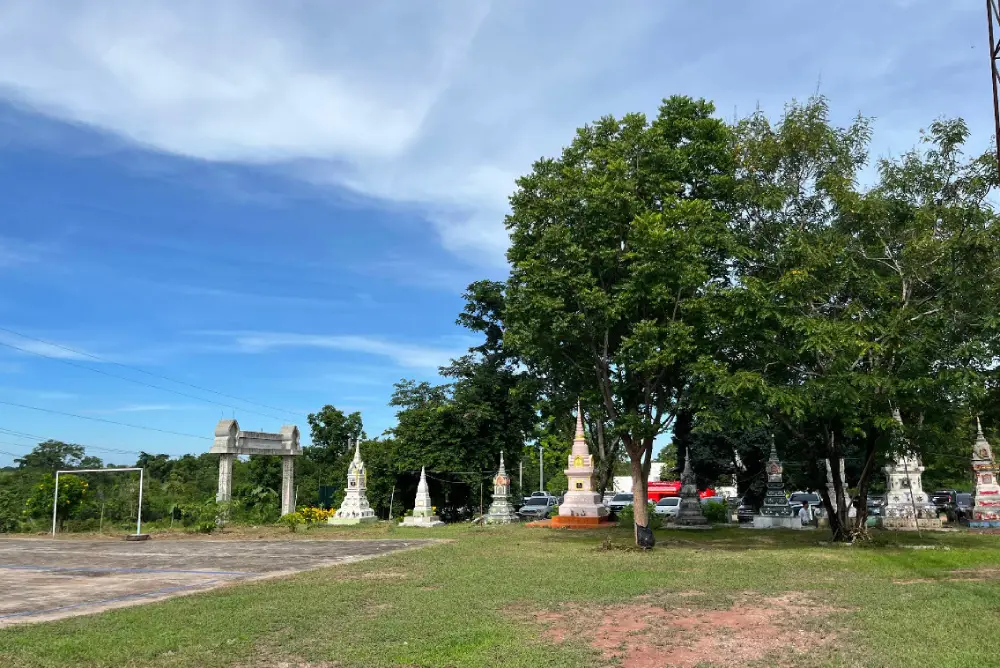
Important areas inside Wat Nong Yang Phatthana include the Buddha worship area, merit-making space, activity hall or religious gathering area, monks’ residences, temple courtyard, and areas used for community merit-making events. These spaces may not be presented like major tourist attractions, but they are meaningful because they are used by villagers in real religious life. They are places where chanting, offerings, Dhamma listening, community preparation, and Buddhist ceremonies take place.
The activity hall or shared religious space is especially important in a community temple. It is used for merit-making, meetings, food offerings, festival preparation, robe-offering events, Kathin, and village gatherings. Such a space allows monks and laypeople to meet regularly and cooperate in temple affairs. It helps the temple function as a religious and social center at the same time.
The temple courtyard is another important part of Wat Nong Yang Phatthana. During festivals, robe-offering ceremonies, or community activities, the courtyard may be used for gathering, food preparation, parking, and social interaction. In rural temples, an open courtyard is not simply empty space. It is a flexible area that allows community cooperation to happen smoothly and visibly.
Monastic areas and monks’ residences should be treated with respect. These spaces are used for daily routines, chanting, rest, and monastic discipline. Visitors should not enter private monastic areas without permission and should maintain a quiet manner around them. Respecting these areas helps preserve the calm atmosphere of the temple and shows proper etiquette in a Buddhist site.
Wat Nong Yang Phatthana is also connected with the rural landscape of Tako Thong Subdistrict. The area is largely agricultural, with villagers growing rice, cassava, sugarcane, chili, corn, mangoes, bananas, and other crops. In such a setting, a temple is closely tied to the rhythm of agricultural life. Villagers often make merit according to seasons, life events, and community needs. The temple therefore reflects both Buddhist faith and the everyday realities of rural work.
Tako Thong Subdistrict has several temples and one monastic residence, showing how important Buddhism is to community life. Temples such as Wat Ban Khuean Lan, Wat Pa Thong Di Niraphan, Wat Ban Sok Hoi Khom, Wat Ban Nong Nok Khian, Wat Ban Huai Charoen Phon, Wat Pho Thong Samakkhi Tham, Wat Tako Thong Wanaram, Wat Ban Sap Mai, Wat Ban Klum Sung, and Wat Ban Pradu Phatthana form a network of local religious places. Wat Nong Yang Phatthana is one important part of this community temple network.
The surrounding area also has natural attractions that can be combined with a temple visit, such as Thung Krathin Waterfall and Huai Sai Reservoir. Thung Krathin Waterfall is located in Tako Thong Subdistrict, while Huai Sai Reservoir is associated with Ban Nong Pradu Phatthana. These places allow travelers to connect religious travel with nature, water resources, and rural scenery in the same route.
Huai Sai Reservoir is meaningful to the local area because it is connected with water, agriculture, and community recreation. A visit to the reservoir after making merit at Wat Nong Yang Phatthana can help travelers experience both the spiritual and environmental sides of Sap Yai District. The atmosphere around local reservoirs is often simple and quiet, reflecting the agricultural rhythm of the surrounding villages.
Thung Krathin Waterfall adds another natural dimension to travel in Tako Thong Subdistrict. Visitors should consider the season when planning a visit because natural water conditions can vary between the rainy and dry seasons. Combining Wat Nong Yang Phatthana with nearby natural places helps travelers understand the relationship between temples, communities, water sources, and local landscapes in rural Chaiyaphum.
Visitors to Wat Nong Yang Phatthana should approach the temple quietly and respectfully. A good visit may begin with paying respect to the Buddha image, making merit according to one’s faith, and walking calmly around the temple compound. If monks or villagers are engaged in ceremonies, visitors should keep an appropriate distance and avoid disturbing them. Photography should be done politely and should not intrude on worshippers or sacred activities.
Modest dress is recommended when visiting the temple. Shirts should cover the shoulders, and trousers or skirts should be appropriate for a Buddhist site. Shoes should be removed before entering sacred buildings or areas where shoes are not allowed. During temple festivals or Kathin ceremonies, travelers should allow extra time and follow the guidance of the temple committee or local villagers. Respectful behavior is an essential part of meaningful cultural travel.
Getting There is most convenient by private car. Travelers can drive to Tako Thong Subdistrict, Sap Yai District, Chaiyaphum Province, and navigate by searching for Wat Nong Yang Phatthana or using coordinates 15.548632, 101.659470. The route connects with the Sap Yai-Bamnet Narong road, Route 2069, and passes through rural community roads. Travelers should plan ahead, especially if combining the temple visit with Thung Krathin Waterfall, Huai Sai Reservoir, or other places in Sap Yai District.
The recommended visiting hours are 08.00 to 17.00. This period is suitable for merit-making, paying respect, and quietly exploring the temple area. Travelers who wish to join specific activities such as Kathin, robe-offering ceremonies, major Buddhist days, or annual village events should check the local schedule before traveling because temple activities may follow the lunar calendar and local community arrangements.
Restaurants around Tako Thong and Sap Yai include local Thai food, noodle shops, Isan food, cafés, and restaurant-accommodation venues. These places are suitable for lunch or a break after visiting the temple and nearby attractions. Because small local restaurants may adjust their opening hours by day or customer flow, travelers should check ahead if planning to visit a specific place. Eating locally also helps support community businesses.
Accommodation near Wat Nong Yang Phatthana includes resorts in Sap Yai District, local lodgings in nearby subdistricts, and additional options in surrounding areas. Staying in Sap Yai is convenient for travelers who want to explore temples, reservoirs, rural roads, and community attractions. Those who prefer more hotel choices may stay in Mueang Chaiyaphum or nearby districts and visit the temple as a day trip.
Wat Nong Yang Phatthana is valuable as a local history and cultural learning site. It shows how a temple, a village, annual traditions, agriculture, and rural landscapes are connected in northeastern Thailand. Studying a temple like this helps travelers understand that Buddhism in village life is not only about formal rituals. It is also a system of relationships connecting generations, memory, cooperation, and shared moral values.
As a faith-based destination, Wat Nong Yang Phatthana is suitable for travelers who appreciate peaceful, community-rooted places. It is not a temple of luxury or grand spectacle, but a temple of continuity and local faith. A visit here offers a chance to make merit, observe rural Buddhist culture, and understand how a modest temple can remain central to village life.
Overall, Wat Nong Yang Phatthana brings together the history of its establishment on 12 October 2001, its 9-rai-4-ngan temple area, Buddhist practice, local traditions, shared community care, and a strong relationship with Ban Nong Yang Phatthana community. It deserves recognition as a cultural and religious destination in Sap Yai District, especially for travelers who want to experience Chaiyaphum through its villages, temples, reservoirs, and local traditions rather than only through famous tourist attractions.
For travelers searching for a quiet and meaningful temple in Chaiyaphum, Wat Nong Yang Phatthana offers a different kind of experience. It reveals how a village temple can care for the mind, preserve traditions, support community gatherings, and remain important to local people over time. Visiting Wat Nong Yang Phatthana is therefore not only a temple visit, but also an encounter with the simple and sincere cultural heart of rural Isan.
| Name | Wat Nong Yang Phatthana |
| Location | Ban Nong Yang Phatthana, Moo 7, Tako Thong Subdistrict, Sap Yai District, Chaiyaphum Province |
| Address | Moo 7, Tako Thong Subdistrict, Sap Yai District, Chaiyaphum 36130, Thailand |
| Coordinates | 15.548632, 101.659470 |
| Highlights | A community Buddhist temple of Ban Nong Yang Phatthana, serving as a spiritual center, merit-making place, meditation site, and venue for local Buddhist activities |
| History | Established on 12 October 2001, with Nai Phairoj Tangphairojwong receiving permission to build the temple |
| Temple Area | 9 rai and 4 ngan |
| Name Origin | Named after Ban Nong Yang Phatthana, the village where the temple is located, reflecting its direct connection with the local community |
| Distinctive Features | A rural Isan community temple combining Buddhism, local traditions, meditation, cultural practice, and village unity |
| Temple Type | Community Buddhist temple under the Mahanikaya order |
| Sacred Objects / Important Features | Buddha worship area, merit-making area, religious activity hall or space, monks’ residences, temple courtyard, and community ceremony areas |
| Main Areas / Zones | Buddha worship area, merit-making area, activity hall or religious gathering space, monks’ residences, temple courtyard, festival area, and community gathering area |
| Facilities | Temple courtyard, activity hall or religious gathering area, and spaces used for community merit-making events |
| Traditions / Main Activities | Buddhist holy day merit-making, food offerings, Dhamma listening, meditation, robe-offering ceremonies, Kathin, Songkran, Buddhist Lent candle procession, Loy Krathong, and major Buddhist observances |
| Approved Temple Builder | Nai Phairoj Tangphairojwong |
| Abbot / Caretaker | Monks and the Wat Nong Yang Phatthana temple committee |
| Open Days | Daily |
| Opening Hours | 08.00 – 17.00 |
| Travel Information | Best reached by private car. Navigate to Tako Thong Subdistrict, Sap Yai District, and search for Wat Nong Yang Phatthana or use coordinates 15.548632, 101.659470 |
| Current Status | A community Buddhist temple in Tako Thong Subdistrict, Sap Yai District, Chaiyaphum Province, still used for Buddhist ceremonies, merit-making, meditation, and community activities |
| Local Administrative Contact | Tako Thong Subdistrict Administrative Organization, Tel. 044-056314 |
| Nearby Tourist Attractions | 1. Wat Tako Thong Wanaram, about 5 km 2. Wat Ban Sap Mai, about 7 km 3. Thung Krathin Waterfall, Tako Thong Subdistrict, about 15 km 4. Huai Sai Reservoir, Ban Nong Pradu Phatthana, about 16 km 5. Wat Ban Pradu Phatthana, about 16 km 6. Wat Ban Klum Sung, about 20 km 7. Wat Tha Kup, Sap Yai District, about 28 km 8. Red Lotus Field at Bueng Lahan, Chatturat District, about 42 km, Tel. 044-812350 |
| Nearby Restaurants | 1. Kuai Tiao Kai Mara Tako Thong, about 4 km 2. Cafe Khun Yai & Resort, about 18 km, Tel. 063-228-1159 3. Touch The Wind Restaurant & Apartments, about 18 km, Tel. 092-889-1004 4. Panachai Pork Shop Buffet & Yang Noei, about 19 km, Tel. 081-063-8504 5. Wut Wild Food and Made-To-Order Restaurant, about 22 km, Tel. 092-686-8051 6. Jungle Cafe Nai Yang Klak Branch, about 30 km, Tel. 095-601-3499 |
| Nearby Accommodations | 1. Cafe Khun Yai & Resort, about 18 km, Tel. 063-228-1159 2. Touch The Wind Homestay, about 18 km, Tel. 092-889-1004 3. Sap Yai Resort, about 19 km, Tel. 081-966-5717, 088-474-7911 4. Fresh and Frame Resort, about 20 km, Tel. 080-591-8695, 089-721-3243 5. Ban Thong Charoen, about 28 km, Tel. 061-965-1994 6. The Palm Village, Chatturat District, about 42 km |
Frequently Asked Questions (FAQ)
Q: Where is Wat Nong Yang Phatthana located?
A: Wat Nong Yang Phatthana is located in Ban Nong Yang Phatthana, Moo 7, Tako Thong Subdistrict, Sap Yai District, Chaiyaphum Province, northeastern Thailand.
Q: When was Wat Nong Yang Phatthana established?
A: Wat Nong Yang Phatthana was established on 12 October 2001, with Nai Phairoj Tangphairojwong receiving permission to build the temple. The temple area covers 9 rai and 4 ngan.
Q: What are the opening hours of Wat Nong Yang Phatthana?
A: Wat Nong Yang Phatthana is open daily from 08.00 to 17.00, suitable for merit-making, paying respect, and quiet temple visits.
Q: What is special about Wat Nong Yang Phatthana?
A: The temple is a spiritual center of Ban Nong Yang Phatthana, used for merit-making, meditation, Buddhist ceremonies, local traditions, and community gatherings.
Q: Is there an entrance fee at Wat Nong Yang Phatthana?
A: Wat Nong Yang Phatthana is a community temple for merit-making and Buddhist activities. Visitors may enter for worship and make donations according to their faith.
Q: How can travelers get to Wat Nong Yang Phatthana?
A: The temple is best reached by private car. Travelers can navigate to Tako Thong Subdistrict, Sap Yai District, and search for Wat Nong Yang Phatthana or use coordinates 15.548632, 101.659470.
Q: What nearby attractions can be combined with a visit?
A: Nearby places include Wat Tako Thong Wanaram, Wat Ban Sap Mai, Thung Krathin Waterfall, Huai Sai Reservoir, Wat Ban Pradu Phatthana, Wat Ban Klum Sung, and the Red Lotus Field at Bueng Lahan.
Q: What type of travelers is Wat Nong Yang Phatthana suitable for?
A: It is suitable for travelers interested in rural Thai temples, peaceful merit-making, local Buddhist culture, community history, and routes combining temples with reservoirs and natural attractions in Sap Yai District.
 Category: ●Places of Worship
 Group: ●Temple
Last Update : 3 MonthAgo
 Last Update : 3 MonthAgo
 Click to Access the Navigation Map GPS
Wat Nong Yang Phatthana Map
Recommend

 Art, Culture and Heritage
 Historical Sites and Monuments(1)
 Landmarks and Memorials(3)
 Royal Palace(1)
 Art, Craft Centres, Tradition(3)
 Educational Places
 Educational Gardens, Farm(1)
Temple(141)
Educational Gardens, Farm(1)
Temple(141)
 Other Sacred Sites(7)
 Suburban Living
 Village, Community(4)
 Nature and Wildlife
 National Parks and Marine Reserves(7)
 Mountain (Doi)(5)
 Dam, Reservoir, Lake(10)
 Waterfalls(15)
 Caves(5)
 River, Canal(4)
 Other natural attractions(1)
 Entertainment and Agricultural
 Farms, Parks and Ecotourism(2)


