
lovethailand home >Northeastern Travel Attractions >Chaiyaphum Travel Attractions >Sap Yai >Tha Kup > Wat Wang Udom (Tham Salak Dai)
TL;DR: Wat Wang Udom (Tham Salak Dai) is located at Ban Wang Udom, Moo 12, Tha Kup Subdistrict, Sap Yai District, Chaiyaphum Province, open Daily, hours 08.00 – 17.00.
Wat Wang Udom (Tham Salak Dai)
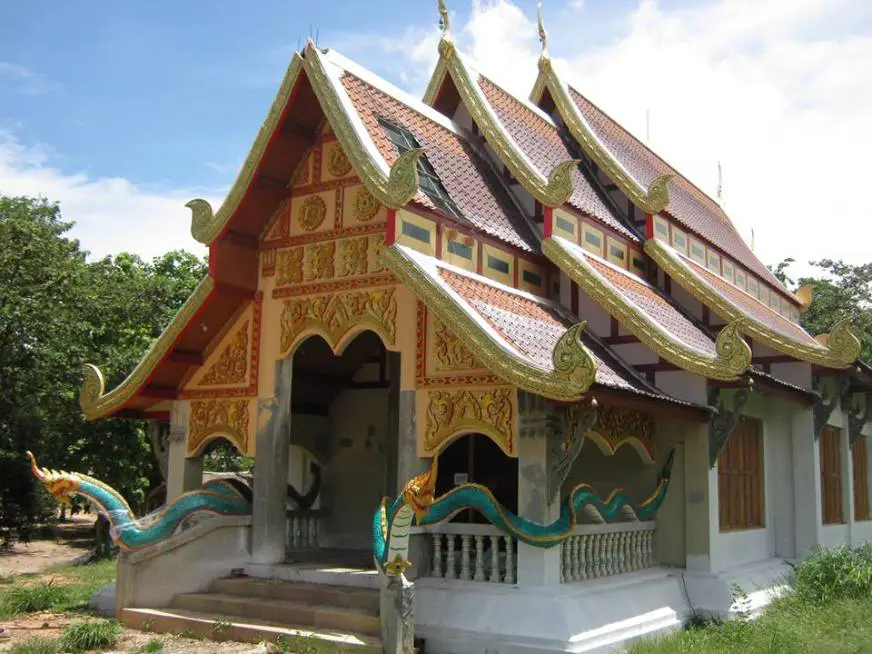
Open Days: Daily
Opening Hours: 08.00 – 17.00
Wat Wang Udom (Tham Salak Dai) in Ban Wang Udom, Tha Kup Subdistrict, Sap Yai District, Chaiyaphum Province, is a distinctive Buddhist temple and meditation place surrounded by caves, sandstone rock terraces, forest, and a peaceful rural landscape. The temple began in 1995 under the initiative of Phra Maha Phian Silasamvaro, the abbot of Wat Ban Lao Don in Rasi Salai District, Sisaket Province, who traveled on tudong to Chaiyaphum to practice meditation and propagate the Buddha’s teachings.
Wat Wang Udom, also known locally as Tham Salak Dai, is important because it grew from the quiet power of nature and the faith of Buddhist supporters. When Phra Maha Phian arrived in the area, a group of devotees offered land for the creation of a meditation center. The site was peaceful and suitable for spiritual practice, with a natural cave, sandstone rock terraces, forest cover, and an atmosphere that encouraged mindfulness. Although the early period involved many difficulties, including remoteness and limited facilities, the temple gradually developed through monastic dedication and community support.
Ban Wang Udom is located in Tha Kup Subdistrict, Sap Yai District, Chaiyaphum Province. Some older Thai records may refer to Sap Yai as a minor district because of its former administrative status, but in current usage it is Sap Yai District. Wat Wang Udom (Tham Salak Dai) is located at 101 Moo 12, Tha Kup Subdistrict, Sap Yai District, Chaiyaphum 36130. The temple stands in a rural setting where community life, forests, Buddhist practice, and natural landforms remain closely connected.
The temple’s landscape is one of its most remarkable features. The area includes a cave and a sandstone terrace that local people call Phra Lan Hin, or the monks’ stone terrace, because many monks came here for meditation practice. In the past, the cave area was also associated with wildlife such as tigers, jackals, wild rabbits, and deer. The use of such a natural place for Buddhist practice reflects the forest temple tradition, where simplicity, seclusion, and direct contact with nature support inner discipline.
The upper sandstone terrace carries strong meaning in local memory. It is not only a geological feature, but also a spiritual place shaped by the practice of monks. The name Phra Lan Hin shows that the community understands this stone terrace as a place connected with meditation, restraint, and monastic presence. The openness of the rock surface, the quietness of the forest, and the strength of the sandstone landscape make the site suitable for contemplation and mindful walking.
Local stories about Tham Salak Dai also add a sense of sacredness to the place. Villagers remembered that in the past people did not dare to go up to the area after evening, and stories were told about the sound of xylophones and drums on full-moon nights. Whether approached as folklore, sacred memory, or local belief, these stories show that the cave and stone terrace have long carried emotional and spiritual meaning for the community. They help visitors understand that the temple is not merely a physical place, but a landscape of faith and memory.
Since 1995, the temple area has also been connected with forest conservation. Keeping the forest cool and peaceful is essential to the identity of the temple. Trees provide shade, quietness, and a meditative atmosphere. For a meditation temple, forest is not only scenery; it is part of the practice environment. The sound of wind, birds, and natural silence helps visitors slow down, reduce distraction, and experience the temple as a place of spiritual rest.
In the early years, the temple changed caretakers several times because it was located far from development and had limited invitations for ceremonies. Such challenges are common for remote meditation sites. They require patience, endurance, and deep commitment from monks who choose to stay. In 1999, Phra Panya Pannavachiro came to oversee the temple and continued to care for it, helping to stabilize the site and develop its religious functions.
Phra Panya Pannavachiro played a significant role in the development of Wat Wang Udom. He helped care for the temple when it still faced many limitations and built a hall that could support Buddhist activities, gatherings of devotees, chanting, merit-making, and meditation practice. In a meditation temple, such a hall is highly important because it creates a shared space for monks and laypeople to come together while the temple continues to develop.
In 2008, Phra Achan Panya began the construction of an ordination hall. The project required strong faith and community support, but its significance was far greater than simply adding a building. In Thai Buddhism, an ordination hall is an important sacred structure connected with formal monastic rites. Its construction showed the intention to strengthen the temple’s religious foundation and develop the meditation center into a more stable Buddhist place.
Current public monastic records identify Phra Khru Preecha Warakon, also known as Sakunnatthapakon Pannavachiro, as the abbot of Wat Wang Udom. Older temple information also records Phra Athikan Sakunnatthapakon Pannavachiro as the abbot of Wat Wang Udom (Tham Salak Dai). This continuity of monastic care has allowed the temple to remain a meditation site and a spiritual center for Ban Wang Udom community.
Wat Wang Udom serves as a place for Buddhist activities for monks, villagers, and general devotees. These activities include merit-making on Buddhist holy days, food offerings, chanting, Dhamma listening, meditation, robe-offering ceremonies, Kathin, and observances on important Buddhist dates. Through these activities, the temple is not only a quiet natural retreat but also a community religious space where faith and culture are practiced throughout the year.
The main strength of Wat Wang Udom as a meditation place lies in its natural setting. The cave provides seclusion, the rock terrace opens the mind to the surrounding landscape, and the forest reduces distraction from the outside world. Visitors who come here are not simply coming to make merit; they are entering a space that encourages silence, reflection, and awareness. This quality makes the temple different from many ordinary village temples.
Tham Salak Dai is the heart of the temple. In Thai Buddhist culture, caves are often associated with seclusion, meditation, and inner search. Many forest monks have chosen caves as places for practice because they help separate the mind from external disturbance. At Wat Wang Udom, the cave is both a natural feature and a spiritual space. Its value lies in the way it supports meditation and connects Buddhist practice with the landscape.
The sandstone terrace above the temple is another important area. It is a natural open space surrounded by forest, carrying the memory of monks who practiced there. Local people call it Phra Lan Hin because of this association with monastic meditation. Visitors should approach this area with respect. It should not be treated only as a viewpoint, but as a place shaped by faith, practice, and community memory.
The forest around the temple is equally important. It gives shade, quietness, and a sense of separation from ordinary noise. For a meditation temple, forest is a living part of the spiritual environment. The preservation of trees helps maintain the atmosphere of the site and makes it suitable for future meditation practice. Visitors should avoid littering, damaging plants, or disturbing the natural surroundings.
Important areas within the temple include Tham Salak Dai cave, Phra Lan Hin sandstone terrace, the meditation hall, the ordination hall, monks’ residences, worship areas, the forest conservation zone, and walking paths. Each area has a different role. The cave and forest support seclusion, the hall supports communal Buddhist activities, the ordination hall gives the temple a formal sacred center, and the walking paths help visitors experience the environment gradually and mindfully.
Wat Wang Udom is also a spiritual center for Ban Wang Udom and nearby communities. Elders come to make merit and listen to Dhamma. Working adults come to renew the mind. Younger people learn temple manners, respect for monks, and the importance of preserving religious places. The temple therefore functions as a place of learning across generations, not through formal lessons alone but through participation in real Buddhist and community life.
Local traditions and annual Buddhist activities give the temple continuing meaning. These may include Buddhist holy day observances, Buddhist Lent activities, end-of-Lent ceremonies, Kathin, robe-offering events, and merit-making activities organized by the community. Such traditions bring villagers and supporters back to the temple and help preserve the relationship between Buddhism, local identity, and community cooperation.
Kathin and robe-offering ceremonies are especially meaningful for a temple located in a quiet natural area. The temple depends on the faith and support of devotees to maintain its buildings, forest environment, meditation spaces, and monastic activities. Supporting Wat Wang Udom is not only about maintaining structures; it is also about preserving a cave, a forest, a rock terrace, and a peaceful Dhamma environment for future generations.
Visitors should follow proper temple etiquette. Modest clothing is recommended. Shirts should cover the shoulders, and trousers or skirts should be appropriate for a Buddhist place. Shoes should be removed before entering sacred buildings or areas where shoes are not allowed. Visitors should speak quietly, especially near meditation areas, caves, and monks’ residences. Respecting the silence of the temple is part of the experience.
Walking around the cave and rock terrace should be done carefully. Natural surfaces may be uneven, sloped, or slippery in some seasons. Visitors should wear suitable footwear, avoid climbing unsafe rocks, avoid writing on stone surfaces, avoid littering, and protect trees and natural features. A responsible visit helps preserve the temple’s sacred and natural atmosphere.
Getting There is most convenient by private car. Travelers can drive to Tha Kup Subdistrict, Sap Yai District, Chaiyaphum Province, and navigate by searching for Wat Wang Udom (Tham Salak Dai) or using coordinates 15.657256, 101.642488. Roads in the area pass through rural communities and local routes. Travelers should plan ahead, especially if combining the temple visit with Huai Som Poi Reservoir, the fossil shell site at Ban Tha Chuan, Wang Kung Reservoir, or other local temples in Tha Kup Subdistrict.
The recommended visiting hours are 08.00 to 17.00. This period is suitable for merit-making, worship, walking around the temple, and safely exploring the cave, rock terrace, and forest areas. Travelers who wish to join specific activities such as Kathin, robe-offering ceremonies, or meditation activities should contact the temple before traveling to match the temple schedule.
The area around Wat Wang Udom can be connected into a faith-and-nature route in Sap Yai District. Huai Som Poi Reservoir, also known as Tha Kup Reservoir, is an important local water source with countryside scenery and wind turbine views. In some seasons, the cosmos flower field by the reservoir becomes a colorful attraction. This makes it easy to combine a temple visit with nature and community travel in the same day.
The fossil shell site at Ban Tha Chuan is another nearby learning destination. It is connected with ancient natural remains and helps visitors understand the geological past of the area. Combining Wat Wang Udom with this site gives the trip a wider meaning, bringing together Buddhism, nature, geology, and local community history in one route.
Travelers can also connect the route with Wat Ban Wang Rang, Wat Ban Pong Ket, Wat Tha Kup, Wat Sap Sai Or, and Wang Kung Reservoir. Visiting several local temples in the same subdistrict allows travelers to see the diversity of rural Isan religious places, from village temples to a cave meditation temple. This type of route is suitable for visitors who want to understand Sap Yai through temples, reservoirs, forests, and community life.
Restaurants around Sap Yai include local Thai food, Isan food, made-to-order dishes, cafés, and restaurant-accommodation venues. These places are suitable for lunch or a break after visiting the temple and nearby attractions. Some restaurants may be located a fair distance from the temple, so it is useful to plan the route and meal time together.
Accommodation near Wat Wang Udom includes small local lodgings in Tha Kup Subdistrict, resorts in Sap Yai District, and additional options in nearby areas. Staying in Sap Yai is convenient for travelers who want to explore temples, reservoirs, rural roads, and community attractions. Those who prefer more hotel choices may stay in Mueang Chaiyaphum or nearby districts and visit the temple as a day trip.
As a faith-based and nature-based destination, Wat Wang Udom (Tham Salak Dai) is suitable for travelers who appreciate quiet, community-rooted, and meditative places. It should not be visited in a rushed or purely sightseeing manner. A more meaningful visit comes from walking slowly, observing the cave and rock terrace, listening to the quietness of the forest, and understanding the temple as a place for inner practice.
Overall, Wat Wang Udom (Tham Salak Dai) brings together the tudong journey of Phra Maha Phian Silasamvaro, the faith of devotees who offered land, the cave and sandstone terrace used for meditation, the conservation of forest, the development of a hall and ordination hall by Phra Panya Pannavachiro, and the continuing role of the abbot and local community. It deserves recognition as an important religious and natural destination in Sap Yai District, Chaiyaphum Province.
For travelers seeking a deeper side of Chaiyaphum beyond famous attractions, Wat Wang Udom (Tham Salak Dai) offers a memorable encounter with a forest meditation temple, a natural cave, a sacred rock terrace, and the quiet cultural heart of rural Isan. A visit here is not only about making merit; it is about experiencing how silence, nature, faith, and community can come together in one spiritual landscape.
| Name | Wat Wang Udom (Tham Salak Dai) |
| Location | Ban Wang Udom, Moo 12, Tha Kup Subdistrict, Sap Yai District, Chaiyaphum Province |
| Address | 101 Moo 12, Tha Kup Subdistrict, Sap Yai District, Chaiyaphum 36130, Thailand |
| Coordinates | 15.657256, 101.642488 |
| Highlights | A cave meditation temple with sandstone terraces, preserved forest, peaceful surroundings, and a strong connection with Buddhist practice in Tha Kup Subdistrict |
| History | Established in 1995 by Phra Maha Phian Silasamvaro after his tudong journey to Chaiyaphum, with land offered by Buddhist devotees for a meditation center |
| Name Origin | The name connects Ban Wang Udom with Tham Salak Dai, the natural cave and meditation area central to the temple’s identity |
| Distinctive Features | Natural cave, sandstone rock terrace known as Phra Lan Hin, preserved forest, secluded atmosphere, and meditation-friendly landscape |
| Sacred Objects / Important Features | Tham Salak Dai cave, Phra Lan Hin sandstone terrace, meditation hall, ordination hall, Buddha worship area, meditation areas, and preserved forest |
| Main Areas / Zones | Tham Salak Dai cave zone, sandstone terrace or Phra Lan Hin zone, meditation hall zone, ordination hall zone, monks’ residence zone, forest conservation zone, temple courtyard, and nature walking paths |
| Facilities | Meditation hall, temple courtyard, merit-making area, Buddha worship area, and spaces for Buddhist activities |
| Traditions / Main Activities | Meditation practice, Buddhist holy day merit-making, food offerings, Dhamma listening, chanting, robe-offering ceremonies, Kathin, and major Buddhist observances |
| Founder / Initiator | Phra Maha Phian Silasamvaro, Abbot of Wat Ban Lao Don, Rasi Salai District, Sisaket Province |
| Abbot / Caretaker | Phra Khru Preecha Warakon (Sakunnatthapakon Pannavachiro), Abbot of Wat Wang Udom |
| Contact Number | 089-4261148, 082-4545925, 083-0801545 |
| Open Days | Daily |
| Opening Hours | 08.00 – 17.00 |
| Travel Information | Best reached by private car. Navigate to Tha Kup Subdistrict, Sap Yai District, and search for Wat Wang Udom (Tham Salak Dai) or use coordinates 15.657256, 101.642488 |
| Current Status | A Buddhist temple and meditation place in Ban Wang Udom, Tha Kup Subdistrict, Sap Yai District, Chaiyaphum Province, used for Buddhist activities, meditation, and community religious life |
| Local Administrative Contact | Tha Kup Subdistrict Administrative Organization, Tel. 044-056-127 |
| Nearby Tourist Attractions | 1. Wat Ban Wang Rang, about 9 km 2. Wat Tha Kup, about 12 km 3. Huai Som Poi Reservoir / Tha Kup Reservoir, about 14 km 4. Cosmos Flower Field at Huai Som Poi Reservoir, about 14 km 5. 15-Million-Year Fossil Shell Site at Ban Tha Chuan, about 16 km 6. Wang Kung Reservoir, about 18 km 7. Wat Ban Pong Ket, about 18 km 8. Red Lotus Field at Bueng Lahan, Chatturat District, about 50 km, Tel. 044-812350 |
| Nearby Restaurants | 1. Wut Wild Food and Made-To-Order Restaurant, about 12 km, Tel. 092-686-8051 2. Touch The Wind Restaurant & Apartments, about 22 km, Tel. 092-889-1004 3. Cafe Khun Yai & Resort, about 23 km, Tel. 063-228-1159 4. Thai Seri Sap Yai, about 23 km, Tel. 097-305-3591 5. 62Cafe, about 23 km 6. Iced Bread Station, about 23 km 7. Jungle Cafe Nai Yang Klak Branch, about 31 km, Tel. 095-601-3499 |
| Nearby Accommodations | 1. Ban Thong Charoen, about 9 km, Tel. 061-965-1994 2. Touch The Wind, about 22 km, Tel. 092-889-1004 3. Cafe Khun Yai & Resort, about 23 km, Tel. 063-228-1159 4. Sap Yai Resort, about 23 km, Tel. 081-966-5717, 088-474-7911 5. Fresh & Frame Resort, about 24 km, Tel. 080-591-8695, 089-721-3243 6. Ban Rai Plai Fah Cosmos Field, Ban Bu Chanuan, about 25 km |
Frequently Asked Questions (FAQ)
Q: Where is Wat Wang Udom (Tham Salak Dai) located?
A: Wat Wang Udom (Tham Salak Dai) is located in Ban Wang Udom, Moo 12, Tha Kup Subdistrict, Sap Yai District, Chaiyaphum Province. It is a meditation temple with a cave, sandstone terrace, and preserved forest.
Q: When was Wat Wang Udom (Tham Salak Dai) established?
A: The temple began in 1995 under the initiative of Phra Maha Phian Silasamvaro after his tudong journey to Chaiyaphum, with land offered by Buddhist devotees for a meditation center.
Q: Why is Tham Salak Dai important?
A: Tham Salak Dai is a natural cave and meditation area surrounded by forest and sandstone terraces. It is valued as a secluded place for Buddhist practice and contemplation.
Q: Who is the abbot of Wat Wang Udom?
A: The abbot of Wat Wang Udom is Phra Khru Preecha Warakon, also known as Sakunnatthapakon Pannavachiro, who continues the temple’s role as a meditation and community Buddhist place.
Q: What are the opening hours of Wat Wang Udom (Tham Salak Dai)?
A: The temple is open daily from 08.00 to 17.00, suitable for merit-making, worship, walking around the cave and rock terrace, and quiet meditation visits.
Q: How can travelers get to Wat Wang Udom (Tham Salak Dai)?
A: The temple is best reached by private car. Travelers can navigate to Tha Kup Subdistrict, Sap Yai District, and search for Wat Wang Udom (Tham Salak Dai) or use coordinates 15.657256, 101.642488.
Q: What nearby attractions can be combined with a visit?
A: Nearby places include Wat Ban Wang Rang, Wat Tha Kup, Huai Som Poi Reservoir, the cosmos flower field at Huai Som Poi Reservoir, the fossil shell site at Ban Tha Chuan, Wang Kung Reservoir, and Wat Ban Pong Ket.
Q: What type of travelers is Wat Wang Udom (Tham Salak Dai) suitable for?
A: It is suitable for travelers interested in meditation temples, natural caves, sandstone terraces, forest conservation, rural Isan culture, and peaceful faith-based travel.
Mobile : 0894261148
 Mobile : 0894261148
 Category: ●Places of Worship
 Group: ●Temple
Last Update : 3 MonthAgo
 Last Update : 3 MonthAgo
 Click to Access the Navigation Map GPS
Wat Wang Udom (Tham Salak Dai) Map
Recommend

 Art, Culture and Heritage
 Historical Sites and Monuments(1)
 Landmarks and Memorials(3)
 Royal Palace(1)
 Art, Craft Centres, Tradition(3)
 Educational Places
 Educational Gardens, Farm(1)
Temple(141)
Educational Gardens, Farm(1)
Temple(141)
 Other Sacred Sites(7)
 Suburban Living
 Village, Community(4)
 Nature and Wildlife
 National Parks and Marine Reserves(7)
 Mountain (Doi)(5)
 Dam, Reservoir, Lake(10)
 Waterfalls(15)
 Caves(5)
 River, Canal(4)
 Other natural attractions(1)
 Entertainment and Agricultural
 Farms, Parks and Ecotourism(2)


