
lovethailand home >North Travel Attractions >Uthai Thani Travel Attractions >Muang Uthai Thani >Nam Suem > Tak Bat Devo Tradition
TL;DR: Tak Bat Devo Tradition, Uthai Thani attractions : Art, Culture and Heritage, Art, Craft Centres, Tradition.
Tak Bat Devo Tradition
Open Days: Held Once A Year On The 1st Waning Day Of The 11th Lunar Month, One Day After Ok Phansa
Opening Hours: Main Ceremony In The Morning; Visitors Should Arrive Before The Ceremony Begins
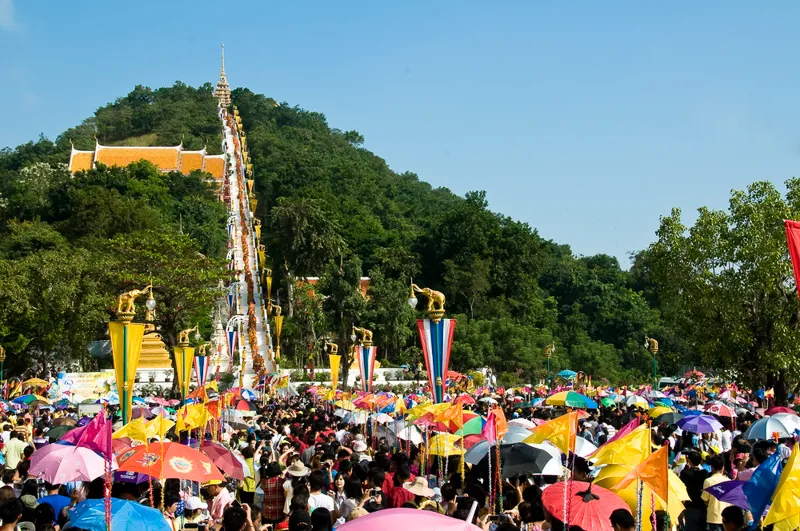
Tak Bat Devo At Wat Sangkat Rattana Khiri In Uthai Thani is one of Thailand’s most memorable Buddhist merit-making traditions after the end of Buddhist Lent. Held at Wat Sangkat Rattana Khiri on Khao Sakae Krang, the ceremony is famous for its dramatic and deeply symbolic setting. More than 500 monks walk down the 449-step staircase from the hilltop to the temple courtyard below, receiving alms from thousands of devotees. The scene closely reflects the Buddhist story of the Buddha descending from Tavatimsa Heaven after teaching the Abhidhamma to his mother for 3 months. For foreign travelers, this event offers a rare opportunity to witness living Thai Buddhism, local devotion, ceremonial beauty, and the cultural identity of Uthai Thani in one extraordinary morning.
The word “Devo” comes from “Devorohana,” meaning the descent from the heavenly realm. According to Buddhist tradition, after the Buddha spent the rainy-season retreat in Tavatimsa Heaven to teach his mother, he returned to the human world at the city of Sankassa. Deities, Brahmas, monks, and laypeople gathered to welcome him. This sacred return became the origin of Tak Bat Devo, the almsgiving ceremony performed on the day after Ok Phansa, the end of Buddhist Lent. In Uthai Thani, this Buddhist story is brought to life through the natural geography of Khao Sakae Krang and the long staircase leading down to Wat Sangkat Rattana Khiri.
The most distinctive feature of the Uthai Thani ceremony is the hill itself. Khao Sakae Krang rises above the town and becomes a symbolic link between heaven and earth. On the morning of the ceremony, monks gather at the top of the hill and descend the 449 steps in a long saffron line. From below, the sight resembles the sacred descent described in Buddhist legend. The yellow robes of the monks stretch down the staircase, while devotees wait quietly with rice, dried food, drinking water, sweets, fruit, and khao tom luk yon, the traditional wrapped sticky-rice offering associated with Tak Bat Devo.
Wat Sangkat Rattana Khiri is one of the most important temples in Uthai Thani Province. It is located near the foot of Khao Sakae Krang in Nam Suem Subdistrict, Mueang Uthai Thani District. The temple is home to Phra Phuttha Mongkhon Saksit, a revered Buddha image regarded as a sacred symbol of Uthai Thani. Its name and setting are closely linked to the Buddhist story of Sankassa, making the temple a particularly meaningful location for the Tak Bat Devo ceremony. The temple, the hill, the staircase, and the annual ritual all work together to create a powerful religious landscape.
Before sunrise, local people and visitors begin gathering around the temple courtyard, nearby streets, and the almsgiving route. Families prepare offerings carefully. Many bring khao tom luk yon, small portions of sticky rice wrapped in leaves. The shape makes the offering easy to carry and traditionally recalls the story of many devotees wishing to offer food to the Buddha and monks at the same time. Today, the offering is made with respect and care, and it remains one of the most recognizable symbols of the Tak Bat Devo tradition.
As the monks descend from Khao Sakae Krang, the atmosphere becomes solemn and beautiful. The long line of saffron robes, the morning light, the sound of temple announcements, and the quiet devotion of the people create a scene that is both visually striking and spiritually moving. In some years, the atmosphere is enhanced by ceremonial decoration and mist-like visual effects, strengthening the symbolic image of the descent from heaven. For many visitors, this is the most unforgettable moment of the entire event.
The ceremony is not limited to almsgiving. Uthai Thani also organizes cultural activities such as floral processions, Buddhist story presentations, ceremonial displays, and community decorations. Government offices, shops, and local organizations take part in preparing the town. Floral floats may pass through the market area before reaching Wat Sangkat Rattana Khiri. These activities show how the event belongs not only to the temple but to the whole city. The people of Uthai Thani participate together, turning the town into a shared space of faith and cultural celebration.
One special local feature is the display of ceremonial altar tables decorated with elephant tusks or symbolic elephant-related ornaments. This reflects Uthai Thani’s local identity and historical memory connected with elephants. In the context of Tak Bat Devo, these displays add a provincial character to the Buddhist ceremony. The event therefore expresses both universal Buddhist meaning and the distinctive culture of Uthai Thani.
The importance of Tak Bat Devo in Uthai Thani can be understood on several levels. Religiously, it commemorates the Buddha’s descent from Tavatimsa Heaven. Culturally, it is one of the province’s strongest annual traditions. Socially, it brings people together through preparation, participation, and shared merit-making. Economically and culturally, it attracts travelers who want to experience a major Thai Buddhist festival in an authentic local setting. The ceremony is therefore both sacred and communal.
For the people of Uthai Thani, this event is part of local identity. It is mentioned in the provincial image and remembered by generations of residents. Many locals grew up with the sight of monks descending Khao Sakae Krang, elders preparing khao tom luk yon, markets becoming lively, and families coming together before dawn to make merit. These memories give the tradition emotional power. It is not simply an annual event; it is a living heritage of the province.
For young people, Tak Bat Devo is an outdoor classroom. The story of the Buddha’s descent from heaven becomes visible through the hill, staircase, monks, offerings, and community participation. Children and students can understand Buddhist history not only through textbooks but through direct experience. They also learn social manners, respect for monks, the importance of community cooperation, and the value of preserving local traditions.
Travelers who want to attend the ceremony should plan carefully. The event attracts large crowds, especially around Wat Sangkat Rattana Khiri, the staircase, and nearby streets. Arriving before dawn is recommended for those who want a good place to make offerings or observe the monks’ procession. Visitors should prepare appropriate offerings in advance, dress modestly, and follow instructions from officials and volunteers. Photography is possible, but it should be done respectfully without blocking monks or disturbing other participants.
Suitable offerings include rice, dried food, drinking water, sweets, fruit, and khao tom luk yon. Visitors should avoid highly perishable food or excessive packaging that creates unnecessary waste. Almsgiving should be done calmly and respectfully. People should not push, rush, or throw offerings carelessly. The spirit of the ceremony is mindfulness, generosity, and reverence.
Visitors can also explore Khao Sakae Krang before or after the main ceremony. The hill offers panoramic views of Uthai Thani town, the Sakae Krang River area, and the surrounding landscape. The 449-step staircase is an important part of the event and can be walked on ordinary days. Understanding the geography of the hill helps visitors appreciate why this site is so suitable for recreating the Buddhist story of the descent from heaven.
Inside Wat Sangkat Rattana Khiri, visitors can pay respect to Phra Phuttha Mongkhon Saksit, the revered Buddha image of Uthai Thani. This sacred image is deeply respected by local people and is an important part of the temple’s spiritual identity. Combining the almsgiving ceremony with a respectful temple visit gives travelers a fuller understanding of Buddhist faith in Uthai Thani.
Near the hilltop is the monument of Somdet Phra Pathom Borom Maha Chanok, the father of King Rama I. This connects Khao Sakae Krang not only with Buddhism but also with the history of the Chakri dynasty and Uthai Thani’s civic identity. A visit to the hill therefore combines religion, royal history, local pride, and scenic views.
Getting There is easy from Uthai Thani town. Travelers can take Tha Chang Road toward Wat Sangkat Rattana Khiri at the foot of Khao Sakae Krang in Nam Suem Subdistrict. The temple is within the municipal area of Uthai Thani. On the festival day, visitors should allow extra travel time because some roads may be closed or controlled for processions and crowds. Those staying in town should leave their accommodation very early in the morning.
Visitors driving to the event should check temporary parking areas and traffic announcements from provincial or municipal authorities. During the ceremony, roads around the temple and hill may be crowded. Using local transport or walking from nearby accommodation can be more convenient. Travelers from other provinces should book accommodation in advance because the festival period brings many visitors to Uthai Thani town.
Proper etiquette is essential. Visitors should dress respectfully, avoid revealing clothing, speak quietly, and never block the monks’ path. Flash photography or intrusive photography should be avoided. People should follow the instructions of monks, officials, and volunteers. Respectful behavior allows both local devotees and visitors to share the ceremony peacefully.
The festival also supports the local economy. Restaurants, markets, hotels, and community shops receive many visitors during this period. After the ceremony, travelers can continue exploring Trok Rong Ya, the Sakae Krang riverside community, Wat Uposatharam, the morning market, and local food shops. A visit to Tak Bat Devo can therefore become a complete cultural trip combining religion, heritage, riverside life, food, and local identity.
Local foods worth trying in Uthai Thani include giant gourami from the Sakae Krang River area, boiled fish dishes, spicy fish soup, Thai home-style food, and local sweets from the town market. Many restaurants are located near the temple and town center, making it convenient to have breakfast or lunch after the ceremony. Food, faith, and river life are closely connected in the cultural experience of Uthai Thani.
Overall, Tak Bat Devo at Wat Sangkat Rattana Khiri brings together many elements in a single event: the Buddhist story of Devorohana, the end of Buddhist Lent, almsgiving, khao tom luk yon, more than 500 monks, the 449-step staircase, Khao Sakae Krang, Phra Phuttha Mongkhon Saksit, floral processions, and the shared devotion of Uthai Thani residents. These elements make the event more than a religious ceremony. It is a living expression of the province’s identity.
For travelers who want to experience Thai tradition deeply, this is one of the most meaningful festivals to witness in person. The sight of monks descending the hill, the devotion of the people waiting with offerings, and the small-town atmosphere of Uthai Thani create an experience that cannot be fully captured in words. Being there allows visitors to understand why this tradition remains one of Uthai Thani’s greatest sources of pride.
In summary, Tak Bat Devo at Wat Sangkat Rattana Khiri is one of Thailand’s most distinctive Buddhist almsgiving traditions after Ok Phansa. With more than 500 monks descending the 449 steps of Khao Sakae Krang, offerings of dried food and khao tom luk yon, floral processions, and the participation of the whole town, the festival is ideal for Buddhist devotees, cultural travelers, photographers, students of Thai tradition, and anyone who wants to experience a powerful living heritage of Uthai Thani.
| Name | Tak Bat Devo At Wat Sangkat Rattana Khiri, Uthai Thani |
| Venue | Wat Sangkat Rattana Khiri, Khao Sakae Krang, Nam Suem Subdistrict, Mueang Uthai Thani District, Uthai Thani Province |
| Address | Wat Sangkat Rattana Khiri, Tha Chang Road, Nam Suem Subdistrict, Mueang Uthai Thani District, Uthai Thani 61000, Thailand |
| Festival Period | Held once a year on the 1st waning day of the 11th lunar month, one day after Ok Phansa |
| Duration | Main almsgiving ceremony for 1 day; some years include additional cultural activities before the main ceremony |
| Highlights | More than 500 monks descend the 449-step staircase from Khao Sakae Krang to receive alms at Wat Sangkat Rattana Khiri |
| Importance | A major post-Buddhist Lent tradition commemorating the Buddha’s descent from Tavatimsa Heaven and one of Uthai Thani’s most important cultural identities |
| Common Offerings | Rice, dried food, drinking water, sweets, fruit, and khao tom luk yon |
| Main Rituals | Buddha image procession representing the descent from Tavatimsa Heaven, monks descending Khao Sakae Krang, almsgiving, khao tom luk yon offerings, floral processions, and ceremonial altar displays |
| Main Areas / Zones | Wat Sangkat Rattana Khiri courtyard, 449-step staircase, monks’ procession route, hilltop pavilion on Khao Sakae Krang, viewpoint area, Phra Phuttha Mongkhon Saksit hall, and procession areas in town |
| Fees | No admission fee |
| Travel Information | From Uthai Thani town, take Tha Chang Road to Wat Sangkat Rattana Khiri at the foot of Khao Sakae Krang. On the festival day, allow extra travel time and check traffic arrangements in advance. |
| Current Status | An annual provincial tradition of Uthai Thani and one of Thailand’s well-known Buddhist almsgiving ceremonies after Ok Phansa |
| Caretaker / Main Contact | Wat Sangkat Rattana Khiri and Uthai Thani provincial agencies jointly support the festival / Tourist information: TAT Uthai Thani Office, Tel. 0-5651-1061 |
| Nearby Tourist Attractions | 1. Khao Sakae Krang, about 0 km 2. Trok Rong Ya Old Market Street, about 1 km 3. Sakae Krang Riverside Community, about 2 km 4. Wat Uposatharam, about 3 km 5. Wat Chantharam Or Wat Tha Sung, about 7 km |
| Nearby Restaurants | 1. Khao Tom Som Pla Luak 2, about 1 km 2. Ko Ti Khao Man Kai Uthai Thani, about 1 km, Tel. 080-688-0883 3. Je Da Pla Luak, about 2 km, Tel. 056-571-409 4. Baan Nok Rim Na Restaurant, about 4 km, Tel. 087-200-4998 5. Ruean Phae Pramong Restaurant, about 4 km, Tel. 056-511-996 |
| Nearby Accommodations | 1. S Ville Resort, about 1 km 2. Uthai Heritage Hotel, about 1 km, Tel. 082-623-9426 3. MY UTHAI HOTEL, about 2 km, Tel. 061-262-6936 4. Payamai Resort Uthai Thani, about 3 km 5. C2U Hotel Uthai Thani, about 4 km |
Frequently Asked Questions (FAQ)
Q: Where is Tak Bat Devo in Uthai Thani held?
A: It is held at Wat Sangkat Rattana Khiri on Khao Sakae Krang in Nam Suem Subdistrict, Mueang Uthai Thani District, Uthai Thani Province.
Q: When is Tak Bat Devo held?
A: It is held on the 1st waning day of the 11th lunar month, one day after Ok Phansa. Some years include additional activities before the main ceremony.
Q: What is the main highlight of the Uthai Thani Tak Bat Devo ceremony?
A: The main highlight is the procession of more than 500 monks walking down the 449-step staircase from Khao Sakae Krang to receive alms at Wat Sangkat Rattana Khiri.
Q: What should visitors prepare for almsgiving?
A: Suitable offerings include rice, dried food, drinking water, sweets, fruit, and khao tom luk yon. Visitors should choose respectful and practical offerings.
Q: Is there an admission fee?
A: No. There is no admission fee, but visitors should dress respectfully and follow the event regulations.
Q: How do travelers get to Wat Sangkat Rattana Khiri?
A: From Uthai Thani town, take Tha Chang Road to Wat Sangkat Rattana Khiri at the foot of Khao Sakae Krang. On the festival day, visitors should allow extra time and check traffic announcements.
Q: What time should visitors arrive?
A: Visitors should arrive before dawn to find a suitable place for almsgiving, prepare offerings, and avoid heavy crowds during the main ceremony.
Q: What nearby attractions can visitors explore after the ceremony?
A: Visitors can continue to Khao Sakae Krang, Trok Rong Ya, the Sakae Krang riverside community, Wat Uposatharam, and Wat Tha Sung.
 Category: ●Art, Culture and Heritage
 Group: ●Art, Craft Centres, Tradition
Last Update : 4 MonthAgo
 Last Update : 4 MonthAgo
 Click to Access the Navigation Map GPS
Tak Bat Devo Tradition Map
Recommend

 Historical Sites and Monuments(3)
 Landmarks and Memorials(1)
Art, Craft Centres, Tradition(5)
Landmarks and Memorials(1)
Art, Craft Centres, Tradition(5)
 Museums(1)
 Places of Worship
 Temple(31)
 Other Sacred Sites(3)
 Suburban Living
 Village, Community(4)
 Local Market(1)
 Nature and Wildlife
 National Parks and Marine Reserves(2)
 Mountain (Doi)(7)
 Dam, Reservoir, Lake(5)
 Waterfalls(5)
 Hot Springs(1)
 Caves(9)
 Flower Field(2)
 River, Canal(2)
 Islands(1)
 Other natural attractions(1)
 Entertainment and Agricultural
 Farms, Parks and Ecotourism(2)
 Shopping
 Shopping and Night Market(1)


