
lovethailand home >North Travel Attractions >Uthai Thani Travel Attractions >Muang Uthai Thani >Sakae Krang > Khao Sakae Krang
TL;DR: Khao Sakae Krang is located at Nam Suem Subdistrict, Mueang Uthai Thani District, Uthai Thani Province, Thailand, open Daily, hours 08.00 – 16.30.
Khao Sakae Krang
Open Days: Daily
Opening Hours: 08.00 – 16.30
Khao Sakae Krang in Uthai Thani Province is one of the most meaningful landmarks in the city, combining scenic views, Buddhist faith, local culture, and Thai history in one accessible destination. Located close to the center of Uthai Thani, the hill is easy to visit and offers several important points of interest, including a replica of the Buddha’s footprint, a sacred bell, the monument of Somdet Phra Pathom Borom Maha Chanok Nat, panoramic views over Uthai Thani town, and Wat Sangkat Rattana Khiri at the foot of the hill. For foreign travelers who want to understand Uthai Thani beyond its riverside markets and quiet streets, Khao Sakae Krang is one of the best places to begin.
The charm of Khao Sakae Krang lies in the way it connects landscape, religion, and local memory. From the hilltop, visitors can look out over the town, the surrounding lowlands, the Sakae Krang River area, and the calm urban rhythm that makes Uthai Thani feel different from larger tourist cities. The view is not dramatic in the style of high mountains, but it is warm, open, and deeply connected to the town below. This is a place where travelers can see the geography of Uthai Thani and, at the same time, understand how the hill, the temple, and the community have shaped local identity for generations.
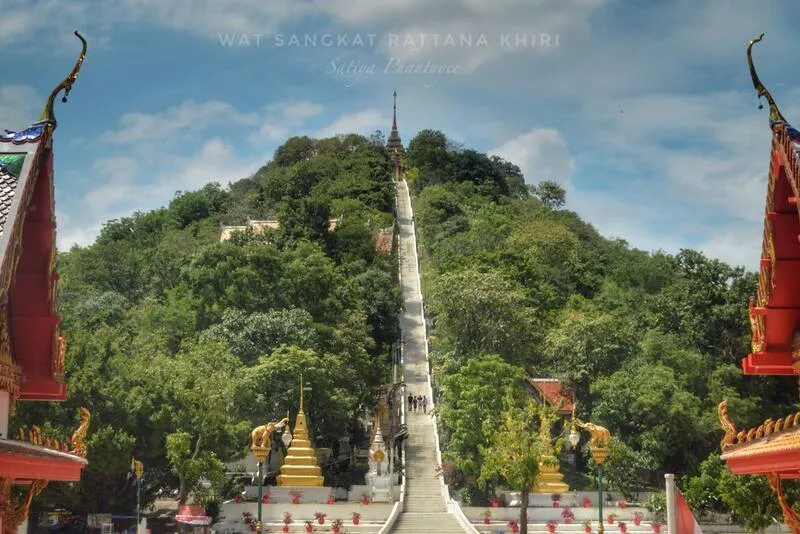
At the foot of the hill stands Wat Sangkat Rattana Khiri, one of the most important temples in Uthai Thani. The temple is located on Tha Chang Road in Nam Suem Subdistrict, Mueang Uthai Thani District. It is closely associated with Phra Phuttha Mongkhon Saksit, the revered Buddha image of Uthai Thani, and with the province’s famous Tak Bat Thewo tradition. During this annual Buddhist ceremony, hundreds of monks walk down the long staircase from Khao Sakae Krang to the temple courtyard below, creating one of the most memorable religious scenes in the province.
Visitors can reach the top of Khao Sakae Krang in more than one way. The most traditional route begins at Wat Sangkat Rattana Khiri, where a long staircase leads directly up the hill. This route is suitable for visitors who want to experience the site slowly and physically, walking through the same symbolic path associated with the Tak Bat Thewo ceremony. Another option is to drive or ride a motorcycle up the hill via Highway 3220, turning at the junction near Uthai Thani Provincial Stadium. The road to the top is about 2 kilometers long and is convenient for families, elderly visitors, and travelers with limited time.
On the hilltop, one of the main sacred sites is the mondop that houses a replica of the Buddha’s footprint. This footprint replica was moved from Wat Chantharam and was made in 1905. The area around the mondop is peaceful and suitable for paying respect, making a wish, and spending a quiet moment away from the town below. For local people, visiting the Buddha’s footprint is not only a sightseeing activity but also an act of Buddhist devotion that has long been part of the spiritual landscape of Uthai Thani.
In front of the mondop is a large bell created in 1900 by Phra Palat Chai. Local people regard this bell as sacred, and many visitors make a point of ringing it when they reach the top of the hill. The sound of the bell carries across the hilltop and creates a calm, resonant atmosphere. For first-time visitors, ringing the bell is one of the simple but memorable experiences that connect them with the faith and customs of Uthai Thani.
Near the mondop is the monument of Somdet Phra Pathom Borom Maha Chanok Nat, the father of King Rama I, the founder of the Chakri Dynasty. His original name was Nai Thongdee. He served in important administrative positions, including Phra Akson Sunthon Sat and later Chaophraya Chakri Sri Ongkharak during the Ayutthaya period. After the establishment of Bangkok as the capital of the Rattanakosin Kingdom, King Rama I elevated his father’s relics with the royal title Somdet Phra Chanokathibodi in 1795. The presence of this monument on Khao Sakae Krang gives the hill a historical significance that extends beyond local devotion.
The bronze statue on Khao Sakae Krang is twice life-size. The figure is seated on a pedestal, with the left hand holding the sheathed sword of the Chaophraya Chakri position across the left thigh, while the right hand rests on the right thigh. On the right side is a tray holding a high-ranking traditional hat without a feather plume, and the figure wears open-heeled sandals. These details make the monument important not only as a place of respect, but also as an object of historical and artistic interpretation. Visitors who take time to observe these features will gain a deeper appreciation of the relationship between Uthai Thani and the early history of the Chakri Dynasty.
Every year on April 6, which is Chakri Memorial Day, a ceremony is held to pay respect at the monument. Around this period, the Suphannika or Fai Kham flowers, the provincial flower of Uthai Thani, bloom on Khao Sakae Krang. Their bright yellow color adds beauty and symbolic meaning to the hill, blending natural scenery with historical reverence. For travelers who enjoy seasonal landscapes, this is one of the most attractive times to visit.
Behind the monument, about 200 meters into the wooded area, visitors can find a world map survey marker created in 1932. This marker was used for map surveying and is an interesting detail for travelers who enjoy geography, history, or lesser-known landmarks. Although it is not as widely discussed as the temple, the bell, or the monument, the survey marker adds another layer of meaning to Khao Sakae Krang by showing that the hill also has a place in the technical and cartographic history of the area.
Wat Sangkat Rattana Khiri at the foot of the hill is equally important. The temple was established in 1890 and was formerly known as Wat Khao Sakae Krang. It was founded by Phra Sunthon Muni, also known as Chai Khangkhasaro, a former ecclesiastical leader of Uthai Thani Province. Within the temple compound is the viharn of Phra Phuttha Mongkhon Saksit, rebuilt in 1977. The Buddha image enshrined inside is a bronze image in the posture of subduing Mara, displaying beautiful Sukhothai-style artistic features. It is deeply revered by the people of Uthai Thani and is widely regarded as the city’s principal sacred Buddha image.
The story of Phra Phuttha Mongkhon Saksit gives Wat Sangkat Rattana Khiri a strong spiritual identity. The image is not simply an object of worship for visitors; it is a symbol of local faith and continuity. The viharn has a solemn atmosphere, and visitors should dress respectfully, remove their shoes where required, and behave calmly inside the temple grounds. For travelers interested in Thai Buddhist culture, this temple provides a valuable opportunity to observe how religious devotion is woven into daily community life.
The most famous annual tradition associated with the temple and the hill is Tak Bat Thewo, held on the first waning day of the 11th lunar month. The ceremony recalls the Buddhist story of the Buddha’s descent from Tavatimsa Heaven after spending the rainy season teaching his mother. In Uthai Thani, the story is represented through a spectacular procession in which monks descend from Khao Sakae Krang along the 449-step staircase to receive alms from local people and visitors in the temple courtyard below. This ceremony is one of the clearest examples of how Buddhist narrative, landscape, and community participation come together in a living tradition.
Visiting during Tak Bat Thewo offers a very different experience from visiting on a normal day. The area becomes lively, crowded, and deeply ceremonial. Travelers can witness local faith on a large scale and see how the hill functions as a sacred stage for one of Uthai Thani’s most important traditions. Anyone planning to attend should arrive early, dress modestly, prepare offerings properly, and follow the instructions of local officers and community organizers. During the festival, parking and movement around the temple can be more difficult than usual.
On ordinary days, Khao Sakae Krang is quieter and easier to explore at a relaxed pace. The morning is a good time for walking up the staircase because the air is cooler and the light is soft. Late afternoon is ideal for photography and views of the town as the sun begins to descend. The hilltop is not a place to rush. Its value comes from slow observation: the sound of the bell, the view over Uthai Thani, the details of the monument, the temple below, and the sense of calm that surrounds the hill.
Khao Sakae Krang is suitable for many types of travelers. Families can bring children to learn about history and Buddhism. Elderly visitors can drive up the hill instead of using the staircase. Cultural travelers can study the temple, the Buddha image, the Tak Bat Thewo tradition, and the monument of Somdet Phra Pathom Borom Maha Chanok Nat. Photographers can capture views of the town, the staircase, temple architecture, and the seasonal yellow blooms of the provincial flower. A single visit can therefore satisfy several interests without requiring a long journey.
The hill can be easily combined with other attractions in Uthai Thani town. After visiting Khao Sakae Krang and Wat Sangkat Rattana Khiri, travelers can continue to the Sakae Krang riverside market area, explore Trok Rong Ya Walking Street on activity days, visit Wat Uposatharam by the river, or continue to Wat Tha Sung, one of the province’s most famous temples. This route allows visitors to experience the hill, the river, the old town, local food, and Buddhist culture within one well-planned day.
Getting There is straightforward from central Uthai Thani. Visitors who want to walk up can begin at Wat Sangkat Rattana Khiri at the foot of the hill. This route is more traditional and gives a stronger sense of connection to the Tak Bat Thewo tradition. Visitors who prefer to drive can use Highway 3220 and turn up the hill near Uthai Thani Provincial Stadium. The road to the top is about 2 kilometers long. Cars and motorcycles can use the road, but drivers should proceed carefully, especially on curves, slopes, and during busy festival periods.
The best time to visit is in the morning or late afternoon. Morning visits are quieter and more comfortable for walking, while late afternoon visits are good for views and photography. Travelers who plan to walk up the stairs should bring drinking water, wear comfortable shoes, and allow enough time. Those driving up the hill should use low speed and be mindful of pedestrians. The hill is easy to visit, but the experience is best when travelers slow down and pay attention to its cultural details.
Visitors should dress politely, respect temple spaces, avoid loud noise, keep the area clean, and refrain from climbing on or touching important religious or historical structures unnecessarily. During ceremonies, visitors should follow local instructions and avoid blocking processions or sacred activities. These simple acts of respect help preserve Khao Sakae Krang as both a tourist attraction and a living cultural site.
Khao Sakae Krang is more than a viewpoint. It is a place where Uthai Thani’s religious faith, royal history, local identity, and natural scenery meet. The Buddha’s footprint replica, sacred bell, monument, survey marker, temple, staircase, and panoramic views all help tell the story of the city. For travelers who want to understand why Uthai Thani feels so calm yet culturally rich, this hill provides a clear and rewarding answer.
A half-day visit is enough to walk or drive up the hill, pay respect at the sacred sites, enjoy the view, and visit nearby places in town. A full-day itinerary can include Khao Sakae Krang, Wat Sangkat Rattana Khiri, the riverside market, Wat Uposatharam, Trok Rong Ya, local restaurants, and accommodation in Uthai Thani town. This makes the hill a practical and meaningful starting point for exploring the province.
Ultimately, visiting Khao Sakae Krang is not only about taking photographs from a hilltop. It is about seeing Uthai Thani from above and understanding the layers of history, faith, and community memory that have shaped the town below. For foreign travelers, the site offers a gentle but powerful introduction to Thai local culture, Buddhist tradition, and the quiet beauty of a provincial city that deserves to be explored with attention and respect.
| Name | Khao Sakae Krang |
| Related Site | Wat Sangkat Rattana Khiri |
| Location | Nam Suem Subdistrict, Mueang Uthai Thani District, Uthai Thani Province, Thailand |
| Address | Wat Sangkat Rattana Khiri, 125 Ban Wang Yang, Moo 3, Nam Suem Subdistrict, Uthai Thani Municipality, Uthai Thani 61000, Thailand |
| Highlights | Hilltop viewpoint, Buddha’s footprint replica, sacred bell, monument of Somdet Phra Pathom Borom Maha Chanok Nat, and the 449-step staircase used in the Tak Bat Thewo tradition |
| History | Wat Sangkat Rattana Khiri was established in 1890 and was formerly known as Wat Khao Sakae Krang. The Buddha’s footprint replica was made in 1905, and the large sacred bell was created in 1900. |
| Name Origin | The name is connected with the Sakae Krang community and Wat Sangkat Rattana Khiri, formerly known as Wat Khao Sakae Krang. |
| Distinctive Features | A hill close to Uthai Thani town, accessible by staircase or road, suitable for worship, scenic views, photography, and local history learning |
| Important Sacred Objects | Phra Phuttha Mongkhon Saksit at Wat Sangkat Rattana Khiri and the Buddha’s footprint replica on Khao Sakae Krang |
| Important Tradition | Tak Bat Thewo, held on the first waning day of the 11th lunar month, when monks descend the 449-step staircase from Khao Sakae Krang to Wat Sangkat Rattana Khiri |
| Travel Information | Visitors can walk up from Wat Sangkat Rattana Khiri or drive up via Highway 3220, turning near Uthai Thani Provincial Stadium. The road to the top is about 2 km. |
| Current Status | Open for sightseeing and worship during regular visiting hours |
| Open Days | Daily |
| Opening Hours | 08.00 – 16.30 |
| Main Areas / Zones | 1. Wat Sangkat Rattana Khiri Courtyard 2. Viharn Of Phra Phuttha Mongkhon Saksit 3. 449-Step Staircase To Khao Sakae Krang 4. Buddha’s Footprint Replica Mondop 5. Sacred Bell On The Hilltop 6. Monument Of Somdet Phra Pathom Borom Maha Chanok Nat 7. Uthai Thani Viewpoint 8. World Map Survey Marker Behind The Hill |
| Facilities | Hill road, staircase, parking areas around the temple and nearby zones, worship areas, and viewpoint on the hilltop |
| Caretaker | Wat Sangkat Rattana Khiri and local authorities in Uthai Thani Municipality |
| Local Authority Contact | Uthai Thani Municipality, Tel. 056-511-061 |
| Nearby Tourist Attractions | 1. Trok Rong Ya Walking Street, about 1 km 2. Sakae Krang Riverside Market, about 2 km 3. Wat Uposatharam, about 3 km 4. Uthai Thani Local History And Cultural Museum, about 3 km 5. Wat Chantharam Or Wat Tha Sung, about 8 km |
| Nearby Restaurants | 1. Ko Ti Khao Man Kai Uthai Thani, about 1 km, Tel. 080-688-0883 2. Jae Da Pla Luak, about 2 km, Tel. 056-571-409 3. Som Pla Luak Branch 1, about 2 km, Tel. 063-449-9192 4. Krua Sakae Krang Floating Restaurant, about 3 km, Tel. 093-137-1711, 089-644-5950 5. Som Pla Luak 2 Rice Soup Restaurant, about 4 km, Tel. 081-984-1437 |
| Nearby Accommodations | 1. S Ville Resort, about 1 km, Tel. 091-292-9789, 081-888-6791 2. Uthai Heritage Hotel, about 2 km, Tel. 082-623-9426 3. My Uthai Hotel, about 3 km, Tel. 061-262-6936 4. Comeneetee Uthai, about 2 km, Tel. 086-652-7749 5. Ban Sakae Krang Resort, about 4 km, Tel. 096-979-8897 |
Frequently Asked Questions (FAQ)
Q: Where is Khao Sakae Krang located?
A: Khao Sakae Krang is located in Mueang Uthai Thani District, Uthai Thani Province, close to Wat Sangkat Rattana Khiri and the town center.
Q: What are the main highlights of Khao Sakae Krang?
A: The main highlights are the Buddha’s footprint replica, sacred bell, monument of Somdet Phra Pathom Borom Maha Chanok Nat, Uthai Thani viewpoint, and the world map survey marker behind the hill.
Q: Why is Wat Sangkat Rattana Khiri important?
A: The temple enshrines Phra Phuttha Mongkhon Saksit, the revered Buddha image of Uthai Thani, and serves as the main location for the province’s Tak Bat Thewo tradition.
Q: How can visitors reach the top of Khao Sakae Krang?
A: Visitors can walk up the staircase from Wat Sangkat Rattana Khiri or drive up the hill via the road near Uthai Thani Provincial Stadium.
Q: What are the opening hours of Khao Sakae Krang?
A: The site is open daily from 08.00 to 16.30. Morning and late afternoon are the most comfortable times to visit.
Q: When is the Tak Bat Thewo ceremony held at Khao Sakae Krang?
A: It is held on the first waning day of the 11th lunar month, when monks descend the 449-step staircase from Khao Sakae Krang to Wat Sangkat Rattana Khiri.
Q: Is Khao Sakae Krang suitable for elderly visitors?
A: Yes. Elderly visitors can drive up the hill instead of walking up the staircase, but they should be careful on slopes and uneven areas.
Q: What nearby places can be visited together with Khao Sakae Krang?
A: Nearby places include Trok Rong Ya Walking Street, Sakae Krang Riverside Market, Wat Uposatharam, the local history museum, and Wat Tha Sung.
 Category: ●Nature and Wildlife
 Group: ●Mountain (Doi)
Last Update : 4 MonthAgo
 Last Update : 4 MonthAgo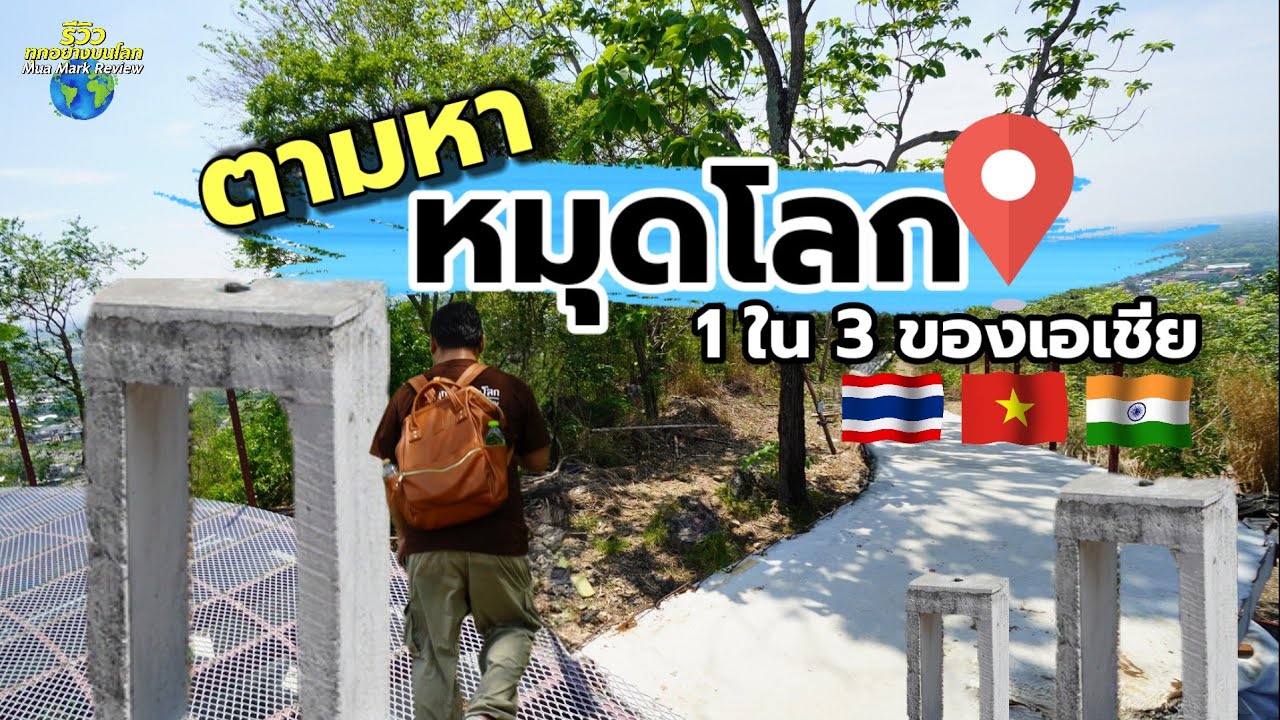
 Click to Access the Navigation Map GPS
Khao Sakae Krang Map
Gellery
Recommend

 Art, Culture and Heritage
 Historical Sites and Monuments(3)
 Landmarks and Memorials(1)
 Art, Craft Centres, Tradition(5)
 Museums(1)
 Places of Worship
 Temple(31)
 Other Sacred Sites(3)
 Suburban Living
 Village, Community(4)
 Local Market(1)
 National Parks and Marine Reserves(2)
Mountain (Doi)(7)
National Parks and Marine Reserves(2)
Mountain (Doi)(7)
 Dam, Reservoir, Lake(5)
 Waterfalls(5)
 Hot Springs(1)
 Caves(9)
 Flower Field(2)
 River, Canal(2)
 Islands(1)
 Other natural attractions(1)
 Entertainment and Agricultural
 Farms, Parks and Ecotourism(2)
 Shopping
 Shopping and Night Market(1)


