
lovethailand home >North Travel Attractions >Uthai Thani Travel Attractions >Ban Rai >Ban Rai > Local Weaving Exhibition And Demonstration Centre
TL;DR: Local Weaving Exhibition And Demonstration Centre is located at Behind Wat Ban Rai, next to Ban Na Fai Bueng Ta Pho School, Ban Rai District, Uthai Thani Province, open Daily, hours 08.00 – 17.00.

Local Weaving Exhibition And Demonstration Centre
Open Days: Daily
Opening Hours: 08.00 – 17.00
Local Weaving Exhibition And Demonstration Centre (Paichit Weaving Group) in Uthai Thani Province is an important cultural learning site in Ban Rai District. Located behind Wat Ban Rai, next to Ban Na Fai Bueng Ta Pho School, the centre can be reached by turning into the alley beside the school and continuing for about 700 meters. This local weaving group preserves the knowledge of handwoven cotton, natural dyeing, traditional patterns, and community-based craftsmanship. For foreign travelers who want to understand Thai textiles beyond finished products, this is a meaningful place to see how fabric, culture, memory, and local wisdom are woven together.
The importance of Paichit Weaving Group lies in its role as a living centre for local textile wisdom. The group continues to demonstrate traditional cotton weaving, a craft that requires knowledge of cotton selection, thread preparation, natural dyeing, loom setting, pattern planning, and careful weaving. Each piece of cloth is not simply a product. It is the result of time, patience, skill, and inherited knowledge. A visit to the centre helps travelers understand that Thai textiles are not only beautiful objects but also cultural records created through the hands and experience of local artisans.
One of the main characteristics of the group is the use of cotton and natural dyes. Natural colors are produced from plants, herbs, bark, leaves, and other local materials. These colors are often soft, warm, and deeply connected with the surrounding environment. Natural dyeing requires experience because the shade can change depending on the plant, season, water, boiling method, and dyeing time. This process shows how weaving is connected with ecological knowledge and how local artisans understand the materials around them.
The patterns woven by the Paichit Weaving Group include old and culturally meaningful designs such as Lai Kho Luang, Lai Kho Kham Duean, and other local motifs. These patterns are not created only for visual beauty. They reflect beliefs, memory, auspicious meanings, and local aesthetics. A textile pattern can be read almost like a cultural language. Through repeated forms, colors, and rhythm, a woven cloth tells stories of community life, taste, identity, and inherited artistic knowledge.
Traditional weaving requires great care at every stage. The process begins with preparing cotton thread so that it is strong enough for weaving. The thread is then dyed, dried, arranged, and placed on the loom. The weaver must control the warp and weft carefully so that the pattern appears correctly. Even a small mistake can affect the design of the whole cloth. This is why handwoven textiles are valuable. They carry the time and concentration of the person who made them.
The loom is the heart of the demonstration area. Visitors can observe the movement of the shuttle, the sound of the reed, the tension of the threads, and the rhythm of the weaver’s hands. This physical experience is very different from seeing textiles in a shop. It allows visitors to understand how human skill, memory, and tools work together to create a piece of fabric. Watching a weaver at work is one of the best ways to appreciate the real value of handmade textiles.
The centre provides opportunities to learn about the weaving process from beginning to end. Visitors can see materials, tools, sample patterns, and finished products. Demonstrations help explain why a handmade textile takes time and why different patterns have different levels of difficulty. The centre therefore functions as a small cultural classroom where tourists, students, designers, and textile lovers can learn from local artisans directly.
In addition to producing textiles for sale, the group also teaches weaving to interested visitors and learners. This educational role is essential because craft knowledge can survive only when it is passed on. By allowing people to observe, ask questions, and learn basic techniques, the group helps preserve the weaving tradition for future generations. Learning at the centre gives visitors both technical understanding and emotional appreciation for the craft.
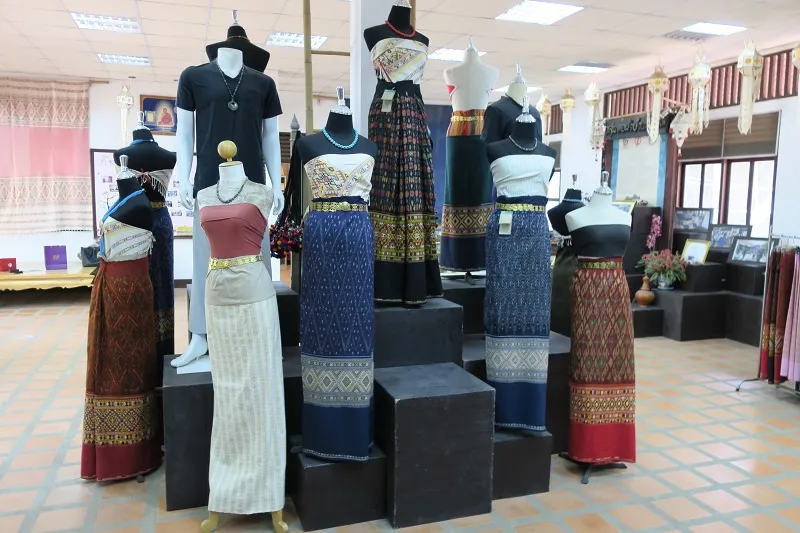
The products available at the centre are diverse. They include traditional tube skirts, cloth for tailoring, bed covers, table covers, khit textiles, chok textiles, and khit pillows. Each product has a different function and cultural meaning. Some are used for clothing, others for home decoration, ceremonial use, or gifts. All of them reflect the skill of local weavers and the continuity of Uthai Thani textile culture.
The traditional tube skirt is one of the most meaningful textile products. In many communities, a woven skirt is connected with women’s lives, family memory, ceremonies, and local identity. Its color, pattern, and technique can reflect age, occasion, status, or community taste. A handwoven skirt is therefore not only clothing, but also a cultural object that carries identity and memory.
Khit and chok weaving techniques require high skill. Khit patterns are created by lifting selected threads to form repeated raised designs, while chok weaving involves inserting colored threads into specific areas to create detailed motifs. Both techniques require strong memory, precision, and experience. Products made with these methods are valuable because they show the technical sophistication of local weaving traditions.
Khit pillows connect woven textiles with domestic life. They are not only useful household items but also cultural objects often associated with family, ceremonies, hospitality, and gifts. Their presence at the centre shows that woven textiles are not limited to clothing. They also belong to homes, rituals, and relationships between people.
The centre also has an old textile museum displaying cloth more than 100 years old, traditional weaving tools, and objects related to local textile production. This museum is important because it allows visitors to compare old and newer patterns, colors, materials, and uses. Old textiles are cultural evidence. They preserve the memory of past weavers and provide inspiration for present and future artisans.
Traditional weaving tools displayed in the museum help visitors understand that weaving is a complex knowledge system. Each tool has a specific purpose, from spinning and winding thread to arranging warp threads and controlling the pattern on the loom. These tools represent community technology developed over generations. They show that local wisdom is practical, precise, and creative.
Paichit Weaving Group also contributes to the local economy. Textile production provides income for families and allows local artisans to turn their skill into meaningful work. Buying directly from the weaving group supports the people who make the products and helps keep the craft alive. Community-based tourism becomes most valuable when visitors understand that their purchases help sustain cultural knowledge.
The centre is suitable for many types of travelers. Textile lovers can study weaving details closely. Designers can find inspiration from patterns and natural colors. Students can learn about traditional technology and cultural heritage. Families can introduce children to handmade work. Visitors looking for meaningful souvenirs can choose products that carry real local stories rather than mass-produced items.
The experience here is simple and community-based. Visitors should not expect a large modern museum with highly commercialized displays. The strength of the centre is its authenticity. Travelers can see real craft work, meet local artisans, observe tools and materials, and understand how textiles are part of daily community life. This direct experience gives the place its cultural value.
Visitors who wish to take photographs should ask permission before photographing weavers or close-up working areas. Although the centre welcomes learning, parts of the area are still working spaces for community members. Respectful cultural tourism begins with asking, listening, and understanding boundaries. This creates a better experience for both visitors and hosts.
Getting There is straightforward from Ban Rai District. Head toward the area behind Wat Ban Rai, next to Ban Na Fai Bueng Ta Pho School. Turn into the alley beside the school and continue for about 700 meters to reach the Paichit Weaving Group. The route is suitable for private cars, rental cars, or local transport. Visitors unfamiliar with the area should ask local residents or use an online map for additional guidance.
The location makes it easy to combine the weaving centre with nearby attractions in Ban Rai District. Travelers can visit Wat Ban Rai, Saw Hai Market, Ban Pha Thung weaving community, Wat Tham Khao Wong, Ban Karung Ancient Town, and Pha Rom Yen Waterfall. A well-planned route can combine craft, culture, nature, food, and local life in one trip.
The best time to visit is during the day, especially from morning to afternoon, when natural light makes it easier to see the colors and details of the textiles. Visitors who want to see demonstrations or arrange a learning activity should contact the group in advance. Advance contact is especially useful for groups, students, or travelers who want a more in-depth experience.
Visitors should come with time and curiosity. This is a place to look closely, ask questions, and appreciate the slow process of handmade work. When buying textiles, travelers should remember that the price reflects materials, labor, time, and craftsmanship. Understanding this helps visitors appreciate the true value of handwoven cloth.
The centre also helps travelers understand another side of Uthai Thani. The province is often known for temples, nature, river communities, and historical attractions, but it also has strong textile traditions and craft communities. Paichit Weaving Group represents the craft heritage of Ban Rai and shows how local knowledge can continue to live through community-based tourism.
For anyone interested in Thai textiles, this centre demonstrates that woven cloth has many layers of value: beauty, function, economy, history, identity, and memory. A single piece of cloth may take days or weeks to complete depending on its size and pattern. Seeing the process directly helps visitors understand why handmade textiles deserve respect and support.
From a conservation perspective, Paichit Weaving Group helps preserve old patterns that might otherwise disappear. Patterns such as Lai Kho Luang and Lai Kho Kham Duean require memory, skill, and practice. Without active weavers, learners, and buyers, these patterns could fade with time. Supporting the group helps keep these old designs alive in contemporary life.
In summary, Local Weaving Exhibition And Demonstration Centre (Paichit Weaving Group) is one of Ban Rai’s meaningful cultural learning sites. Its strengths include naturally dyed cotton textiles, traditional patterns, weaving demonstrations, educational activities, handmade products, and a museum of century-old textiles. A visit here is more than shopping for fabric. It is an encounter with Thai craft wisdom, community pride, and the living heritage of Uthai Thani.
| Name | Local Weaving Exhibition And Demonstration Centre (Paichit Weaving Group) |
| Location | Behind Wat Ban Rai, next to Ban Na Fai Bueng Ta Pho School, Ban Rai District, Uthai Thani Province |
| Address | Ban Rai District, Uthai Thani 61140, Thailand; turn into the alley beside Ban Na Fai Bueng Ta Pho School for about 700 meters |
| Highlights | Natural-dyed cotton weaving, traditional patterns, weaving demonstrations, handmade textile products, and a museum of century-old textiles |
| Distinctive Features | Traditional cotton weaving using natural dyes and old patterns such as Lai Kho Luang, Lai Kho Kham Duean, and other local motifs |
| Activities | Watch weaving demonstrations, learn natural dyeing, study old textile patterns, visit the textile museum, buy handwoven products, and learn the local cotton-weaving process |
| Key Products | Traditional tube skirts, tailoring cloth, bed covers, table covers, khit textiles, chok textiles, khit pillows, and local cotton products |
| Travel Information | From Ban Rai District, head behind Wat Ban Rai near Ban Na Fai Bueng Ta Pho School, then turn into the alley beside the school for about 700 meters |
| Current Status | Active local weaving learning centre and demonstration site in Ban Rai District, Uthai Thani Province |
| Open Days | Daily |
| Opening Hours | 08.00 – 17.00 |
| Fees | No official admission fee information listed |
| Facilities | Weaving demonstration area, product sales area, old textile museum, traditional weaving tools, and community craft learning space |
| Main Areas / Zones | Loom demonstration area, natural dyeing area, old textile display, weaving tool display, product sales area, and old pattern learning area |
| Caretaker / Main Contact | Paichit Weaving Group / Local weaving contact information: Tel. 081-971-0521 |
| Nearby Tourist Attractions | 1. Wat Ban Rai, about 1 km 2. Saw Hai Market Ban Rai, about 4 km 3. Ban Pha Thung Local Weaving Centre, about 14 km 4. Wat Tham Khao Wong, about 18 km 5. Ban Karung Ancient Town, about 22 km 6. Pha Rom Yen Waterfall, about 28 km |
| Nearby Restaurants | 1. Baan Suan Restaurant Ban Rai, about 4 km, Tel. 056-539-061 2. Lemone Cafe & Resort Ban Rai, about 4 km 3. Café de Sua Mueang Karung, about 22 km, Tel. 093-416-3567 4. Kuai Tiao Rim Sa Karung, about 22 km, Tel. 097-038-6008 5. Kuai Tiao 9 Baht Mueang Karung, about 22 km, Tel. 099-142-6668 |
| Nearby Accommodations | 1. Baan Suan Resort Ban Rai, about 4 km, Tel. 056-539-060, 098-864-1258 2. Lemone Cafe & Resort Ban Rai, about 4 km 3. Tree Stone House Ban Rai, about 5 km 4. Ban Rai Nai Suan Resort, about 6 km, Tel. 089-267-6174 5. Baan Nub Dao Homestay Mueang Karung, about 22 km |
Frequently Asked Questions (FAQ)
Q: Where is the Local Weaving Exhibition And Demonstration Centre (Paichit Weaving Group) located?
A: It is located behind Wat Ban Rai, next to Ban Na Fai Bueng Ta Pho School in Ban Rai District, Uthai Thani Province. Visitors turn into the alley beside the school for about 700 meters.
Q: What is interesting about Paichit Weaving Group?
A: Visitors can see natural-dyed cotton weaving, traditional textile patterns, handmade products, and a museum of old textiles more than 100 years old.
Q: What are the important textile patterns at the centre?
A: Important patterns include Lai Kho Luang, Lai Kho Kham Duean, and other local motifs that reflect community wisdom and culture.
Q: Can visitors learn weaving at the centre?
A: Yes. Visitors can learn about the weaving process and watch demonstrations. Advance contact is recommended for group visits or deeper learning activities.
Q: What products are sold by Paichit Weaving Group?
A: Products include traditional tube skirts, tailoring cloth, bed covers, table covers, khit textiles, chok textiles, khit pillows, and local cotton products.
Q: Who should visit this weaving centre?
A: The centre is suitable for textile lovers, cultural travelers, students, designers, families, and visitors looking for meaningful community-made souvenirs.
Q: What is the best time to visit?
A: Daytime is recommended, especially from morning to afternoon, when the colors, patterns, and weaving process can be clearly observed.
Q: Are there nearby attractions?
A: Yes. Nearby attractions include Wat Ban Rai, Saw Hai Market, Ban Pha Thung weaving community, Wat Tham Khao Wong, Ban Karung Ancient Town, and Pha Rom Yen Waterfall.
 Category: ●Art, Culture and Heritage
 Group: ●Art, Craft Centres, Tradition
Last Update : 4 MonthAgo
 Last Update : 4 MonthAgo
 Click to Access the Navigation Map GPS
Local Weaving Exhibition And Demonstration Centre Map
Recommend

 Historical Sites and Monuments(3)
 Landmarks and Memorials(1)
Art, Craft Centres, Tradition(5)
Landmarks and Memorials(1)
Art, Craft Centres, Tradition(5)
 Museums(1)
 Places of Worship
 Temple(31)
 Other Sacred Sites(3)
 Suburban Living
 Village, Community(4)
 Local Market(1)
 Nature and Wildlife
 National Parks and Marine Reserves(2)
 Mountain (Doi)(7)
 Dam, Reservoir, Lake(5)
 Waterfalls(5)
 Hot Springs(1)
 Caves(9)
 Flower Field(2)
 River, Canal(2)
 Islands(1)
 Other natural attractions(1)
 Entertainment and Agricultural
 Farms, Parks and Ecotourism(2)
 Shopping
 Shopping and Night Market(1)


