
lovethailand home >Central Travel Attractions >Suphan Buri Travel Attractions >Muang Suphan Buri >Ban Pho > Ting Krachat Festival
TL;DR: Ting Krachat Festival, Suphan Buri attractions : Art, Culture and Heritage, Art, Craft Centres, Tradition.
Ting Krachat Festival
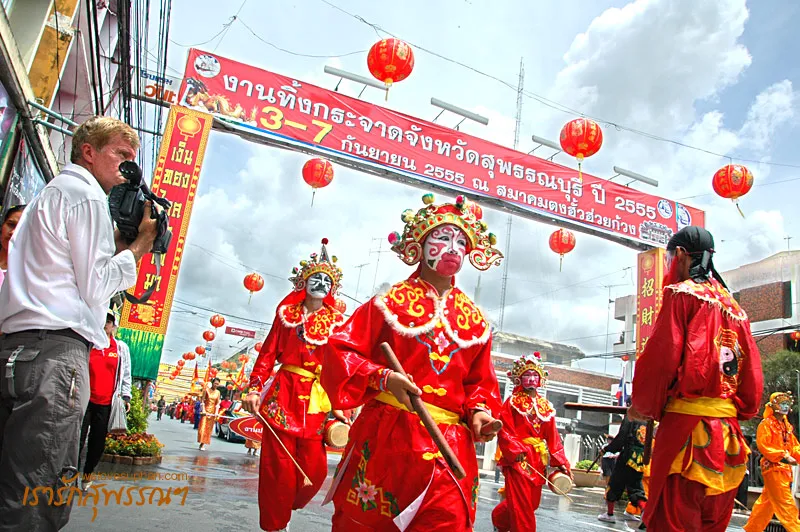
Open Days: Held Annually Around the Full Moon of the 7th Lunar Month in the Chinese Calendar, Usually in Late August or Early September
Opening Hours: According to the Annual Event Schedule
The Ting Krachat Festival of Suphan Buri is one of the province’s most important Thai-Chinese traditions. Held around the full moon of the 7th lunar month in the Chinese calendar, usually in late August or early September in the Thai calendar, the festival is rooted in Mahayana Buddhist belief and Chinese cultural practice. Its main purpose is to dedicate merit to departed souls, including spirits without relatives, while also promoting generosity, compassion, and social care within the community. For foreign travelers, this festival offers a meaningful opportunity to understand the deep relationship between religion, charity, ancestor remembrance, and Thai-Chinese identity in Suphan Buri.
The heart of the Ting Krachat Festival is giving. Local residents, shop owners, associations, foundations, and devotees donate consumer goods, dry food, rice, and daily necessities. These items are prepared for distribution and offered symbolically to wandering spirits according to traditional belief. The festival therefore operates on several levels at once. Religiously, it is an act of compassion toward the dead. Socially, it is an act of sharing with people in need. Culturally, it preserves an old Thai-Chinese tradition that has remained closely connected with Suphan Buri’s urban community.
The origin of the tradition is associated with a Mahayana Buddhist scripture. According to the legend, while Venerable Ananda was practicing meditation at Nigrodharama in Kapilavastu, a suffering spirit appeared before him in the form of a hungry ghost. The ghost was thin and skeletal, with a neck as small as a needle hole, and flames came from its mouth when it was hungry. The ghost told Ananda that he would die in 3 days. When Ananda asked how this fate could be avoided, the ghost said that he should perform a ritual of offering food and goods to hungry ghosts and wandering spirits. Ananda reported this to the Buddha, who instructed him to perform an act of compassion as described.
This legend gives the Ting Krachat Festival a meaning that goes beyond the public distribution of goods. It is based on compassion toward all beings, including spirits believed to be suffering in unseen realms. The act of giving is not limited to family members or known ancestors. It extends to unknown souls, the forgotten dead, and those without relatives to dedicate merit to them. In this sense, the festival reduces selfishness and expands the idea of charity to include both the living and the dead.
In Suphan Buri, the festival is closely connected with Suphan Buri City Pillar Shrine, Tong Hua Hoi Kuang Association, and Tong Yiah Siang Teung Foundation on Phan Kham Road. A major ritual involves inviting the City Pillar deity to preside over the ceremony. A temporary kong tek ritual hall is constructed as the ceremonial center, and the City Pillar deity is invited to reside there during the ritual period. This creates a sacred center for the festival and symbolizes the unity of the local community.
The kong tek ritual hall is one of the most important areas of the event. It is where offerings are arranged, rituals are performed, and donated goods are gathered. The items come from local residents, market vendors, business owners, and worshippers. The act of donation shows that the festival belongs to the whole community, not only to a single organization. People participate as donors, ritual attendants, volunteers, performers, recipients of goods, and visitors. This shared participation is what keeps the festival alive from generation to generation.
The festival usually begins 3 days after the Chinese Ghost Festival period and is connected with the full moon of the 7th lunar month in the Chinese calendar. Activities may continue for several days, depending on the annual schedule. Major components include ritual chanting, merit dedication, the procession inviting the City Pillar deity, kong tek ceremonies, Teochew opera performances, the arrangement of donation baskets, and the day of Ting Krachat itself. The atmosphere combines sacred ritual, community participation, and lively Thai-Chinese cultural expression.
Near the ritual hall, a raised platform about 4 to 5 meters high is traditionally constructed. On the platform are baskets filled with donated consumer goods. On the day of Ting Krachat, numbered tokens are thrown down from the platform. People who collect the tokens can exchange them for goods according to the numbers. This practice is one of the most recognizable scenes of the festival. It reflects the physical act of giving and receiving, while also creating a vivid public expression of charity and community sharing.
Another important symbol of the festival is the large figure known in Chinese as Tai Su, often associated with the King of Hell or a guardian of spirits. The figure is made of paper over a bamboo frame and painted in blue, white, and red. It usually stands about 4 to 5 meters high, with a stern face and a commanding gesture. Tai Su serves as a symbolic guardian who controls hungry ghosts and wandering spirits so that they receive offerings in an orderly way and do not fight over the donated items.
On the head of Tai Su is an image of Guanyin, the Bodhisattva of Compassion. This detail is deeply meaningful. Although Tai Su appears fierce and powerful, the presence of Guanyin above him shows that compassion is the highest principle of the ritual. Guanyin represents mercy, while Tai Su represents order and control. Together, they express the balance between compassion and ritual authority within Mahayana Buddhist and Chinese spiritual practice.
In front of the kong tek hall, Teochew opera has long been part of the festival’s atmosphere. In earlier times, 2 opera troupes competed with each other and performed continuously throughout the day and night for 3 days and 3 nights. On the afternoon of the third day, the 2 troupes would race to seize and plant a flag, with the first troupe to do so considered the winner. This custom added excitement, artistry, and community entertainment to the festival, making it both a religious event and a cultural celebration.
Teochew opera in the Ting Krachat Festival is not merely entertainment. It is also connected with ritual performance offered to deities and spirits. The music, costumes, stage movement, and dramatic storytelling help create a sacred and festive atmosphere. For Thai-Chinese communities, opera links language, memory, ancestors, shrines, and performance traditions. The festival is therefore a space where religious ritual, performing arts, and community identity come together.
Socially, the Ting Krachat Festival strengthens relationships among many groups. Thai residents, Thai-Chinese families, shrine committees, local authorities, business owners, foundations, associations, vendors, volunteers, and visitors all participate. Donations create a shared sense of ownership. Those with more give to those with less. Those with faith dedicate merit to the dead. Younger generations observe the generosity of elders. The festival therefore functions as both a religious ritual and a community welfare practice.
Culturally, the festival is one of the clearest examples of Thai-Chinese identity in Suphan Buri. The City Pillar Shrine itself reflects a blend of Thai and Chinese religious architecture and ritual. The procession, the kong tek hall, Tai Su, Guanyin, Teochew opera, donation baskets, and public charity all show how cultural practices from different traditions have become part of the local identity. The festival is not a separate Chinese event standing outside Thai society; it is a local tradition that has been integrated into Suphan Buri’s shared cultural life.
The festival is also important for tourism because it allows visitors to experience a living tradition rather than simply visiting a static attraction. During the event, the City Pillar Shrine area becomes filled with ritual activity, processions, opera sounds, offerings, people, food stalls, and community movement. Visitors can see how belief is practiced in real life and how the town comes together around the shrine. This makes the festival especially interesting for cultural travelers, photographers, students, and anyone interested in Thai-Chinese religious traditions.
The annual schedule changes according to the Chinese lunar calendar. In general, the festival falls around the full moon of the 7th lunar month, usually in late August or early September. In some years, the event continues for several days to include processions, kong tek rites, opera performances, charity distribution, and related ceremonies. Travelers should check the annual schedule from Suphan Buri Cultural Office, the Tourism Authority of Thailand Suphan Buri Office, or local organizers before planning a visit.
First-time visitors should begin at Suphan Buri City Pillar Shrine, the ritual center of the festival. They can then observe the kong tek hall, donated offerings, Tai Su figure, opera performance areas, and procession routes. Those visiting on procession day will see the impressive invitation of the City Pillar deity and the cultural performance elements of the event. Those visiting on the Ting Krachat day will see the central act of giving and receiving, which is the heart of the tradition.
Visitors should observe proper manners during the festival. Dress respectfully, avoid blocking the procession or ritual areas, do not push or compete aggressively for goods, and take photographs with care, especially near shrines, ritual altars, and sacred objects. Understanding the meaning of the festival will help visitors appreciate it as a compassionate religious and cultural practice rather than simply a crowded public event.
Getting There is convenient because the main venue is in Suphan Buri town at Suphan Buri City Pillar Shrine on Malai Maen Road, Rua Yai Subdistrict, Mueang Suphan Buri District. From Bangkok, travelers can take Highway 340 to Suphan Buri town and continue to the City Pillar Shrine area. Those arriving by bus can get off at Suphan Buri Bus Terminal and continue by local transport to the shrine. During the festival, visitors should allow extra travel time because traffic and crowds around the shrine area may be heavier than usual.
The festival can be combined easily with nearby attractions such as Dragon Descendants Museum, Heavenly Dragon Park, the Old City Wall and City Gate of Suphan Buri, Wat Pa Lelai Worawihan, Suphan Buri National Museum, and Banharn-Jamsai Tower. A half-day visit can focus on the shrine and festival area, while a full-day itinerary can include temples, museums, and viewpoints around the town.
The Ting Krachat Festival of Suphan Buri should be understood as a living cultural heritage of the Thai-Chinese community. It is not only a charity event or an annual fair. It contains Mahayana Buddhist legend, merit dedication, the invitation of the City Pillar deity, kong tek rituals, Tai Su, Teochew opera, donation practices, and the collective effort of the community. All these elements point to the same central value: compassion, generosity, and the preservation of community bonds across generations.
| Festival Name | Ting Krachat Festival of Suphan Buri |
| Location | Suphan Buri City Pillar Shrine, Malai Maen Road, Rua Yai Subdistrict, Mueang Suphan Buri District, Suphan Buri Province |
| Address | 491/1 Moo 1, Rua Yai Subdistrict, Mueang Suphan Buri District, Suphan Buri 72000, Thailand |
| Event Period | Around the full moon of the 7th lunar month in the Chinese calendar, usually in late August or early September; the exact annual schedule changes according to the Chinese calendar |
| Highlights | City Pillar deity procession, kong tek ritual hall, Tai Su figure, Ting Krachat charity distribution, donated goods, procession, and Teochew opera performances |
| History | A Mahayana Buddhist and Thai-Chinese tradition dedicated to transferring merit to departed souls, wandering spirits, and the deceased without relatives, while promoting compassion and community generosity |
| Distinctive Features | A living ritual that combines religion, Chinese belief, charity, Teochew opera, and community participation in Suphan Buri town |
| Travel Information | From Bangkok, take Highway 340 to Suphan Buri town and continue to Suphan Buri City Pillar Shrine on Malai Maen Road. Bus travelers can continue from Suphan Buri Bus Terminal by local transport. |
| Current Status | Still held annually as an important traditional festival of Suphan Buri Province, centered around Suphan Buri City Pillar Shrine and supported by local organizations |
| Fees | No Admission Fee for the Festival Area |
| Facilities | Shrine area, ritual area, procession viewing area, food and local stalls during the festival, and easy access to nearby attractions in Suphan Buri town |
| Main Areas / Zones | 1. Suphan Buri City Pillar Shrine 2. Kong Tek Ritual Hall 3. Temporary Enshrinement Area for the City Pillar Deity 4. Tai Su Figure Area 5. Ting Krachat Charity Distribution Area 6. Teochew Opera Performance Area 7. Tong Hua Hoi Kuang Association and Tong Yiah Siang Teung Foundation Area on Phan Kham Road |
| Caretaker / Related Organizations | Suphan Buri City Pillar Shrine Committee, Suphan Buri Cultural Office, local authorities, Tong Hua Hoi Kuang Association, and Tong Yiah Siang Teung Foundation |
| Main Contact Number | Suphan Buri Cultural Office Tel. 035-536-058 / Suphan Buri City Pillar Shrine Tel. 035-521-690 |
| Nearby Tourist Attractions | 1. Heavenly Dragon Park and Dragon Descendants Museum, about 0.2 km 2. Old City Wall and City Gate of Suphan Buri, about 1 km 3. Wat Pa Lelai Worawihan, about 2 km 4. Banharn-Jamsai Tower, about 3 km 5. Suphan Buri National Museum, about 4 km 6. Hall of Fame of H.E. Banharn Silpa-Archa, about 5 km 7. Sam Chuk 100-Year Market, about 37 km |
| Nearby Restaurants | 1. Playground Bistro, about 0.5 km, Tel. 061-446-9442 2. Café Amazon at Heavenly Dragon Park, about 0.1 km 3. Je Pai Noodle Shop, about 0.4 km 4. Zaap Yok Krok Som Tam Suphan Buri, about 0.6 km 5. Nopparatana Restaurant, about 3 km, Tel. 035-555-333, 081-587-6154 6. Surachai Pla Phao, about 6 km, Tel. 081-763-6102, 081-942-4654 |
| Nearby Accommodations | 1. Vasidtee City Hotel Suphan Buri, about 3 km, Tel. 035-526-111, 035-526-123 2. Songphanburi Hotel, about 3 km 3. Hop Inn Suphan Buri, about 4 km, Tel. 02-080-2222 4. B2 Suphan Buri Premier Hotel, about 4 km 5. Sri U-Thong Grand Hotel, about 3 km 6. Country Lake View Hotel, about 6 km |
Frequently Asked Questions (FAQ)
Q: When is the Ting Krachat Festival of Suphan Buri held?
A: It is held around the full moon of the 7th lunar month in the Chinese calendar, usually in late August or early September. The exact annual dates change according to the Chinese lunar calendar.
Q: Where is the Ting Krachat Festival held?
A: The main venue is Suphan Buri City Pillar Shrine on Malai Maen Road, Rua Yai Subdistrict, Mueang Suphan Buri District, with related activities connected to Tong Hua Hoi Kuang Association and Tong Yiah Siang Teung Foundation on Phan Kham Road.
Q: What is the meaning of the Ting Krachat Festival?
A: It is a Mahayana Buddhist tradition of dedicating merit to departed souls, wandering spirits, and the deceased without relatives, while promoting compassion, generosity, and community care.
Q: What is Tai Su in the Ting Krachat Festival?
A: Tai Su is a large paper figure associated with the guardian of spirits. It symbolically controls hungry ghosts and wandering spirits so that they receive offerings in an orderly way.
Q: Is there an admission fee for the festival?
A: No. Visitors can enter the festival area, observe rituals, processions, and activities without an admission fee.
Q: What activities can visitors see at the festival?
A: Visitors can see the City Pillar deity procession, kong tek rituals, Tai Su figure, charity distribution, donated goods, Teochew opera performances, and local festival activities.
Q: How should visitors dress for the festival?
A: Visitors should dress respectfully, avoid blocking ritual areas or processions, and follow the guidance of organizers and shrine staff.
Q: What nearby attractions can be visited with the festival?
A: Nearby attractions include Heavenly Dragon Park, the Old City Wall and City Gate of Suphan Buri, Wat Pa Lelai Worawihan, Banharn-Jamsai Tower, and Suphan Buri National Museum.
 Category: ●Art, Culture and Heritage
 Group: ●Art, Craft Centres, Tradition
Last Update : 2 MonthAgo
 Last Update : 2 MonthAgo
 Click to Access the Navigation Map GPS
Ting Krachat Festival Map
Recommend

 Historical Sites and Monuments(2)
 Landmarks and Memorials(4)
Art, Craft Centres, Tradition(2)
Landmarks and Memorials(4)
Art, Craft Centres, Tradition(2)
 Museums(5)
 Educational Places
 Educational Gardens, Farm(4)
 Training Center(2)
 Places of Worship
 Temple(36)
 Other Sacred Sites(4)
 Suburban Living
 Village, Community(6)
 Local Market(7)
 Floating Market(1)
 Nature and Wildlife
 National Parks and Marine Reserves(4)
 Mountain (Doi)(2)
 Dam, Reservoir, Lake(3)
 Caves(1)
 Bays and Beaches(1)
 Entertainment and Agricultural
 Farms, Parks and Ecotourism(6)
 Theater(1)


