
lovethailand home >Central Travel Attractions >Suphan Buri Travel Attractions >Sam Chuk >Sam Chuk > Wat Sam Chuk
TL;DR: Wat Sam Chuk is located at No. 3, Moo 1, Sam Chuk Subdistrict, Sam Chuk District, Suphan Buri Province 72130, Thailand, open Daily, hours 09.00 – 18.00.
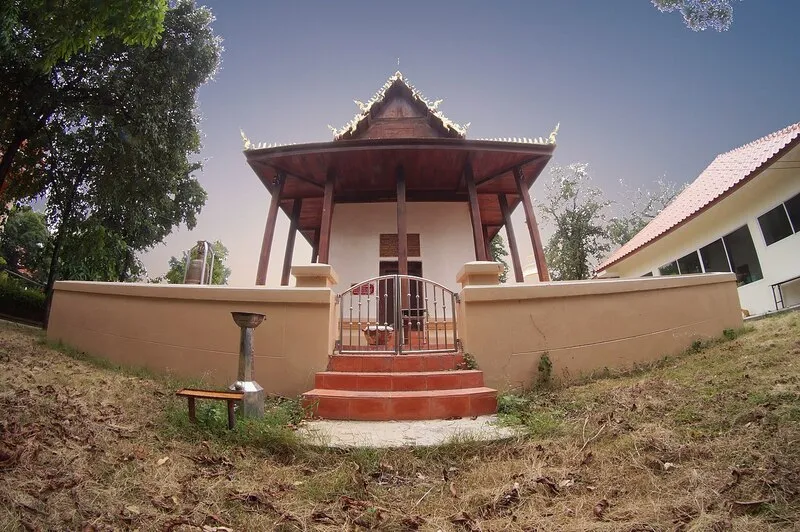
Wat Sam Chuk
Open Days: Daily
Opening Hours: 09.00 – 18.00
Wat Sam Chuk in Suphan Buri Province is an old Buddhist temple located at No. 3, Moo 1, Sam Chuk Subdistrict, Sam Chuk District. Covering about 20 rai, the temple lies approximately 34 kilometers north of Suphan Buri town and about 600 meters from the Suphan Buri-Chai Nat road. Although Sam Chuk is widely known for its famous 100-year-old market, Wat Sam Chuk is an important cultural and spiritual landmark that reveals the religious heritage of the community. The temple is especially meaningful for visitors interested in old temples, Buddhist art, registered antiquities, community museums, and the cultural landscape of Sam Chuk.
The exact founding date of Wat Sam Chuk is not clearly recorded, but several important objects indicate that it is an old temple with a long history. The most significant evidence is the replica Buddha footprint enshrined inside a mondop. This Buddha footprint has been registered as an antiquity by the Fine Arts Department, making it one of the temple’s most important cultural treasures. In Thai Buddhist tradition, a Buddha footprint represents the presence, path, and teaching of the Buddha. It is not merely a physical object for worship, but a symbol of spiritual remembrance.
Wat Sam Chuk should be visited together with Sam Chuk 100-Year Market for a fuller understanding of the district. The market represents commerce, wooden shop houses, riverside food culture, and old community life. The temple represents faith, sacred objects, Buddhist art, and memory. Together, the two places show how Thai communities traditionally developed around both temples and markets. A visit to Wat Sam Chuk therefore adds depth to a trip that might otherwise focus only on food and shopping.
Historically, the temple has served as a spiritual center for local residents. Thai temples often function not only as places for religious ceremonies, but also as community centers, schools of moral learning, repositories of local objects, and gathering places for important events. Wat Sam Chuk continues this role through its worship areas, old Buddha images, antiquities, and community museum. The temple preserves a quieter side of Sam Chuk that complements the lively atmosphere of the market.
The mondop housing the replica Buddha footprint is one of the first areas visitors should see. A mondop is a sacred structure often built to enshrine an important religious object. At Wat Sam Chuk, the Buddha footprint inside the mondop is especially important because of its antiquity status. Visitors should approach this area with respect, avoid touching old objects without permission, and spend time observing the setting carefully. This is one of the key places that explains why Wat Sam Chuk is historically significant.
A sandstone Buddha image from the Ayutthaya period was once enshrined in the mondop. It has since been restored and moved to serve as the principal Buddha image on the sermon hall. This image reflects the long history of Buddhist art in central Thailand. Sandstone Buddha images are valued for their age, material, and connection with older artistic traditions. By placing the restored image as the principal Buddha in the sermon hall, the temple makes it accessible for worship while preserving its historical meaning.
The sermon hall is therefore another important area inside Wat Sam Chuk. In Thai temples, sermon halls are used for listening to Dhamma teachings, merit-making ceremonies, community activities, and religious gatherings. With an Ayutthaya-period sandstone Buddha image installed as the principal Buddha, the sermon hall of Wat Sam Chuk combines living religious practice with the preservation of old Buddhist art.
Another distinctive feature of the temple is a pair of bronze hong figures. These figures once stood in front of the mondop. Today, one is kept at the chanting hall, while the other is kept at the museum kuti. In Thai and Buddhist art, the hong, often associated with a celestial swan or mythical bird, can symbolize grace, purity, auspiciousness, and refinement. The bronze pair adds artistic and symbolic value to the temple and reflects the care with which the community has preserved its old objects.
The chanting hall houses Luang Pho Thammachak, a Buddha image from the U Thong period. This image has long been revered by local residents and is regarded as one of the temple’s most sacred objects. U Thong-style Buddha images are known for their strong, dignified form and their importance in the development of central Thai Buddhist art. For worshippers, Luang Pho Thammachak is a sacred image for merit-making and blessings. For cultural travelers, it is an important object for understanding the artistic heritage of Suphan Buri.
The name “Thammachak” refers to the Dhamma Wheel, a symbol of the Buddha’s teaching and the turning of the wheel of truth. Paying respect to Luang Pho Thammachak is therefore not only an act of devotion, but also a reminder of Buddhist teaching and moral conduct. For the people of Sam Chuk, the image has long been part of the temple’s identity and collective faith.
Wat Sam Chuk also has a community museum known as the Wat Sam Chuk Museum. It preserves and displays old objects connected with the temple and local community. Items may include rare antiques, bronze hong figures, old weapons, Buddha images, carved wooden doors, and objects that reflect local life. The museum gives the temple an educational role beyond worship. It allows visitors to understand Sam Chuk through objects, memory, and community preservation.
The presence of a museum inside the temple reflects an important role of Thai temples as guardians of local heritage. Many temples in Thailand preserve more than sacred images. They also hold tools, household objects, documents, photographs, and cultural items from earlier generations. Wat Sam Chuk Museum helps younger people and travelers see how local history can be preserved within an active religious space.
For travelers visiting Sam Chuk 100-Year Market, the temple offers a valuable extension of the experience. The market is lively, colorful, and full of food, shops, and wooden architecture. The temple is quieter and more reflective. Visiting both places allows travelers to experience the complete identity of Sam Chuk: trade, food, old houses, Buddhism, antiquities, and community memory.
The charm of Wat Sam Chuk lies in its simplicity and authenticity. It is not a massive temple complex dominated by new monumental structures. Instead, it is meaningful because of its old objects, sacred images, community museum, and connection with the local way of life. Visitors who enjoy old temples and cultural details should walk slowly and observe the temple carefully. Many of its most important features are quiet rather than spectacular.
The temple’s location makes it easy to include in a wider itinerary. Nearby destinations include Sam Chuk 100-Year Market, Si Prachan Old Market, Wat Lat Singh, Don Chedi Monument, and Buffalo Village Suphan Buri. Travelers can plan a half-day or full-day cultural route around Sam Chuk and nearby districts. Starting with Wat Sam Chuk and the market is a good way to understand the district before continuing to historical or rural attractions.
Visitors interested in local history should see Wat Sam Chuk as part of the broader Sam Chuk community. Sam Chuk is an old district along the Tha Chin River, known for its market, wooden houses, local food, and long-standing community life. Wat Sam Chuk is one of the religious anchors of this setting. It shows the spiritual side of a community better known to many visitors through its market.
From an art-historical point of view, the temple is important because it preserves objects from different periods, including an Ayutthaya-period sandstone Buddha image and Luang Pho Thammachak in U Thong style. These objects help visitors understand that Suphan Buri has a long Buddhist and artistic history. The province was not only a place of later markets and modern communities, but also part of an older cultural landscape connected with Ayutthaya and earlier central Thai traditions.
Wat Sam Chuk is also suitable for families, students, and cultural learners. The temple, museum, and nearby market create a practical learning route. Children and young visitors can see real objects rather than only reading about them. They can learn that history is preserved not only in national museums, but also in local temples where communities care for old objects over generations.
A normal visit to Wat Sam Chuk may take about 45 minutes to 1.5 hours. Visitors who only wish to pay respect to the Buddha footprint, the sandstone principal Buddha, Luang Pho Thammachak, and the bronze hong figures may need less than an hour. Those who want to spend time in the museum and learn about the objects should allow more time. Visitors interested in the museum should contact the temple in advance when possible.
The best time to visit is in the morning or afternoon, when the weather is more comfortable and it is easy to combine the temple with Sam Chuk 100-Year Market. Weekdays are quieter, while weekends provide a livelier market atmosphere. Visitors should dress modestly, speak quietly in worship areas, avoid touching old objects without permission, and help keep the temple clean.
Getting there is easiest by private car. From Suphan Buri town, drive north along the Suphan Buri-Chai Nat route toward Sam Chuk District. The temple is about 34 kilometers from Suphan Buri town and around 600 meters from the main road. From Bangkok, travelers can use the Bang Bua Thong-Suphan Buri route or the Nakhon Pathom-Suphan Buri route, then continue toward Sam Chuk.
Travelers without a private car can first reach Suphan Buri town or Sam Chuk Market, then continue by local transport or hired vehicle. Because the temple is close to the market and the main road, access is not difficult. However, private transport is more convenient for combining Wat Sam Chuk with Wat Lat Singh, Don Chedi Monument, Wat Ban Krang, and Si Prachan Old Market.
For foreign travelers, Wat Sam Chuk offers a clear example of how Thai local temples preserve both religion and community memory. A visit here helps explain that Thai communities are shaped not only by markets and food culture, but also by temples that preserve sacred objects, old Buddha images, and local museums. Foreign visitors who come to Sam Chuk 100-Year Market should consider stopping at Wat Sam Chuk to understand the area more completely.
In summary, Wat Sam Chuk is an important old temple in Sam Chuk District, Suphan Buri Province. Its highlights include the registered replica Buddha footprint, an Ayutthaya-period sandstone Buddha image restored as the principal Buddha on the sermon hall, a pair of bronze hong figures, Luang Pho Thammachak in U Thong style, and the Wat Sam Chuk Museum. For travelers seeking a deeper cultural experience beyond the famous market, Wat Sam Chuk is a meaningful place to include in a Suphan Buri itinerary.
| Name | Wat Sam Chuk |
| Location | No. 3, Moo 1, Sam Chuk Subdistrict, Sam Chuk District, Suphan Buri Province 72130, Thailand |
| Area | About 20 Rai |
| Highlights | Registered replica Buddha footprint, Ayutthaya-period sandstone Buddha image, Luang Pho Thammachak in U Thong style, bronze hong pair, and Wat Sam Chuk Museum |
| History | An old temple with no clearly recorded founding date. Its antiquity is reflected through the replica Buddha footprint, Ayutthaya-period sandstone Buddha image, and U Thong-style Luang Pho Thammachak. |
| Distinctive Features | An old community temple in Sam Chuk with sacred objects, registered antiquities, a local museum, and a strong connection with Sam Chuk 100-Year Market |
| Important Objects And Areas | Buddha-footprint mondop, sermon hall, Ayutthaya-period sandstone Buddha image, Luang Pho Thammachak, chanting hall, bronze hong figures, museum kuti, and Wat Sam Chuk Museum |
| Travel Information | From Suphan Buri town, drive north along the Suphan Buri-Chai Nat route toward Sam Chuk District. The temple is about 34 km from town and around 600 meters from the main road. |
| Current Status | Open for merit-making, worship, paying respect to Luang Pho Thammachak, visiting the Buddha footprint, and learning about old objects during opening hours |
| Open Days | Daily |
| Opening Hours | 09.00 – 18.00 |
| Fees | No Admission Fee |
| Facilities | Parking area, worship areas, sermon hall, chanting hall, mondop, Wat Sam Chuk Museum, merit-making areas, and walking areas inside the temple |
| Main Areas / Zones | Buddha-Footprint Mondop Zone Sermon Hall And Ayutthaya Sandstone Buddha Zone Chanting Hall And Luang Pho Thammachak Zone Bronze Hong Figure Zone Museum Kuti And Wat Sam Chuk Museum Zone Buddhist Worship And Merit-Making Zone |
| Abbot / Caretaker | Phra Khru Suwan Wichit Somchitto |
| Main Contact Number | 035-571-108, 089-000-8462 |
| Nearby Tourist Attractions | 1. Sam Chuk 100-Year Market, about 1 km 2. Si Prachan Old Market, about 13 km 3. Wat Lat Singh, about 18 km 4. Don Chedi Monument, about 20 km 5. Buffalo Village Suphan Buri, about 24 km |
| Nearby Restaurants | 1. Local Restaurants In Sam Chuk 100-Year Market, about 1 km 2. Kuai Tiao Yam Khai In Sam Chuk Market, about 1 km 3. Udom Chok Coffee In Sam Chuk Market, about 1 km 4. Kung Pen Sam Chuk, about 3 km 5. Local Restaurants In Sam Chuk District, about 1–3 km |
| Nearby Accommodations | 1. Happy Motel Sam Chuk, about 2 km, Tel. 062-424-5323, 035-504-211 2. Punpisa Resort, about 3 km 3. Grand Bronze Resort, about 4 km 4. Accommodations Around Sam Chuk 100-Year Market, about 1–3 km 5. Hotels And Resorts In Suphan Buri Town, about 34 km |
Frequently Asked Questions (FAQ)
Q: Where is Wat Sam Chuk located?
A: Wat Sam Chuk is located at No. 3, Moo 1, Sam Chuk Subdistrict, Sam Chuk District, Suphan Buri Province, about 34 km north of Suphan Buri town and around 600 meters from the Suphan Buri-Chai Nat road.
Q: What is Wat Sam Chuk famous for?
A: The temple is known for its registered replica Buddha footprint, Ayutthaya-period sandstone Buddha image, Luang Pho Thammachak in U Thong style, bronze hong pair, and Wat Sam Chuk Museum.
Q: Why is the replica Buddha footprint important?
A: The replica Buddha footprint is an important sign of the temple’s antiquity and has been registered as an antiquity by the Fine Arts Department.
Q: What type of Buddha image is Luang Pho Thammachak?
A: Luang Pho Thammachak is a Buddha image in U Thong style. It is enshrined in the chanting hall and has long been revered by local residents.
Q: Does Wat Sam Chuk have a museum?
A: Yes. Wat Sam Chuk has a museum displaying old objects, Buddha images, bronze hong figures, old weapons, carved wooden doors, and community heritage items.
Q: What are the opening hours of Wat Sam Chuk?
A: Wat Sam Chuk is open daily from 09.00 to 18.00.
Q: Is there an admission fee for Wat Sam Chuk?
A: No. Wat Sam Chuk does not charge an admission fee for general visits.
Q: What nearby attractions can be visited with Wat Sam Chuk?
A: Nearby attractions include Sam Chuk 100-Year Market, Si Prachan Old Market, Wat Lat Singh, Don Chedi Monument, and Buffalo Village Suphan Buri.
Tel : 035571791, 035572755
 Tel : 035571791, 035572755
 Category: ●Places of Worship
 Group: ●Temple
Last Update : 5 MonthAgo
 Last Update : 5 MonthAgo
 Click to Access the Navigation Map GPS
 Art, Culture and Heritage
 Historical Sites and Monuments(2)
 Landmarks and Memorials(4)
 Art, Craft Centres, Tradition(2)
 Museums(5)
 Educational Places
 Educational Gardens, Farm(4)
 Training Center(2)
Temple(36)
Training Center(2)
Temple(36)
 Other Sacred Sites(4)
 Suburban Living
 Village, Community(6)
 Local Market(7)
 Floating Market(1)
 Nature and Wildlife
 National Parks and Marine Reserves(4)
 Mountain (Doi)(2)
 Dam, Reservoir, Lake(3)
 Caves(1)
 Bays and Beaches(1)
 Entertainment and Agricultural
 Farms, Parks and Ecotourism(6)
 Theater(1)
 Travel Articles, Recipes
 Travel Review, Food Review(1)


