
lovethailand home >Central Travel Attractions >Sing Buri Travel Attractions >Muang Sing Buri >Bang Krabue > Wat Sa-at Rat Bamrung
TL;DR: Wat Sa-at Rat Bamrung is located at Moo 4, Ban Lat Khao, formerly Ban Huai Salot, Bang Krabue Subdistrict, Mueang Sing Buri District, Sing Buri Province, open Daily, hours Daytime Visits Are Recommended.
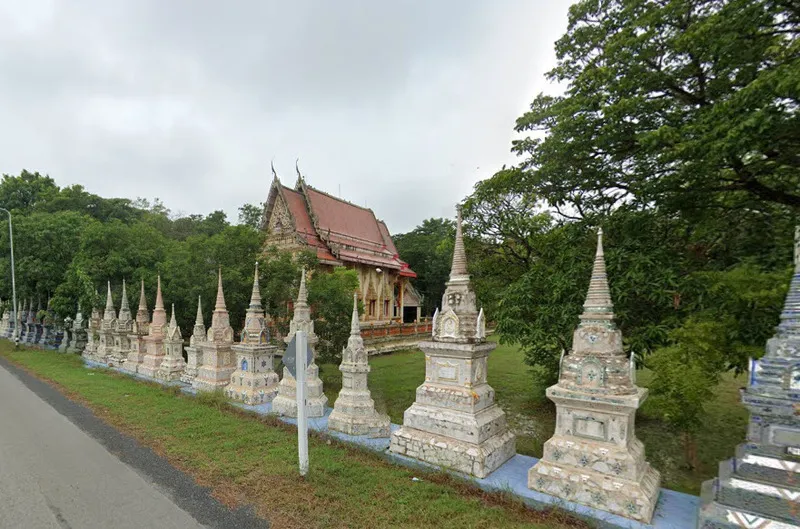
Wat Sa-at Rat Bamrung
Open Days: Daily
Opening Hours: Daytime Visits Are Recommended
Wat Sa-at Rat Bamrung in Sing Buri Province is a local Buddhist temple in Moo 4, Bang Krabue Subdistrict, Mueang Sing Buri District. The temple is closely connected with the community formerly known as Ban Huai Salot, now officially called Ban Lat Khao. Its history reflects the strong faith of local villagers who wanted a temple of their own for merit-making, almsgiving, Buddhist ceremonies, and community gatherings. Before the temple was established, villagers had to travel to Wat Sathit Watthanaram or other nearby temples on Buddhist holy days. Later, they began gathering for merit-making under a large Bodhi tree and in an old school building, and this local faith eventually developed into Wat Sa-at Rat Bamrung.
The temple is meaningful because it was not created as a grand royal project or a major tourist monument. It grew from the real needs of villagers. In the early years, the land in the present temple area was agricultural land, and the community did not yet have a permanent temple. The old school building, built on land donated to the government by Nai Thiap Taraketu for educational purposes, became a temporary place for religious gatherings. This close connection between school, village, and temple shows how Thai rural communities often built their social life around shared spaces of learning, faith, and cooperation.
At the beginning, the villagers named the temple Wat Sa-at Rat Bamrung and invited Phra Pan Dhammakamo, a monk from Wat Thammachak in Thap Ya Subdistrict, In Buri District, Sing Buri Province, to stay and support the religious life of the new community. Although his first stay was brief, inviting a monk to reside in the village was a crucial step. It meant the community could begin organizing Buddhist rituals, merit-making, and local religious activities more regularly. This early stage shows how the temple began with simplicity but with strong shared intention.
When construction began, the site had to be inspected by senior monastic authorities. On Wednesday, 30 April 1958, corresponding to the 12th waxing moon of the 6th lunar month, Phra Khru Uthai Phorarat, the district ecclesiastical chief from Wat Pho Kaeo Nopphakhun, together with Luang Pho Fung Uttama, a respected elder monk and abbot of Wat Sadao in Mae La Subdistrict, Bang Rachan District, came to inspect the construction site. They explained that a temple could not be built on land belonging to a school, although a school could be built on temple land. This temporarily halted the villagers’ hope of establishing the temple at the original location.
The community’s faith, however, did not fade. Nai Muan Meesa-at and Nang Thurian Meesa-at, who owned land in the present temple area, donated more than 6 rai of land for the construction of the temple. This act of generosity became the decisive turning point in the history of Wat Sa-at Rat Bamrung. Phra Khru Uthai Phorarat and Luang Pho Fung Uttama presided over the first boundary marking, and Phra Pan Dhammakamo was invited to return and stay as before. From that point onward, the people of Moo 4, Bang Krabue Subdistrict, had their own temple for Buddhist practice and community ceremonies.
The temple’s name preserves the memory of local generosity. At one stage, it was referred to as Wat Meesa-at Rat Bamrung, honoring the Meesa-at family who donated land and materials for the early monastic residence. The word “sa-at” means clean or pure, but in this context it also evokes sincerity and good intention. The phrase “rat bamrung” suggests that the people themselves supported and nourished the temple. The name therefore reflects both gratitude and community identity. It is a temple born from local devotion.
Local history records that the temple was permitted as a temple on 16 February 1960, while ecclesiastical registration information records its formal establishment on 17 September 1970 and the granting of Wisungkhamsima in 1987. These dates show different layers of the temple’s development: the villagers’ beginning, the local religious use of the site, and later formal ecclesiastical recognition. Together, they help explain how a community temple can grow gradually from faith into an officially recognized Buddhist institution.
The most important sacred image associated with Wat Sa-at Rat Bamrung is Luang Pho Phet, a revered Buddha image respected by local villagers. Luang Pho Phet is the spiritual center of the temple and the focus of worship for people in Ban Lat Khao and nearby communities. Devotees come to pay respect, make merit, and ask for blessings for peace, stability, family well-being, and success in life. In Thai community temples, a sacred Buddha image is more than a statue. It is a center of shared memory, prayer, gratitude, and hope across generations.
Visitors who come to pay respect to Luang Pho Phet should do so calmly and respectfully. Dress modestly, remove shoes before entering sacred areas, speak softly, and avoid touching sacred objects unless clearly permitted. Wat Sa-at Rat Bamrung is a local temple, not a commercialized tourist attraction. Its value lies in its peaceful atmosphere and its role in daily community faith. Travelers who take time to observe quietly will better understand the relationship between the temple, the villagers, and the sacred image.
Wat Sa-at Rat Bamrung is especially meaningful for travelers who want to understand community temples in central Thailand. The temple was built because villagers needed a nearby place for Buddhist holy day merit-making. It was shaped by the generosity of land donors, the guidance of elder monks, the service of resident monks, and the continuing support of local people. This makes the temple an excellent example of how Buddhism is sustained at village level, not only in famous royal temples or large historical monuments.
Main areas inside the temple include the ordination hall, the area for paying respect to Luang Pho Phet, the sermon hall, monks’ residences, community activity spaces, and the temple courtyard used for annual merit-making events. The temple is not arranged as a large museum or exhibition site. It is a living religious space used by villagers, monks, schoolchildren, and local families. Visitors should therefore treat it as an active temple and respect the rhythm of community life.
The temple is also closely connected with Wat Sa-at Rat Bamrung School and the community of Moo 4. This relationship reflects a common pattern in Thai village culture, where the temple and school often support each other. The school provides formal education, while the temple supports moral learning, Buddhist ceremonies, and community identity. This connection helps younger generations understand local history and maintain ties with Buddhist traditions.
Public information identifies Phra Khru Phatthara Thammakoson as the monk associated with Wat Sa-at Rat Bamrung, and a public contact number for the temple is available. Visitors who wish to attend annual ceremonies, Kathin, Pha Pa, or other temple events should contact the temple in advance. This is especially useful because temple schedules often follow the Buddhist lunar calendar and local community arrangements.
For travelers exploring Sing Buri, Wat Sa-at Rat Bamrung can be combined with other nearby temples in Bang Krabue and Mueang Sing Buri District. A cultural route may include Wat Budda, Wat Sathit Watthanaram, Wat Pho Langka, Wat Sawang Arom and its Nang Yai Museum, Sing Buri City Pillar Shrine, and Wat Phra Non Chakkrasi Worawihan. This route gives visitors a broader view of Sing Buri through meditation temples, riverside community temples, local sacred images, traditional shadow puppetry, and major Buddhist landmarks.
Getting There by private car is convenient. From the Sing Buri City Pillar Shrine intersection, take the Bang Rachan road and pass the traffic-light intersection. Continue straight past Wat Budda. When reaching the roadside rest pavilion, turn right and drive straight for about 3 km to reach Wat Sa-at Rat Bamrung in Moo 4, Bang Krabue Subdistrict. This route is suitable for travelers who want to visit several temples in Bang Krabue on the same day.
The best time to visit is during daylight hours, especially in the morning or afternoon. During the rainy season, visitors should check local road conditions before traveling because some routes in rural areas may be affected by rain. Weekdays are suitable for a quiet visit, while Buddhist holy days and temple events allow visitors to see the community’s religious life more actively.
Proper temple etiquette is important. Visitors should dress modestly, covering shoulders and knees, remove shoes before entering sacred buildings, speak quietly, avoid entering monks’ private areas without permission, and avoid photographing monks or local worshippers without consent. Donations should be made through official temple channels or by asking temple caretakers politely.
Photography should also be done respectfully. Suitable subjects include the ordination hall, the worship area of Luang Pho Phet, the sermon hall, the temple courtyard, trees, and the village atmosphere around Ban Lat Khao. Public captions should present the temple as a place of local faith and community history rather than as a casual photo backdrop.
Overall, Wat Sa-at Rat Bamrung is an important local temple in Bang Krabue Subdistrict. Its value lies in its origin from village faith, its connection with Ban Huai Salot or present-day Ban Lat Khao, the generosity of the Meesa-at family, the early role of Phra Pan Dhammakamo, and the continuing devotion to Luang Pho Phet. For foreign travelers seeking a sincere view of community Buddhism in central Thailand, this temple offers a quiet but meaningful cultural experience.
| Name | Wat Sa-at Rat Bamrung |
| Location | Moo 4, Ban Lat Khao, formerly Ban Huai Salot, Bang Krabue Subdistrict, Mueang Sing Buri District, Sing Buri Province |
| Address | Moo 4, Bang Krabue Subdistrict, Mueang Sing Buri District, Sing Buri 16000, Thailand |
| Highlights | Luang Pho Phet, the temple’s revered Buddha image; a community-built temple founded from local faith; and the historical connection between the temple, school, and Ban Lat Khao community |
| History | The villagers began creating the temple in 1958 after needing a local place for merit-making. The community first used a large Bodhi tree and an old school building. Later, Nai Muan and Nang Thurian Meesa-at donated more than 6 rai of land for the temple. Local history records permission as a temple on 16 February 1960, while ecclesiastical registration records formal establishment on 17 September 1970 |
| Distinctive Features | A local community temple created through the cooperation of villagers, land donors, senior monks, and early resident monks; a spiritual center of Moo 4, Bang Krabue Subdistrict |
| Main Areas / Zones | 1. Ordination Hall 2. Worship Area Of Luang Pho Phet 3. Sermon Hall And Community Merit-Making Area 4. Monks’ Residences And Monastic Area 5. Temple Courtyard And Annual Ceremony Area 6. Area Connected With Wat Sa-at Rat Bamrung School And Ban Lat Khao Community |
| Travel Information | From Sing Buri City Pillar Shrine intersection, take the Bang Rachan road, pass the traffic-light intersection and Wat Budda, continue to the roadside rest pavilion, turn right, and drive straight for about 3 km |
| Current Status | Open as a local Buddhist temple under the Mahanikaya order and used for community religious activities |
| Open Days | Daily |
| Recommended Visiting Time | Daytime, especially morning to afternoon |
| Fees | No admission fee; visitors may make merit according to personal faith |
| Abbot / Caretaker | Phra Khru Phatthara Thammakoson |
| Main Contact Number | 036-524-342 Wat Sa-at Rat Bamrung School: 036-522-223 |
| Official Website / Official Page | Local Information: Bang Krabue Subdistrict Administrative Organization School Information: Wat Sa-at Rat Bamrung School, Sing Buri Primary Educational Service Area Office |
| Nearby Tourist Attractions | 1. Wat Budda, about 3 km 2. Wat Sathit Watthanaram, about 5 km 3. Wat Pho Langka, about 6 km 4. Sing Buri City Pillar Shrine, about 7 km 5. Wat Sawang Arom And Nang Yai Museum, about 8 km 6. Wat Phra Non Chakkrasi Worawihan, about 10 km |
| Nearby Restaurants | 1. Pad Thai Bang Mon, about 8 km, Tel. 062-329-3531 2. Lueat Mu Hia Lek, about 8 km, Tel. 083-963-6577, 081-293-5861 3. Kuai Tiao Ruea Soda (Chama Kala), about 10 km, Tel. 097-951-9326 4. Khwai Art Sing Buri, about 10 km 5. Kanlaya Pla Chon Nam Tok, about 10 km |
| Nearby Accommodations | 1. Chaisaeng Villa Hotel, about 7 km 2. Baanbudsarin Apartment, about 7 km 3. Golden Dragon Resort, about 8 km 4. Heyday Singburi Hotel, about 9 km 5. Sumali Villa, about 10 km |
Frequently Asked Questions (FAQ)
Q: Where is Wat Sa-at Rat Bamrung located?
A: Wat Sa-at Rat Bamrung is located in Moo 4, Bang Krabue Subdistrict, Mueang Sing Buri District, Sing Buri Province, in the community now known as Ban Lat Khao.
Q: When was Wat Sa-at Rat Bamrung founded?
A: Local history records that villagers began creating the temple in 1958, while ecclesiastical registration records its formal establishment on 17 September 1970.
Q: What is Wat Sa-at Rat Bamrung known for?
A: The temple is known for Luang Pho Phet, its revered Buddha image, and for its history as a community temple created from the faith of villagers in Moo 4, Bang Krabue Subdistrict.
Q: Who donated the land for Wat Sa-at Rat Bamrung?
A: Nai Muan Meesa-at and Nang Thurian Meesa-at donated more than 6 rai of land for the temple’s construction.
Q: Who was the early monk invited to stay at the temple?
A: The villagers invited Phra Pan Dhammakamo from Wat Thammachak in Thap Ya Subdistrict, In Buri District, to stay during the early stage of the temple’s development.
Q: Is there an admission fee for Wat Sa-at Rat Bamrung?
A: No. There is no admission fee. Visitors may make merit according to personal faith.
Q: How can travelers get to Wat Sa-at Rat Bamrung?
A: From Sing Buri City Pillar Shrine intersection, take the Bang Rachan road, pass the traffic-light intersection and Wat Budda, continue to the roadside rest pavilion, turn right, and drive straight for about 3 km.
Q: What nearby attractions can be visited with Wat Sa-at Rat Bamrung?
A: Nearby attractions include Wat Budda, Wat Sathit Watthanaram, Wat Pho Langka, Sing Buri City Pillar Shrine, Wat Sawang Arom, and Wat Phra Non Chakkrasi Worawihan.
 Category: ●Places of Worship
 Group: ●Temple
Last Update : 3 MonthAgo
 Last Update : 3 MonthAgo
 Click to Access the Navigation Map GPS
 Art, Culture and Heritage
 Historical Sites and Monuments(4)
 Landmarks and Memorials(3)
 Art, Craft Centres, Tradition(3)
 Museums(1)
 Educational Places
 Library(1)
Temple(42)
Library(1)
Temple(42)
 Church(1)
 Other Sacred Sites(2)
 Research and Development
 Royal Project(3)
 Suburban Living
 Village, Community(1)
 Local Market(1)
 Nature and Wildlife
 National Parks and Marine Reserves(1)
 River, Canal(7)
 Bays and Beaches(1)
 Other natural attractions(2)
 Entertainment and Agricultural
 Animal camps and shows(1)
 Farms, Parks and Ecotourism(1)


