
lovethailand home >Central Travel Attractions >Sing Buri Travel Attractions >Tha Chang >Pho Prachak > Royal Mad Boat Wat Cham Pa Thong
TL;DR: Royal Mad Boat Wat Cham Pa Thong is located at Wat Champa Thong, Moo 5, Pho Prachak Subdistrict, Tha Chang District, Sing Buri Province, open Daily, hours Outdoor Temple Area Open All Day.
Royal Mad Boat Wat Cham Pa Thong
Open Days: Daily
Opening Hours: Outdoor Temple Area Open All Day
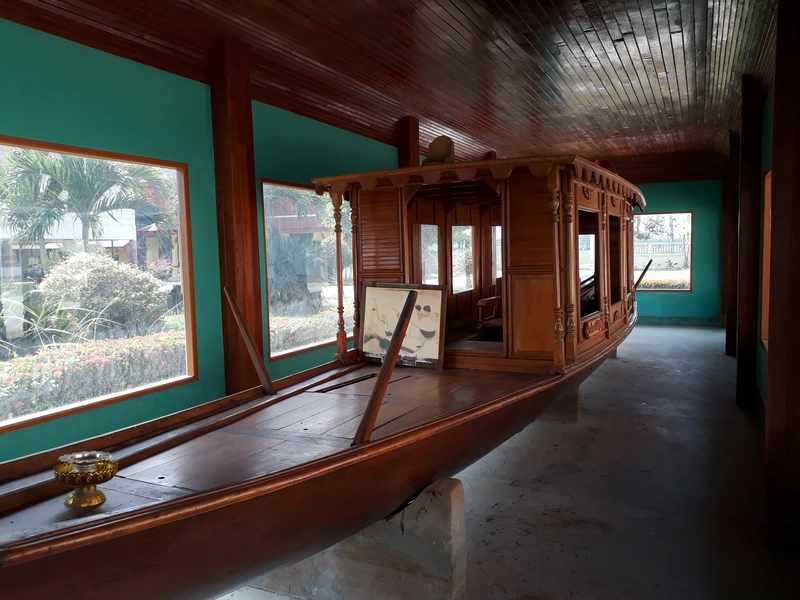
The Royal Mad Boat at Wat Champa Thong in Sing Buri is one of the most meaningful local historical objects in Tha Chang District. Preserved within Wat Champa Thong, Moo 5, Pho Prachak Subdistrict, this traditional covered rowing boat is closely connected with Thailand’s royal travel history along the Noi River. The boat is associated with King Chulalongkorn, Rama V, during his royal journey along the Noi River on 25 October R.S. 127, when he came to listen to a Mahachat sermon from the Chuchok chapter. It is also linked with King Vajiravudh, Rama VI, who visited the old capital region and stayed at Wat Champa Thong on 19 September 1916. Today, the Mad Boat at Wat Champa Thong is more than an old wooden vessel. It is a cultural witness to the relationship between the Thai monarchy, river travel, Buddhism, and local communities in Sing Buri.
Wat Champa Thong is a local Buddhist temple in Pho Prachak Subdistrict, Tha Chang District, Sing Buri Province. The temple is known for several important features, including the covered Mad Boat known as Ruea Champa Thong Sing Buri, a large reclining Buddha image in Rattanakosin style, and the calm atmosphere of a central Thai community temple. Its uniqueness lies in the way national history and local cultural memory meet in one place. The boat represents river travel, while the temple represents Buddhist devotion, merit-making, and community life.
Mad boats are traditional vessels strongly associated with the waterways of central Thailand. Before modern roads became dominant, rivers and canals were the main routes for travel, trade, religious events, and royal journeys. A Mad boat was usually strong, stable, and suitable for navigating natural rivers and smaller waterways. The boat preserved at Wat Champa Thong is a covered rowing boat, or ruea mat keng, and is known by the name Ruea Champa Thong Sing Buri. Its historical value comes not only from its age and craftsmanship, but also from its connection with royal visits along the Noi River.
The first major event that gives this boat its special meaning is its association with the royal journey of King Rama V along the Noi River on 25 October R.S. 127. During this visit, the king came to listen to a Mahachat sermon, specifically the Chuchok chapter. The Mahachat sermon is one of the most important Buddhist traditions in Thai society, especially in central Thailand, where temple communities have long gathered to listen to the story of Vessantara Jataka. Because of this connection, the Mad Boat at Wat Champa Thong should not be viewed merely as a means of transportation. It is part of a historical moment that links royal travel, Buddhist teaching, and local religious culture.
The Chuchok chapter is one of the most memorable parts of the Mahachat tradition. It carries moral lessons and vivid storytelling that have long made it familiar to Thai audiences. The fact that Wat Champa Thong is connected with this royal occasion gives the temple a deeper cultural dimension. It shows how Buddhist sermons, river journeys, and local temple life were interwoven in the social and spiritual landscape of central Thailand.
The boat is also connected with King Rama VI. On 19 September 1916, during his royal visit to the old capital region, King Rama VI stayed at Wat Champa Thong. This event reinforces the importance of the temple as a riverside resting point and a meaningful local site during royal travel. The visit reflects the role of temples not only as religious centers but also as important community spaces capable of welcoming significant official and ceremonial journeys.
The cultural value of the Mad Boat at Wat Champa Thong can be understood in several layers. Historically, it is connected with two Thai kings. Culturally, it reflects the importance of river travel in central Thailand before roads became the main transport network. Religiously, it is tied to the Mahachat sermon and Buddhist merit-making traditions. Locally, it remains part of the identity of Wat Champa Thong and the people of Pho Prachak Subdistrict.
For travelers interested in local history, this boat provides a clear example of the relationship between waterways and the royal court. The Noi River and its surrounding communities formed an important cultural landscape in Sing Buri and nearby provinces. A preserved royal-related boat inside a temple helps visitors understand that rivers were not only natural features. They were living routes of faith, administration, travel, commerce, and community memory.
Visitors to Wat Champa Thong should take time to observe the boat carefully. Its form as a covered rowing boat, its traditional character, and its setting inside the temple all help tell the story of central Thailand’s water-based culture. Seeing the boat as a cultural object allows visitors to understand why an old wooden vessel can carry such deep meaning. It connects the past with the present, local memory with royal history, and river culture with Buddhism.
Besides the historic boat, Wat Champa Thong is also home to a large reclining Buddha image in Rattanakosin style. The reclining Buddha is an important Buddhist artistic form associated with peace, reflection, and the final stage of the Buddha’s life. Visitors can also make merit, pay respect to sacred images, and experience the quiet rhythm of a local temple in Sing Buri.
The atmosphere of Wat Champa Thong is modest and peaceful. It is not a crowded tourist attraction, but it is well suited for travelers who appreciate meaningful heritage sites. The temple’s value lies in its preserved history, its link with river culture, and the way the local community continues to care for its religious and cultural inheritance. A visit here offers a deeper view of Sing Buri beyond the province’s larger temples and better-known landmarks.
Wat Champa Thong can be included in a cultural route around Sing Buri. Travelers can combine the visit with Wat Muang Chum, Wat Sai, Wat Phikun Thong, Wat Phra Non Chaksi Worawihan, and Bang Rachan Heroes Park. This route is suitable for visitors interested in Buddhism, royal history, local communities, and the historical landscape of central Thailand.
Getting There is most convenient by private car. From Sing Buri town, travel toward Tha Chang District and continue to Pho Prachak Subdistrict. The temple is located in Moo 5, and visitors can search for “Wat Champa Thong Sing Buri” on a navigation map. The distance from Sing Buri town is suitable for a day trip, and travelers from Bangkok can use the main highway to Sing Buri before continuing on local roads to Tha Chang District.
As Wat Champa Thong is an active Buddhist temple and a community space, visitors should dress respectfully, speak quietly, and avoid touching historical objects or the boat without permission. Photography should be done with consideration for religious activities and local visitors. The Mad Boat should be regarded as a cultural heritage object that deserves careful preservation for future generations.
In summary, the Mad Boat at Wat Champa Thong is a distinctive historical attraction in Sing Buri. It is ideal for travelers who want to follow royal river journeys, learn about traditional central Thai boats, and understand how temples preserved both faith and history. The boat makes history tangible: not just as text in a book, but as a living heritage object connected to a temple, a river, and the memory of the local community.
| Name | The Royal Mad Boat at Wat Champa Thong, Sing Buri |
| Location | Wat Champa Thong, Moo 5, Pho Prachak Subdistrict, Tha Chang District, Sing Buri Province |
| Address | Moo 5, Pho Prachak Subdistrict, Tha Chang District, Sing Buri 16140, Thailand |
| Coordinates | Q9VW+V9C, Pho Prachak Subdistrict, Tha Chang District, Sing Buri |
| Highlights | A historic covered Mad boat associated with King Rama V’s journey along the Noi River and King Rama VI’s visit to Wat Champa Thong |
| History | Connected with King Rama V’s visit on 25 October R.S. 127 to listen to a Mahachat sermon from the Chuchok chapter, and King Rama VI’s visit on 19 September 1916 during his royal tour of the old capital region |
| Name Origin | The name Ruea Champa Thong Sing Buri is associated with Wat Champa Thong and the local Champa Thong community in Pho Prachak Subdistrict |
| Distinctive Features | A covered rowing Mad boat reflecting traditional central Thai river travel and royal reception history |
| Important Features In The Temple | The Champa Thong Sing Buri Mad boat, a large Rattanakosin-style reclining Buddha image, and community religious areas |
| Travel Information | Travel by private car from Sing Buri town toward Tha Chang District, then continue to Pho Prachak Subdistrict. Search for “Wat Champa Thong Sing Buri” on a navigation map |
| Current Status | Active local Buddhist temple and historical learning site open for merit-making and appropriate visits |
| Open Days | Daily |
| Opening Hours | Outdoor Temple Area Open All Day |
| Fees | No Admission Fee |
| Facilities | Merit-making area, parking space inside the temple, and resting areas within the temple grounds |
| Main Areas / Zones | Mad boat preservation area, reclining Buddha area, viharn, ordination hall, sermon hall, and monastic zone |
| Official Website / Official Page | Wat Champa Thong Facebook Page @WatJampaThong16140 |
| Nearby Tourist Attractions | 1. Wat Muang Chum, about 5 km 2. Wat Sai, about 8 km 3. Wat Phikun Thong, about 11 km 4. Wat Phra Non Chaksi Worawihan, about 17 km 5. Bang Rachan Heroes Park, about 26 km |
| Nearby Restaurants | 1. Local Noi River Restaurants In Tha Chang District, about 3 km 2. Local Restaurants In Pho Prachak Subdistrict, about 3 km 3. Restaurants Near Wat Phikun Thong, about 11 km 4. Restaurants In Sing Buri Town, about 18 km 5. Restaurants Near Wat Phra Non Chaksi, about 17 km |
| Nearby Accommodations | 1. Accommodations In Tha Chang District, about 4 km 2. Accommodations Near Wat Phikun Thong, about 11 km 3. Accommodations Near Wat Phra Non Chaksi, about 17 km 4. Hotels In Sing Buri Town, about 18 km 5. Resorts Along The Sing Buri–Chai Nat Route, about 20 km |
Frequently Asked Questions (FAQ)
Q: Where is the Mad Boat at Wat Champa Thong located?
A: It is located inside Wat Champa Thong, Moo 5, Pho Prachak Subdistrict, Tha Chang District, Sing Buri Province.
Q: Why is the Mad Boat at Wat Champa Thong important?
A: It is historically linked with King Rama V’s royal journey along the Noi River and King Rama VI’s royal visit to Wat Champa Thong, making it significant in both royal and local history.
Q: What event connects King Rama V with Wat Champa Thong?
A: King Rama V visited the Noi River area on 25 October R.S. 127 to listen to a Mahachat sermon from the Chuchok chapter.
Q: How is King Rama VI connected with Wat Champa Thong?
A: King Rama VI visited the old capital region and stayed at Wat Champa Thong on 19 September 1916.
Q: What else can visitors see at Wat Champa Thong?
A: Visitors can see the historic Mad boat, a large Rattanakosin-style reclining Buddha image, and the temple’s community religious areas.
Q: Is there an admission fee?
A: No. Visitors can enter the temple for merit-making and appropriate sightseeing free of charge.
Q: What nearby places can be combined with a visit to Wat Champa Thong?
A: Nearby places include Wat Muang Chum, Wat Sai, Wat Phikun Thong, Wat Phra Non Chaksi Worawihan, and Bang Rachan Heroes Park.
 Category: ●Art, Culture and Heritage
 Group: ●Historical Sites and Monuments
Last Update : 4 MonthAgo
 Last Update : 4 MonthAgo
 Click to Access the Navigation Map GPS
Royal Mad Boat Wat Cham Pa Thong Map
 Historical Sites and Monuments(4)
 Landmarks and Memorials(3)
 Art, Craft Centres, Tradition(3)
 Museums(1)
 Educational Places
 Library(1)
 Places of Worship
 Temple(42)
 Church(1)
 Other Sacred Sites(2)
 Research and Development
 Royal Project(3)
 Suburban Living
 Village, Community(1)
 Local Market(1)
 Nature and Wildlife
 National Parks and Marine Reserves(1)
 River, Canal(7)
 Bays and Beaches(1)
 Other natural attractions(2)
 Entertainment and Agricultural
 Animal camps and shows(1)
 Farms, Parks and Ecotourism(1)


