
lovethailand home >Central Travel Attractions >Sing Buri Travel Attractions >Intha Buri >Intha Buri > Tempera Murals
TL;DR: Tempera Murals is located at Wat Muang, In Buri Subdistrict, In Buri District, Sing Buri Province, open Daily, hours 08.00 – 16.30.
Tempera Murals
Open Days: Daily
Opening Hours: 08.00 – 16.30
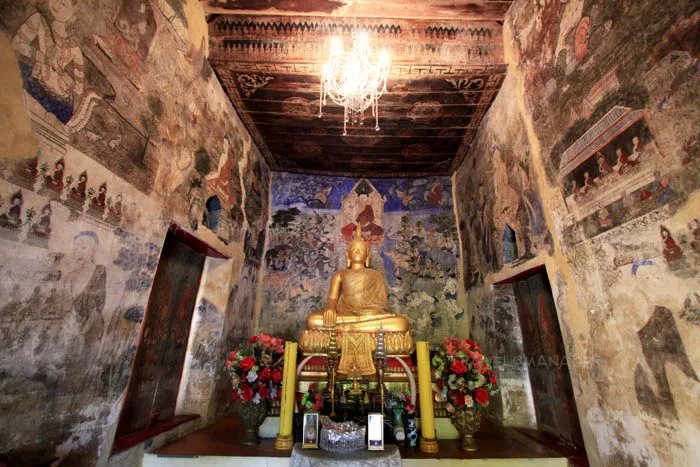
The Tempera Murals of Wat Muang in Sing Buri are among the most valuable local mural paintings in In Buri District. Wat Muang is located in In Buri Subdistrict, In Buri District, Sing Buri Province, on the eastern side of the Chao Phraya River. The temple was established around 1822 during the early Rattanakosin period. Its name comes from the old landscape of the area, where many large mango trees once grew around the temple. Local people therefore called it “Wat Muang,” a name connected with the Thai word for mango. The temple’s most important artistic feature is the old viharn, which houses a Buddha image in the posture of subduing Mara and contains mural paintings made with tempera-like powdered pigments. These paintings show at least two layers of repainting and do not follow one continuous narrative sequence, giving them a distinct character as local folk art.
Wat Muang is an old community temple in In Buri District, located not far from In Buri Market and the Asian Highway. It is not a large or crowded tourist attraction, but it is highly meaningful for visitors interested in Thai murals, local Buddhist art, early Rattanakosin culture, and riverside communities along the Chao Phraya River. The value of Wat Muang lies not only in its age, but also in its rare murals, which reflect folk craftsmanship, religious imagination, and cultural connections with Lao communities in the area.
The mural paintings inside the viharn are executed with powdered pigments over a prepared surface. Their composition reveals the hand of local craftsmen who did not strictly follow the refined conventions of royal court painting. A key feature is the visible layering of paintings created in more than one phase. The stories are not arranged as a single continuous sequence. Some scenes relate to the life of the Buddha, some express Buddhist moral ideas, and others reflect local ways of life and ancient social memory. This makes the murals an important source for understanding how local communities interpreted Buddhism through visual art.
The beauty of Wat Muang’s murals is not the formal perfection of court painting, but the direct and expressive quality of folk art. The lines, colors, and composition are free, lively, and deeply local. Some scenes appear independent rather than strictly connected to one another. This does not reduce their value. Instead, it reveals how the community used painting as a visual space for transmitting belief, memory, fear, hope, and Buddhist understanding in its own way.
Inside the viharn, the principal Buddha image forms the spiritual center of the space. The murals around the walls create a sacred visual environment. In the past, murals were not simply decoration. They served as visual teaching tools, helping people learn Buddhist stories and moral lessons through images. Visitors should therefore spend time looking carefully at the details, as each scene helps reveal both religious belief and social life in earlier times.
One of the most significant aspects of Wat Muang’s murals is the influence of Lao art and culture. Academic studies of the murals point to elements associated with folk craftsmanship and Lao artistic traditions, including the use of color, the arrangement of scenes, and the selection of certain themes. This connection corresponds with the local history of In Buri, where Lao communities from Vientiane settled in the central plains during the early Rattanakosin period. Wat Muang therefore offers a clear example of how mural painting can reflect migration, cultural memory, and community identity.
The establishment of Wat Muang around 1822 places the temple within the early Rattanakosin period, when riverside communities along the Chao Phraya River played important roles in religion, settlement, and travel. Temples at that time were not only places for rituals. They were centers of community learning, shared memory, and cultural expression. The murals of Wat Muang are therefore valuable historical evidence showing how a local temple functioned as a religious and cultural center.
The name Wat Muang comes from the many mango trees that once grew in the temple area. This local naming tradition reflects the close relationship between temples and their natural surroundings. Many Thai temples are named after trees, canals, ponds, fields, or other features of the local landscape. Over time, the name Wat Muang became the name of one of Sing Buri’s important mural sites.
The most important structure for visitors is the old viharn, where the murals are preserved. The viharn is significant both as a religious building and as a container of local artistic heritage. The temple also has an old chedi, which forms part of its historical landscape. Some buildings within the temple have been rebuilt or renovated in modern times, but the old viharn and its murals remain the heart of Wat Muang’s cultural value.
Visitors interested in art should observe the texture and tone of the powdered pigments. This traditional painting technique gives the murals a soft, aged, and natural appearance. The visible layers of repainting reveal the passage of time, later repairs, and the community’s effort to preserve or renew the images. These details make the paintings especially meaningful for those interested in conservation, art history, and local craftsmanship.
For visitors interested in Buddhist art, the murals of Wat Muang show how temple paintings communicated religious ideas to local communities. Scenes from the Buddha’s life explain key events in Buddhist tradition. Moral and meditation-related images remind viewers of impermanence and the nature of the human body. Social scenes preserve traces of old community life. Together, they make the murals valuable not only as art, but also as historical and anthropological evidence.
The atmosphere of Wat Muang is quiet and suitable for slow, respectful travel. Visitors should not rush. The real value of the site lies in gradually looking at the murals, reading the images, and understanding the sacred space of the viharn. The temple’s location in In Buri also offers a sense of an old riverside community, making it ideal for travelers who want to see a deeper side of Sing Buri beyond major temples and popular landmarks.
Wat Muang can be combined with other nearby attractions in In Buri District, such as Wat Sai, Wat Sadao, Wat Kradangnga Buppharam, In Buri National Museum, and Ban Khu Mueang Ancient City. This route is suitable for travelers who want to understand Sing Buri through Dvaravati heritage, riverside communities, old temples, and early Rattanakosin murals. Visiting these places together creates a richer and more connected view of the province.
Getting There is convenient by private car. From the Asian Highway, head toward In Buri District. Wat Muang is about 2.5 km south of In Buri Market and is located in In Buri Subdistrict, In Buri District, Sing Buri Province. Travelers can search for “Wat Muang Sing Buri” or “Wat Muang In Buri” on a navigation map. The temple is suitable as part of a one-day route through In Buri’s old temples and historical sites.
Visitors should remember that the murals are old and fragile. Do not touch the walls, avoid using flash photography at close range, do not lean against painted surfaces, and dress respectfully when entering the temple. The viharn is a sacred Buddhist space as well as an important art site, so visitors should keep a quiet and respectful manner.
In summary, the tempera murals of Wat Muang are among Sing Buri’s most meaningful artistic treasures. They combine the history of an old temple, the memory of Lao-related communities in In Buri, traditional powdered-pigment painting, Buddhist belief, and folk craftsmanship. Travelers interested in old temples, Thai murals, early Rattanakosin art, and Chao Phraya riverside history should include Wat Muang as an important stop in Sing Buri.
| Name | Tempera Murals Of Wat Muang, Sing Buri |
| Location | Wat Muang, In Buri Subdistrict, In Buri District, Sing Buri Province |
| Address | Rural Road 2006, In Buri Subdistrict, In Buri District, Sing Buri 16110, Thailand |
| Highlights | Old powdered-pigment murals inside the viharn, showing at least two layers of painting and reflecting local folk craftsmanship with Lao artistic influence |
| History | The temple was established around 1822 during the early Rattanakosin period and is one of In Buri’s old community temples |
| Name Origin | The name comes from the many large mango trees that once grew around the temple area |
| Distinctive Features | Powdered-pigment murals over a prepared surface, with non-continuous narrative scenes reflecting Buddhist belief, folk art, and ancient local life |
| Important Features In The Temple | Old viharn, Buddha image in the posture of subduing Mara, powdered-pigment murals, and old chedi |
| Travel Information | From the Asian Highway, enter In Buri District. The temple is about 2.5 km south of In Buri Market. Search for “Wat Muang Sing Buri” or “Wat Muang In Buri” on a navigation map |
| Current Status | Active local Buddhist temple and important mural art site in In Buri District |
| Open Days | Daily |
| Opening Hours | 08.00 – 16.30 |
| Fees | No Admission Fee |
| Facilities | Merit-making area, temple grounds, and parking area within the temple |
| Main Areas / Zones | Old viharn, ordination hall, old chedi, merit-making area, and monastic zone |
| Main Contact Number | Sing Buri Tourism Information, Tel. 0 3658 1662 |
| Nearby Tourist Attractions | 1. Wat Sai In Buri, about 8 km 2. Wat Sadao, about 8 km 3. Wat Kradangnga Buppharam, about 8 km 4. In Buri National Museum, about 9 km 5. Ban Khu Mueang Ancient City, about 19 km |
| Nearby Restaurants | 1. Pick Baan Cafe Sing Buri, about 1 km 2. Ariya’s Bakery In Buri, about 1 km 3. Som Tam Tid Air, about 1 km 4. Café Amazon PTT In Buri, about 1 km 5. Rim Nam Restaurant In Buri, about 2 km |
| Nearby Accommodations | 1. In In Resort, about 8 km 2. Route652 Resort Singburi, about 14 km 3. Ing Mae La Resort, about 17 km 4. Chaisaeng In The Park, about 22 km 5. Chaisaeng Palace Hotel, about 24 km |
Frequently Asked Questions (FAQ)
Q: Where are the murals of Wat Muang located?
A: The murals are located inside the old viharn of Wat Muang in In Buri Subdistrict, In Buri District, Sing Buri Province.
Q: When was Wat Muang established?
A: Wat Muang was established around 1822 during the early Rattanakosin period.
Q: Why is the temple called Wat Muang?
A: The name comes from the many large mango trees that once grew in the temple area.
Q: What makes Wat Muang’s murals special?
A: They are powdered-pigment murals over a prepared surface, showing at least two layers of painting and non-continuous narrative scenes that reflect local folk craftsmanship.
Q: What are the opening hours of Wat Muang?
A: Wat Muang is open daily from 08.00 to 16.30.
Q: Is there an admission fee?
A: No. Visitors can enter the temple and view the old viharn during opening hours free of charge.
Q: What should visitors be careful about when viewing the murals?
A: Visitors should not touch the walls, avoid using flash photography at close range, avoid leaning against painted surfaces, and dress respectfully inside the temple.
 Category: ●Art, Culture and Heritage
 Group: ●Historical Sites and Monuments
Last Update : 4 MonthAgo
 Last Update : 4 MonthAgo
 Click to Access the Navigation Map GPS
 Historical Sites and Monuments(4)
 Landmarks and Memorials(3)
 Art, Craft Centres, Tradition(3)
 Museums(1)
 Educational Places
 Library(1)
 Places of Worship
 Temple(42)
 Church(1)
 Other Sacred Sites(2)
 Research and Development
 Royal Project(3)
 Suburban Living
 Village, Community(1)
 Local Market(1)
 Nature and Wildlife
 National Parks and Marine Reserves(1)
 River, Canal(7)
 Bays and Beaches(1)
 Other natural attractions(2)
 Entertainment and Agricultural
 Animal camps and shows(1)
 Farms, Parks and Ecotourism(1)


