
lovethailand home >North Travel Attractions >Sukhothai Travel Attractions >Si Sat Chana Lai >Hat Sieow > Thai Phuan Elephant Ordination Procession
TL;DR: Thai Phuan Elephant Ordination Procession is located at Wat Hat Siao, Hat Siao Subdistrict, Si Satchanalai District, Sukhothai Province, open Held annually on April 7-8, hours Main activities take place throughout the day, with the elephant ordination.
Thai Phuan Elephant Ordination Procession
Open Days: Held annually on April 7-8
Opening Hours: Main activities take place throughout the day, with the elephant ordination procession usually held from daytime to afternoon; visitors should check the annual schedule before traveling
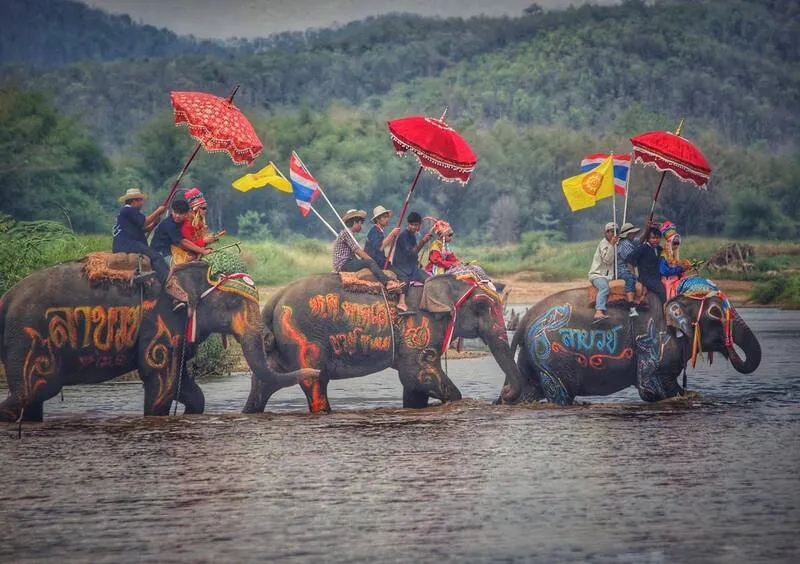
The Thai Phuan Elephant Ordination Procession of Ban Hat Siao, known locally as “Buat Chang,” is one of Sukhothai Province’s most distinctive living cultural traditions. Held every year on April 7-8 at Wat Hat Siao in Hat Siao Subdistrict, Si Satchanalai District, the festival combines Buddhist ordination, Thai Phuan ethnic identity, elephant symbolism, local dress, music, community cooperation, and beliefs inspired by the Vessantara Jataka. It is not simply a colorful parade. It is a powerful expression of faith, gratitude, family merit-making, and cultural memory among the Thai Phuan people of Ban Hat Siao.
The Elephant Ordination Procession of Ban Hat Siao is an annual Thai Phuan tradition held on April 7-8 at Wat Hat Siao, Si Satchanalai, Sukhothai. The highlight is the ordination candidate dressed as a “luk kaeo,” wearing colorful Thai Phuan clothing, jewelry, a ceremonial headdress, and dark sunglasses, then riding on the neck of a decorated elephant in a procession through the community before entering Buddhist ordination rites. The tradition has been practiced for more than 150 years and remains one of the most remarkable cultural festivals in northern Thailand.
Ban Hat Siao is a Thai Phuan community with a strong cultural identity. The Thai Phuan people in this area trace their ancestry to migrants from Mueang Phuan in Xiangkhouang, north of Vientiane in present-day Laos. After settling in Si Satchanalai, they continued to preserve their language, local customs, dress, rituals, weaving traditions, and community values. The Elephant Ordination Procession is therefore not only a family ordination event. It is a cultural marker that shows how the Thai Phuan community keeps its memory and identity alive.
The most distinctive feature of this tradition is the use of elephants in the ordination procession. In many parts of Thailand, ordination candidates may be carried in a procession, placed on a vehicle, or escorted by family members. At Ban Hat Siao, the candidate rides on an elephant, turning the event into a majestic and symbolic procession. This practice is connected to the Vessantara Jataka, especially the story of the noble elephant Paccaya Naga, the auspicious elephant associated with Prince Vessantara. The elephant symbolizes merit, abundance, rain, fertility, and royal virtue. Placing the ordination candidate on an elephant therefore elevates the act of ordination into an image of great merit and auspiciousness.
In Buddhist culture, ordination is one of the most meaningful acts in a family’s life. A son who enters the monkhood is understood to repay gratitude to parents, study the Dhamma, and bring merit to the family. In Ban Hat Siao, this personal act becomes a community celebration. Relatives, neighbors, temple members, musicians, local leaders, and visitors all become part of the event. The ordination candidate’s journey to the temple is not walked alone. It is carried by the faith and joy of the whole community.
The festival usually unfolds across 3 important stages: the preparation day, the elephant procession day, and the ordination day. The preparation day is known as “wan suk dip.” Families prepare the house, food, ceremonial objects, clothing, hospitality arrangements, and offerings. One important custom is “thiao ban,” in which relatives or community members visit homes to invite people to join the ordination merit-making. Those who go out for thiao ban traditionally dress in local clothing, reflecting respect, beauty, and the social etiquette of the Thai Phuan community.
The custom of thiao ban is more than a practical invitation. It is a social mechanism that connects households. By walking from house to house, the host family invites relatives and neighbors to become part of the merit-making. People then help according to their ability. Some prepare food, some assist with decorations, some help with the procession, and others welcome guests. In this way, one ordination becomes a shared responsibility and a shared joy for the community.
On the preparation day, there may also be a communal meal, music, entertainment, and celebration. Relatives returning from other places meet one another, elders speak with younger generations, and children observe how traditional ceremonies are prepared. This early stage is important because it shows that the festival does not exist only on the procession day. It begins with cooperation, hospitality, and the gradual gathering of the community around a family’s act of merit.
April 7 is the most visually striking day of the festival. It is the day of the elephant procession. In the morning, relatives help shave the head and eyebrows of the ordination candidate, bathe him, and dress him. He then receives precepts at a nearby temple before returning home to change from plain white clothing into the elaborate costume of a “luk kaeo.” The luk kaeo costume is one of the most recognizable features of the Hat Siao tradition. The candidate wears colorful Thai Phuan clothing, jewelry, facial decoration, dark sunglasses, and a ceremonial headdress known as a thoet.
The image of the luk kaeo is rich in symbolism. The candidate is about to leave lay life and enter the Buddhist monastic path. Dressing him beautifully honors the merit he is about to make and expresses the family’s joy. The brilliant colors, jewelry, headdress, and formal presentation also reveal the aesthetic sense of Thai Phuan culture, where ordination is not treated as a quiet private act alone but as a moment of dignity, celebration, and communal pride.
After being dressed as a luk kaeo, the candidate sits on the neck of a decorated elephant, holding incense and candles with hands pressed together. The elephant is adorned with colorful cloth and ceremonial decoration. The procession then moves from the host’s house toward Wat Hat Siao, accompanied by music, cheering, traditional dress, offerings, and the excitement of spectators along the route. The sight of a beautifully dressed ordination candidate riding on an elephant is the defining image of the festival and the reason this tradition has become widely known in Sukhothai and beyond.
The procession includes much more than the candidate and the elephant. Relatives carry ordination objects and offerings. Musicians provide rhythm and energy. Community members dress in Thai Phuan clothing. Friends, neighbors, and visitors line the streets to watch, bless, and take photographs. In some years, many elephants join the procession, creating a powerful and memorable scene. The streets of Ban Hat Siao become a living cultural stage where faith, family, ethnic identity, and celebration meet.
When the procession reaches Wat Hat Siao, the candidate descends from the elephant, pays respect to the spirit shrine inside the temple area, and enters the ordination-related Buddhist rites in the ubosot. After the initial rites, the processions of different candidates may gather into a larger community procession around the village before returning to their homes. This stage is filled with both devotion and festivity. People are not simply watching a show. They are joining in the merit of the ordination and expressing joy for every candidate and family involved.
April 8 is the ordination day, when the candidate formally enters Buddhist ordination. In Thai Phuan usage, a newly ordained monk may be called “chao sua,” while a novice may be called “chua ai.” These local terms are important because they preserve the language and cultural identity of the Thai Phuan community. They also show how Buddhist practice and ethnic tradition are woven together in everyday ritual life.
Wat Hat Siao plays a central role in the festival. Located at 51/2 Moo 2, Ban Hat Siao, Hat Siao Subdistrict, Si Satchanalai District, Sukhothai Province, the temple is the spiritual center of the Thai Phuan community. It is not only the place where ordination rites are performed. It is also the cultural stage where the community gathers, remembers, celebrates, and passes the tradition to younger generations.
The clothing of participants is another major part of the festival’s identity. Thai Phuan women often wear locally woven textiles, including the famous tin chok textiles of Ban Hat Siao. Men wear local or formal traditional clothing. These textiles are not merely decorative. They express ethnic identity, craft knowledge, and local pride. When the procession takes place, textiles, elephants, music, ordination, and community participation come together to form a complete image of Thai Phuan culture.
The festival also reflects a meaningful relationship between people and elephants. Elephants appear in the procession as auspicious animals and symbols of merit. At the same time, the presence of elephants requires careful management. Visitors should keep a respectful distance, avoid sudden movements, avoid flash photography near the elephants, and follow instructions from mahouts and event officials. Respect for the animals is an important part of attending the festival responsibly.
Socially, the festival strengthens the Thai Phuan community of Ban Hat Siao. Organizing the event requires cooperation from families, the temple, Hat Siao Municipality, local leaders, youth groups, musicians, weavers, cooks, vendors, and residents. Everyone has a role. The festival is therefore a process of community building. It keeps the tradition active because people do not merely remember it; they continue to organize, perform, support, and transmit it every year.
For cultural tourism in Sukhothai, the Elephant Ordination Procession is extremely valuable. Many travelers know Sukhothai through historical parks and ancient ruins. This festival reveals another side of the province: living culture. Visitors encounter real people, real faith, Thai Phuan language, handwoven textiles, music, elephants, and a ritual that still matters deeply to the community. It is one of the strongest examples of how Sukhothai’s heritage continues beyond archaeology.
For international travelers, the festival provides an exceptional introduction to Thai culture. It brings together Buddhism, filial gratitude, merit-making, Jataka belief, elephant symbolism, ethnic dress, temple ritual, and community cooperation. Watching the procession is not only about seeing a colorful parade. It is about understanding how a community transforms ordination into a public expression of identity, faith, and joy.
Visitors should plan ahead because April 7 attracts many spectators. Arriving early helps secure a safe viewing point along the procession route. Modest dress, comfortable shoes, drinking water, a hat, and sun protection are recommended. Visitors should avoid blocking the procession, entering restricted areas, or standing too close to elephants. Following the instructions of local officials, temple staff, and procession organizers helps keep the event safe and respectful.
Getting There is easiest by private car or rental car. From Si Satchanalai District, travel toward Hat Siao Subdistrict and Wat Hat Siao. Travelers coming from Sukhothai town can drive toward Si Satchanalai and continue to Ban Hat Siao. From Si Satchanalai Historical Park, the community can be reached within a relatively short drive. Visitors without private transport should arrange a hired vehicle or rental car in advance, especially during the festival when traffic and crowds increase.
The trip can be combined with several nearby cultural attractions, including Hat Siao community, Ban Hat Siao tin chok textile learning areas, the Thai Wisdom Learning Center or Suntree Thai Weaving Center, Si Satchanalai Historical Park, Wat Chang Lom, Wat Chedi Chet Thaeo, Wat Nang Phaya, and the Thuriang Kilns at Ban Ko Noi. This route gives travelers a complete experience of Si Satchanalai through ancient monuments, craft heritage, textiles, community life, and living traditions.
Local food and community products are also part of the experience. Visitors can try regional dishes such as khao perp, Sukhothai-style noodles, Thai Phuan local food, and local sweets. Handwoven Thai Phuan textiles and community products make meaningful souvenirs. Supporting local shops and artisans helps keep income within the community and gives cultural tourism a direct benefit for local people.
The Elephant Ordination Procession of Ban Hat Siao carries many layers of meaning. It is a family merit-making event, a communal gathering, a Thai Phuan identity marker, and a major cultural attraction of Sukhothai Province. Every element, from thiao ban and luk kaeo dressing to elephant riding, temple rites, ordination, and local terms such as chao sua and chua ai, gives the tradition a character that cannot be found elsewhere in the same form.
In conclusion, the Thai Phuan Elephant Ordination Procession of Ban Hat Siao is a living cultural heritage that expresses faith, gratitude, community unity, and ethnic identity. It shows how Buddhist ordination can be combined with Jataka belief, local dress, elephants, music, and community participation to create one of northern Thailand’s most memorable traditions. For travelers who want to understand Sukhothai as a living cultural landscape, not only as an ancient capital, this festival is one of the most meaningful experiences to witness.
| Name | Thai Phuan Elephant Ordination Procession of Ban Hat Siao |
| Local Name | Buat Chang / Elephant Ordination |
| Location | Wat Hat Siao, Hat Siao Subdistrict, Si Satchanalai District, Sukhothai Province |
| Address | Wat Hat Siao, 51/2 Moo 2, Ban Hat Siao, Hat Siao Subdistrict, Si Satchanalai District, Sukhothai 64130, Thailand |
| Festival Period | April 7-8 every year, with a preparation day before the procession and ordination rites following the procession according to community custom |
| Highlights | Ordination candidates dressed as luk kaeo in colorful Thai Phuan clothing, ceremonial headdresses, jewelry, dark sunglasses, and riding decorated elephants through Ban Hat Siao |
| History | A tradition of the Thai Phuan people of Ban Hat Siao, whose ancestors migrated from Mueang Phuan in Xiangkhouang, Laos, and have preserved the custom for more than 150 years |
| Belief Origin | Connected with the Vessantara Jataka and the auspicious elephant Paccaya Naga, symbolizing merit, abundance, rain, and prosperity |
| Distinctive Features | A Buddhist ordination tradition combining Thai Phuan belief, elephants, ethnic dress, music, temple rites, and strong community participation |
| Main Activities | Preparation day and thiao ban invitation custom, head and eyebrow shaving of the candidate, receiving precepts, dressing as luk kaeo, elephant procession, paying respect to the spirit shrine, entering the ubosot, and Buddhist ordination rites |
| Travel Information | Best reached by private car or rental car from Sukhothai town or Si Satchanalai District toward Hat Siao Subdistrict; visitors should allow extra travel time during the festival due to large crowds |
| Current Status | An annual Thai Phuan community tradition and one of Sukhothai Province’s important cultural festivals |
| Caretaker / Related Authorities | Wat Hat Siao, Hat Siao Municipality, the Thai Phuan community of Ban Hat Siao, and cultural and tourism agencies in Sukhothai Province |
| Main Contact Number | Hat Siao Municipality, Tel. 055-671-122 |
| Official Website / Official Page | Hat Siao Municipality / Hat Siao Subdistrict Municipality Official Page |
| Nearby Tourist Attractions | 1. Wat Hat Siao, about 0 km 2. Hat Siao Community, about 0.5 km 3. Thai Wisdom Learning Center / Suntree Thai Weaving Center, about 2 km 4. Ban Hat Siao Tin Chok Textile Learning Area, about 2 km 5. Si Satchanalai Historical Park, about 10 km 6. Wat Chang Lom, about 10 km 7. Thuriang Kilns at Ban Ko Noi, about 12 km |
| Nearby Restaurants | 1. Khao Perp Yai Khrueang, about 1 km 2. Ban Klang Na Restaurant Si Satchanalai, about 8 km, Tel. 081-441-6185 3. CSL Restaurant, about 4 km 4. Pa Song Restaurant, Si Satchanalai District, about 5 km 5. Local Restaurants in Hat Siao Community, about 0.5-2 km |
| Nearby Accommodations | 1. Chanalai Resort and Hotel, about 4 km, Tel. 055-672-555 2. Navy Sisatchanalai, about 4 km 3. Downhill Resort, about 5 km 4. Sisatchanalai Heritage Resort, about 8 km 5. Akara House Sukhothai, about 5 km 6. Nam Yom Resort, about 6 km |
Frequently Asked Questions (FAQ)
Q: Where is the Elephant Ordination Procession of Ban Hat Siao held?
A: It is held at Wat Hat Siao in Hat Siao Subdistrict, Si Satchanalai District, Sukhothai Province, the spiritual center of the Thai Phuan community of Ban Hat Siao.
Q: When is the festival held?
A: The festival is held annually on April 7-8. April 7 is the elephant procession day, and April 8 is the ordination day according to Buddhist rites.
Q: Why does the ordination candidate ride on an elephant?
A: The practice is connected with the Vessantara Jataka and the auspicious elephant Paccaya Naga, symbolizing merit, abundance, and prosperity.
Q: What does “luk kaeo” mean in this tradition?
A: Luk kaeo refers to the ordination candidate dressed in colorful Thai Phuan clothing, jewelry, a ceremonial headdress, and dark sunglasses before riding on the elephant in the procession.
Q: What are the main steps of the festival?
A: The main steps include the preparation day and thiao ban invitation custom, shaving the candidate’s head and eyebrows, receiving precepts, dressing as luk kaeo, the elephant procession, entering the ubosot, and Buddhist ordination rites.
Q: How should visitors prepare for the festival?
A: Visitors should arrive early, dress respectfully, wear comfortable shoes, bring drinking water, and follow local instructions, especially around elephants and procession routes.
Q: What nearby places can be visited together with the festival?
A: Nearby places include Hat Siao Community, Ban Hat Siao textile learning areas, Si Satchanalai Historical Park, Wat Chang Lom, and the Thuriang Kilns at Ban Ko Noi.
 Category: ●Art, Culture and Heritage
 Group: ●Art, Craft Centres, Tradition
Last Update : 5 MonthAgo
 Last Update : 5 MonthAgo
Recommend

 Historical Sites and Monuments(4)
 Landmarks and Memorials(5)
Art, Craft Centres, Tradition(11)
Landmarks and Memorials(5)
Art, Craft Centres, Tradition(11)
 Museums(5)
 Places of Worship
 Temple(40)
 Other Sacred Sites(10)
 Suburban Living
 Village, Community(3)
 Nature and Wildlife
 National Parks and Marine Reserves(3)
 Mountain (Doi)(2)
 Dam, Reservoir, Lake(4)
 Waterfalls(8)
 Caves(4)
 River, Canal(2)
 Entertainment and Agricultural
 Farms, Parks and Ecotourism(3)
 Travel Articles, Recipes
 Travel Review, Food Review(1)


