
lovethailand home >North Travel Attractions >Sukhothai Travel Attractions >Muang Sukhothai >Muang Kao > Ramkhamhaeng National Museum
TL;DR: Ramkhamhaeng National Museum is located at Charot Withi Thong Road, Mueang Kao Subdistrict, Mueang Sukhothai District, Sukhothai Province, open Daily, hours 09.00 – 16.00.
Ramkhamhaeng National Museum
Open Days: Daily
Opening Hours: 09.00 – 16.00
Ramkhamhaeng National Museum in Sukhothai Province is one of the most important museums for understanding the history, art, archaeology, and cultural identity of ancient Sukhothai. Located near Sukhothai Historical Park, the museum is an ideal starting point for travelers who want to understand the ancient capital before walking through its temples and ruins. Its exhibitions bring together archaeological objects, Buddhist sculptures, stucco fragments, inscriptions, Sangkhalok ceramics, ethnographic objects, and large outdoor displays, allowing visitors to see how Sukhothai developed as a city, a kingdom, an artistic center, and a key foundation of Thai culture.
The museum is named after King Ramkhamhaeng the Great, the celebrated ruler of Sukhothai in the early 19th Buddhist century. His name is closely associated with the historical memory of Sukhothai, including governance, trade, cultural identity, and the development of written language. Naming the museum after King Ramkhamhaeng gives the site a strong symbolic meaning: it is not simply a building that stores ancient objects, but a gateway to understanding one of the most influential periods in Thai history.
Ramkhamhaeng National Museum is especially useful for foreign travelers because it gives context to the ancient monuments of Sukhothai. Many visitors arrive at the historical park and admire the beauty of Wat Mahathat, Wat Si Sawai, Wat Sa Si, Wat Phra Phai Luang, and Wat Si Chum, but the museum helps explain the deeper meaning behind what they see. It shows how Buddhist art, Hindu imagery, inscriptions, ceramics, city planning, local communities, and religious beliefs were connected. After visiting the museum, the ruins of Sukhothai become easier to read and more meaningful.
The museum’s collection largely comes from archaeological surveys, excavations, and restoration work carried out at ancient monuments in old Sukhothai and nearby historical cities. Its displays also include objects from the lower northern region of Thailand, including areas associated with Phitsanulok, Kamphaeng Phet, Phichit, Uttaradit, Nakhon Sawan, Phetchabun, and Tak. This wider regional coverage is important because Sukhothai was not an isolated city. It was part of a broader network of communities, trade routes, religious movements, and artistic traditions that shaped the cultural landscape of mainland Southeast Asia.
A significant part of the museum’s collection was also transferred from the museum at Wat Ratchathani in Sukhothai. These objects had been preserved by Phra Boranawatthachan, also known as Phra Ratchaprasitthikhun, a former abbot of Wat Ratchathani and former ecclesiastical governor of Sukhothai Province. Moving these antiquities and art objects into a national museum allowed them to be properly preserved, studied, and displayed for the public. This history gives the museum an important role not only as a tourist attraction, but also as a national institution for cultural conservation.
The origin of the museum is closely tied to the work of the Fine Arts Department. Since 1953, the department had been surveying, excavating, and restoring ancient monuments in old Sukhothai, where a large number of antiquities were discovered. The Thai government recognized the need to establish a national museum in the ancient city area to preserve these cultural treasures and make them accessible for education. Construction took place between 1960 and 1963, using government funding together with public donations from the people of Sukhothai. The museum was officially opened on 25 January 1964.
The main museum building is a two-storey Thai applied-style structure designed to suit its role as a museum of archaeology, history, and art history. Inside, visitors encounter a chronological and thematic presentation of human settlement, religious belief, artistic development, and material culture. The displays include stone tools, bronze tools, beads, pottery, bronze drums, Buddhist images, Hindu images, inscriptions, Sangkhalok ceramics, weapons, and ethnographic objects. Together, these items show how the region gradually developed from early communities into a sophisticated urban and cultural center.
One of the first important sections presents the transition from forest communities to settled towns. This part introduces prehistoric archaeological materials such as stone tools, bronze tools, beads, pottery, and bronze drums. For foreign visitors, this section is helpful because it shows that the story of Sukhothai did not begin suddenly with kings and temples. It was built upon a long human presence, agricultural development, local knowledge, and social organization that existed before the rise of the Sukhothai Kingdom.
Another major exhibition section focuses on Buddhist and Hindu images from ancient city-states before Sukhothai. These works reflect the influence of Dvaravati art and Khmer art in Thailand from around the 12th to 18th Buddhist centuries. The objects include Buddhist images, lingams, yoni bases, and sacred sculptures connected with Brahmanical-Hindu traditions. This section is important because it helps visitors understand that Sukhothai developed from earlier cultural layers and gradually formed its own artistic identity by absorbing and transforming influences from surrounding regions.
The stucco sculpture section is one of the most visually engaging parts of the museum. It displays stucco fragments found at ancient monuments in old Sukhothai and Si Satchanalai, including motifs such as kala faces, deities, makara creatures, naga-related designs, and hermit figures. These objects once decorated temples, stupas, and religious buildings. Seen up close, they reveal details of costume, ornament, religious symbolism, and craftsmanship that are often difficult to appreciate when viewing ruins outdoors.
The section on Hindu images in Sukhothai adds another layer to the city’s cultural history. It presents sacred figures connected with Brahmanical-Hindu worship, including sculptures from San Ta Pha Daeng and metal images such as Shiva and Harihara associated with the Ho Thewalai Mahakaset area. These objects show that religious life in Sukhothai was complex and multi-layered. Buddhism was central, but Brahmanical-Hindu beliefs also played a role in ritual, symbolism, and royal culture.
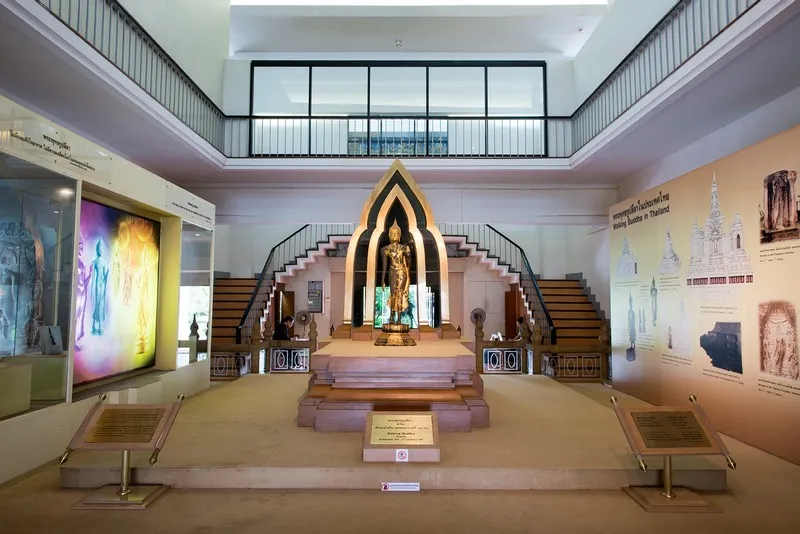
The Buddhist image section is a highlight of the museum. Sukhothai Buddhist sculpture is widely admired for its elegance, balance, serenity, and spiritual expression. The walking Buddha image, in particular, is one of the most distinctive achievements of Sukhothai art. Its graceful movement, gentle facial expression, and refined proportions reflect not only technical mastery but also an idealized vision of Buddhist peace and compassion. Seeing these sculptures in the museum helps visitors understand why Sukhothai art holds such an important place in Thai art history.
The section on scripts and language is essential for understanding Sukhothai through written evidence. Inscriptions are among the most important sources for studying politics, religion, geography, economy, and daily life in the past. For travelers, this section helps connect the physical objects in the museum with historical memory. It shows how written records allow historians to understand events, beliefs, social relationships, and the organization of the city in ways that architecture alone cannot reveal.
The Sangkhalok ceramics section is another must-see area. Sangkhalok ware was produced mainly in Si Satchanalai and old Sukhothai, and it became one of the most famous ceramic traditions in Thai history. The museum displays different forms, glazing techniques, decorative patterns, and production methods. These ceramics are not just beautiful objects; they also provide evidence of trade, technology, local taste, and the economic connections of Sukhothai with wider markets.
The Lai Sue Thai Memorial Building was built in 1983 to commemorate the 700th anniversary of Thai script. It includes visitor information, a ticketing area, a meeting room, and an exhibition titled “Sukhothai: Past and Present.” This exhibition presents ancient and modern maps, a three-dimensional model of Sukhothai city, and information about conservation, restoration, and the development of the ancient city into a World Heritage cultural site together with Si Satchanalai and Kamphaeng Phet. It is a useful introduction for visitors who want to understand Sukhothai as both a historical city and a protected heritage landscape.
The Stucco Sculpture Building presents decorative stucco pieces that once adorned prangs, stupas, viharns, and other religious buildings in Sukhothai and nearby areas. The displays are arranged to help visitors study artistic styles, religious meanings, and social life reflected through decorative art. These stucco fragments demonstrate that Sukhothai architecture was not only monumental but also richly detailed, filled with symbolic imagery and refined craftsmanship.
The open-air exhibition area displays large antiquities, art objects, foundations of ancient structures, and reconstructed elements. Visitors can see evidence related to relic deposits, valuable objects found inside Sangkhalok and Chinese ceramics, reconstructed Sangkhalok kilns, and elephant sculptures inspired by important monuments such as Wat Chang Lom in old Sukhothai, Wat Chang Lom in Si Satchanalai, and Wat Chang Rop in Kamphaeng Phet. This outdoor area helps connect the museum’s indoor displays with the broader historical landscape of the region.
The open wooden hall focuses more on everyday life and ethnographic materials. It displays objects such as a model viharn, ox carts, sampan boats, rice milling tools, ploughs, and agricultural equipment. This section expands the story of Sukhothai beyond kings, temples, and high art. It reminds visitors that ancient cities were also lived-in communities shaped by farming, transport, craftsmanship, water systems, and local ways of life.
Among the museum’s important objects are a bronze walking Buddha image in Sukhothai style from around the 20th Buddhist century, a stucco Buddha image in Sukhothai style from around the 19th Buddhist century, and a stone Buddha footprint with four superimposed footprints from the Sukhothai period. These works are valuable not only because of their age and beauty, but also because they represent the religious devotion, artistic ideals, and cultural achievements of Sukhothai society.
For practical travel planning, Ramkhamhaeng National Museum is located on Charot Withi Thong Road in Mueang Kao Subdistrict, Mueang Sukhothai District, Sukhothai Province. It is very close to Sukhothai Historical Park, making it easy to combine with nearby monuments such as Wat Mahathat, Wat Sa Si, Wat Si Sawai, the King Ramkhamhaeng Monument, and Wat Si Chum. Travelers with limited time may visit the museum first for background knowledge, then explore the historical park. Those who have already visited the ruins can return to the museum afterward to better understand the objects, symbols, and artistic styles they encountered.
Getting There is straightforward by private car, rental car, bicycle, or local transport from the old city area. From Sukhothai town, follow Charot Withi Thong Road toward Mueang Kao and Sukhothai Historical Park. The museum is located in the main heritage tourism zone, so it fits easily into a half-day or full-day itinerary. Visitors should allow at least 1 – 2 hours for the museum, and more time if they wish to read the exhibition panels carefully or study the collections in detail.
Ramkhamhaeng National Museum is suitable for a wide range of visitors, including history lovers, students, families, photographers, researchers, and international travelers. Its strength lies in its ability to make Sukhothai more understandable. Instead of seeing the old city only as a collection of beautiful ruins, visitors leave the museum with a clearer sense of the people, beliefs, technologies, artistic choices, and cultural networks that made Sukhothai one of Thailand’s most important historical centers.
In terms of cultural conservation, the museum plays a role beyond tourism. It preserves, studies, researches, interprets, and presents archaeological and artistic heritage under the Fine Arts Department. It also supports public education and lifelong learning. A visit to this museum therefore contributes to a broader understanding of Thailand’s heritage and helps keep the story of Sukhothai alive for future generations.
Ramkhamhaeng National Museum should be included in any thoughtful visit to Sukhothai. It deepens the experience of the historical park, explains the meaning of important artistic forms, and gives travelers a stronger appreciation of Sukhothai’s role in Thai history. After visiting the museum, the ancient temples, Buddha images, inscriptions, ceramics, and city layout of Sukhothai become more than scenic ruins; they become evidence of a living civilization whose cultural influence continues to shape Thailand today.
| Name | Ramkhamhaeng National Museum |
| Location | Charot Withi Thong Road, Mueang Kao Subdistrict, Mueang Sukhothai District, Sukhothai Province |
| Address | 778 Moo 3, Charot Withi Thong Road, Mueang Kao Subdistrict, Mueang Sukhothai District, Sukhothai 64210, Thailand |
| Highlights | A national museum presenting Sukhothai archaeology, Buddhist art, Hindu imagery, inscriptions, Sangkhalok ceramics, stucco sculptures, ethnographic objects, and open-air archaeological displays |
| History | The Fine Arts Department began surveying and restoring ancient Sukhothai from 1953. The museum was built between 1960 and 1963 and officially opened on 25 January 1964. |
| Name Origin | Named after King Ramkhamhaeng the Great, the famous ruler of Sukhothai in the early 19th Buddhist century |
| Distinctive Features | A major museum for archaeology, history, and art history of Sukhothai, with exhibitions in the main building, Lai Sue Thai Memorial Building, Stucco Sculpture Building, open wooden hall, and outdoor display area |
| Travel Information | From Sukhothai town, travel along Charot Withi Thong Road toward Mueang Kao and Sukhothai Historical Park. The museum is convenient by private car, rental car, bicycle, or local transport from the old city area. |
| Current Status | Open to visitors |
| Open Days | Daily |
| Opening Hours | 09.00 – 16.00 |
| Fees | Thai nationals 30 baht; foreign visitors 200 baht; students in uniform, monks, novices, and religious clergy are exempt from admission fees |
| Facilities | Group guided services, free museum brochures, documentary video for groups, meeting room, restrooms, ramps for elderly visitors and visitors with disabilities, and a shop selling books, postcards, CDs, VCDs, and souvenirs |
| Main Areas / Zones | Lai Sue Thai Memorial Building, Ramkhamhaeng National Museum Building, Prehistoric Settlement Section, Buddhist and Hindu Images of Ancient City-States, Stucco Sculpture, Hindu Images in Sukhothai, Buddhist Images in Sukhothai, Scripts and Language, Sangkhalok Ceramics, Buddhist Art in Thailand, Weapons, Stucco Sculpture Building, Open Wooden Hall, and Outdoor Exhibition Area |
| Caretaker | The Fine Arts Department, Ministry of Culture |
| Main Contact Number | 055-697367 |
| nm_ramkamhang@finearts.go.th | |
| Official Website / Official Page | Fine Arts Department website for Ramkhamhaeng National Museum, Sukhothai, and the official Facebook page: Ramkhamhaeng National Museum |
| Nearby Tourist Attractions | 1. Sukhothai Historical Park, about 0.2 km 2. Wat Mahathat, about 0.7 km 3. King Ramkhamhaeng Monument, about 0.8 km 4. Wat Sa Si, about 1 km 5. Wat Si Sawai, about 1 km 6. Wat Si Chum, about 2 km |
| Nearby Restaurants | 1. Chanda’s Historical Garden Restaurant, about 0.5 km, Tel. 092-993-3408 2. MaeBoonmee Cafe & Bistro, about 0.8 km, Tel. 085-400-0140 3. Coffee Cup Sukhothai, about 0.8 km 4. Ali Baba Indian Restaurant, about 1 km, Tel. 083-635-4400 5. Poo Restaurant Sukhothai, about 12 km, Tel. 093-197-4070 |
| Nearby Accommodations | 1. Wake Up at Muang Kao Boutique Hotel, about 0.5 km, Tel. 062-419-6924 2. Sukhothai Garden, about 0.8 km, Tel. 091-843-1537 3. Tharaburi Resort Sukhothai, about 0.8 km, Tel. 055-697-132 4. Thai Thai Sukhothai Resort, about 1.5 km, Tel. 084-932-1006 5. Legendha Sukhothai Resort, about 1.5 km, Tel. 055-697-214 |
Frequently Asked Questions (FAQ)
Q: Where is Ramkhamhaeng National Museum located?
A: Ramkhamhaeng National Museum is located at 778 Moo 3, Charot Withi Thong Road, Mueang Kao Subdistrict, Mueang Sukhothai District, Sukhothai Province, close to Sukhothai Historical Park.
Q: What are the opening hours of Ramkhamhaeng National Museum?
A: The museum is open daily from 09.00 to 16.00.
Q: How much is the admission fee?
A: Admission is 30 baht for Thai nationals and 200 baht for foreign visitors. Students in uniform, monks, novices, and religious clergy are exempt from admission fees.
Q: What can visitors see inside Ramkhamhaeng National Museum?
A: Visitors can see Sukhothai Buddhist sculptures, Hindu images, inscriptions, Sangkhalok ceramics, stucco sculptures, weapons, ethnographic objects, the Lai Sue Thai Memorial Building, the open wooden hall, and outdoor archaeological displays.
Q: Is Ramkhamhaeng National Museum suitable for foreign travelers?
A: Yes. It is highly recommended for foreign travelers because it explains the history, art, religion, and archaeology of Sukhothai before or after visiting the historical park.
Q: How long should visitors spend at the museum?
A: Most visitors should allow at least 1 – 2 hours. Those who want to study the collections and exhibition panels in detail may want to spend more time.
Q: What nearby attractions can be visited with the museum?
A: Nearby attractions include Sukhothai Historical Park, Wat Mahathat, Wat Sa Si, Wat Si Sawai, the King Ramkhamhaeng Monument, and Wat Si Chum.
Tel : 665569736
 Tel : 665569736
 Category: ●Art, Culture and Heritage
 Group: ●Museums
Last Update : 5 MonthAgo
 Last Update : 5 MonthAgo
 Click to Access the Navigation Map GPS
Ramkhamhaeng National Museum Map
Recommend

 Historical Sites and Monuments(4)
 Landmarks and Memorials(5)
 Art, Craft Centres, Tradition(11)
Museums(5)
Art, Craft Centres, Tradition(11)
Museums(5)
 Places of Worship
 Temple(40)
 Other Sacred Sites(10)
 Suburban Living
 Village, Community(3)
 Nature and Wildlife
 National Parks and Marine Reserves(3)
 Mountain (Doi)(2)
 Dam, Reservoir, Lake(4)
 Waterfalls(8)
 Caves(4)
 River, Canal(2)
 Entertainment and Agricultural
 Farms, Parks and Ecotourism(3)
 Travel Articles, Recipes
 Travel Review, Food Review(1)


