
lovethailand home >North Travel Attractions >Sukhothai Travel Attractions >Thung Saliam >Ban Mai Chai Mongkhon > Wat Yai Chai Mongkhon
TL;DR: Wat Yai Chai Mongkhon is located at Ban Mai Chai Mongkhon Subdistrict, Thung Saliam District, Sukhothai Province, Thailand, open Daily, hours Morning – Evening For General Worship Visits.
Wat Yai Chai Mongkhon
Open Days: Daily
Opening Hours: Morning – Evening For General Worship Visits
Wat Yai Chai Mongkhon is a local Buddhist temple under the Mahanikaya monastic order located in Ban Mai Chai Mongkhon Subdistrict, Thung Saliam District, Sukhothai Province. It is one of the most important archaeological and religious sites associated with the ancient town of Bang Khlang. Locally, the temple is also known as Wat Yai or Wat Bang Khlang. Covering more than 8 rai and 130 square wah, it is regarded as the largest archaeological temple site in Bang Khlang and stands outside the ancient town on the northern side. For foreign travelers, Wat Yai Chai Mongkhon offers a meaningful opportunity to explore a quieter but historically rich part of Sukhothai’s Buddhist heritage.
The temple is significant because it combines 2 identities in one place. It is both an active Buddhist temple and an archaeological site with important remains from the Sukhothai period. Visitors can see the principal chedi, the vihara, surrounding smaller chedis, and the boundary wall area, while also experiencing the temple as a living place of worship for the local community. This combination makes Wat Yai Chai Mongkhon different from archaeological sites that are no longer used for religious life. Here, history and present-day faith continue to exist together.
Archaeological evidence suggests that Wat Yai Chai Mongkhon may have been built during the reign of King Maha Thammaracha Lithai, one of the most important Buddhist kings of the Sukhothai Kingdom. His reign is strongly associated with the promotion of Buddhism, Buddhist learning, religious architecture, and sacred art. If the temple belongs to this historical period, it reflects a time when Buddhism was deeply integrated into political, cultural, and urban life in Sukhothai and its connected settlements.
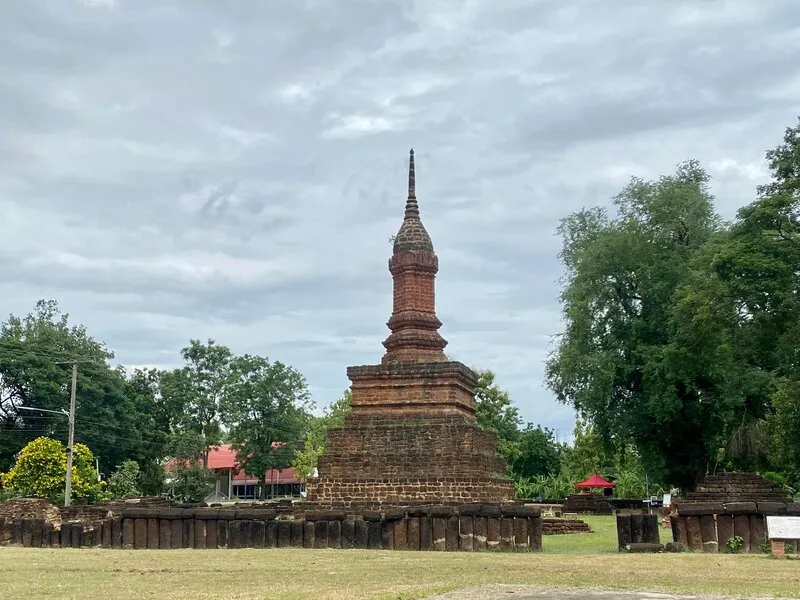
The most important architectural feature of Wat Yai Chai Mongkhon is the principal chedi inside the temple’s sacred enclosure. The chedi was built of laterite and has the form known in Thai as phum khao bin or lotus-bud style. This form is strongly associated with Sukhothai Buddhist architecture. The lotus-bud chedi is visually elegant and symbolically meaningful. In Buddhism, the lotus represents purity, spiritual growth, and awakening. Its use in a principal chedi gives the monument both artistic grace and religious depth.
The principal chedi of Wat Yai Chai Mongkhon had once collapsed, and the lotus-bud top was found fallen nearby. This fallen upper section became important evidence for understanding the original form of the structure. Local belief also associates the principal chedi with the relics of the Buddha or a sacred relic connected with the ancient town. Whether approached through archaeology or devotion, the chedi remains the sacred and visual heart of the temple. It has now been restored, allowing visitors to better understand its original importance.
The Fine Arts Department carried out archaeological excavation and restoration work at Wat Yai Chai Mongkhon in 2001. This work helped reveal the structure of the temple and preserve the site for future generations. The excavation clarified the layout of the principal chedi, vihara, smaller chedis, and the sacred enclosure. For students of history, archaeology, and Buddhist architecture, the site provides valuable evidence for understanding religious planning in the Sukhothai cultural sphere.
The vihara at Wat Yai Chai Mongkhon faces east, which is a common and meaningful orientation in Buddhist architecture. The east is associated with light, awakening, and auspicious beginnings. The vihara would have served as a worship and assembly space, while the principal chedi behind it formed the sacred focus of the temple. This arrangement reflects the planning principles found in many Sukhothai temples, where religious buildings are arranged along an intentional sacred axis.
Several smaller chedis are also found around the temple area. These surrounding chedis contribute to the sacred landscape of the site. In ancient temples, smaller chedis may have been built for devotional purposes, memorial functions, or as part of the broader Buddhist precinct. Their presence at Wat Yai Chai Mongkhon suggests that the temple was not only a single monument, but a developed religious complex with multiple sacred components.
A vihara located to the north of the principal chedi is believed to have been built later than the main chedi. This suggests that the temple developed over time rather than being completed in a single phase. Such gradual development is common in important Buddhist temples, where new structures are added as faith, resources, and community needs grow. Reading the temple in this way helps visitors understand it as a living historical landscape rather than a fixed architectural object.
Wat Yai Chai Mongkhon was registered as an archaeological monument on 29 September 1997. It was officially established as a temple in 1986 and later received its royal consecrated boundary on 25 February 2022. These milestones confirm its dual importance as both a protected heritage site and an active Buddhist temple. The consecrated boundary allows the temple to conduct important monastic ceremonies according to Buddhist discipline.
The importance of Wat Yai Chai Mongkhon is closely tied to the ancient town of Bang Khlang. While many visitors know Sukhothai through Sukhothai Historical Park and Si Satchanalai Historical Park, Bang Khlang offers another important layer of regional history. It reflects the network of settlements, temples, and religious communities that existed beyond the most famous heritage zones. A visit to Wat Yai Chai Mongkhon therefore expands the way travelers understand Sukhothai’s historical geography.
Artistically, the temple is valuable because of its laterite lotus-bud chedi. Laterite was an important building material in many ancient monuments in northern and central Thailand. It provided durability and structural strength. The use of laterite at Wat Yai Chai Mongkhon reflects the construction techniques of the period, while the lotus-bud form connects the site to the refined Buddhist aesthetics of Sukhothai. The combination of material and form gives the monument both strength and elegance.
Visitors should explore the site slowly. Begin with the sacred boundary and the overall layout, then observe the principal chedi, the east-facing vihara, the smaller chedis, and the surrounding area. The value of the site becomes clearer when the structures are viewed together. The temple was not built randomly; its architecture reflects religious order, spatial hierarchy, and symbolic relationships between worship space and sacred relic space.
Wat Yai Chai Mongkhon also remains important to the local community. Local people visit the temple for merit-making, chanting, Buddhist activities, and religious ceremonies. During important Buddhist occasions such as Makha Bucha Day, Visakha Bucha Day, Asalha Bucha Day, Buddhist Lent, the end of Buddhist Lent, and Kathin season, the temple continues to function as a gathering place for the community. This living religious role gives the site warmth and meaning beyond its archaeological value.
Getting There is easiest by private car. Travelers can head to Thung Saliam District in Sukhothai Province and continue to Ban Mai Chai Mongkhon Subdistrict. The temple is located in the Bang Khlang area, outside the ancient town on the northern side. Visitors can search for “Wat Yai Chai Mongkhon Thung Saliam Sukhothai” or “Wat Yai Chai Mongkhon Ban Mai Chai Mongkhon” in navigation apps. The route can be combined with other attractions in Thung Saliam.
Travelers can plan a cultural route that includes Wat Yai Chai Mongkhon, Wat Phiphat Mongkhon, Wat Thung Saliam or Wat Luang Pho Sila, and other local sites around Thung Saliam. Those with more time can continue to Mae Mok Reservoir or Si Satchanalai Historical Park. This route is suitable for travelers interested in Buddhist art, local history, quiet temples, and cultural landscapes away from the busiest tourist areas.
Visitors should dress modestly and behave respectfully because Wat Yai Chai Mongkhon is both an active temple and an archaeological site. Shoulders and knees should be covered when entering sacred areas. Visitors should not climb on the ruins, move stones or laterite blocks, write on structures, or touch ancient remains unnecessarily. Respectful behavior helps preserve the site and maintains the sacred atmosphere for local worshippers.
The temple is suitable for travelers interested in history, archaeology, Sukhothai art, Buddhist architecture, and local spiritual culture. It is not only a place for taking photographs. It is a site that rewards careful observation. The principal chedi, vihara, smaller chedis, and sacred enclosure together tell a story of religious planning, community devotion, and the long continuity of Buddhism in the Bang Khlang area.
In summary, Wat Yai Chai Mongkhon in Sukhothai Province is one of the most important temple sites in the ancient town of Bang Khlang. It is the largest archaeological temple site in the area, with a laterite lotus-bud principal chedi, east-facing vihara, surrounding chedis, and a strong connection with Sukhothai Buddhist art. It is also an active temple and a spiritual center for the local community. For foreign travelers, it offers a quiet, meaningful, and historically rich experience of Sukhothai beyond the main historical park routes.
| Name | Wat Yai Chai Mongkhon |
| Location | Ban Mai Chai Mongkhon Subdistrict, Thung Saliam District, Sukhothai Province, Thailand |
| Address | Moo 1, Ban Mai Chai Mongkhon Subdistrict, Thung Saliam District, Sukhothai Province |
| Highlights | The largest archaeological temple site in Bang Khlang, featuring a laterite lotus-bud principal chedi, an east-facing vihara, surrounding smaller chedis, and a sacred enclosure |
| History | Believed to have been built during the reign of King Maha Thammaracha Lithai. Registered as an archaeological monument on 29 September 1997, excavated by the Fine Arts Department in 2001, and granted royal consecrated boundary on 25 February 2022. |
| Name Origin | Locally called Wat Yai or Wat Bang Khlang because it is the major temple site in the ancient town of Bang Khlang |
| Distinctive Features | A Mahanikaya local temple that is both an active Buddhist temple and a major archaeological site north of ancient Bang Khlang, covering about 8 rai and 130 square wah |
| Key Evidence | Laterite lotus-bud principal chedi, east-facing vihara, surrounding smaller chedis, sacred enclosure wall, and the fallen lotus-bud top of the principal chedi found near the monument |
| Travel Information | Best reached by private car. Travel to Thung Saliam District and continue to Ban Mai Chai Mongkhon Subdistrict. Search for “Wat Yai Chai Mongkhon Thung Saliam Sukhothai” in navigation apps. |
| Current Status | An active Mahanikaya Buddhist temple and an important archaeological site of Bang Khlang, used for worship, merit-making, Buddhist practice, and local historical learning |
| Open Days | Daily |
| Opening Hours | Morning – Evening For General Worship Visits |
| Main Areas / Zones | Principal chedi, vihara, surrounding smaller chedis, sacred enclosure, archaeological area, and Buddhist activity spaces |
| Abbot / Caretaker | Phra Thanarat Pakasutho |
| Main Contact Number | 090-917-7967 |
| Official Website / Official Page | Facebook Page: Wat Yai Chai Mongkhon, Ban Mai Chai Mongkhon Subdistrict, Thung Saliam District, Sukhothai |
| Nearby Tourist Attractions | 1. Ancient Bang Khlang Town, about 1 km 2. Wat Phiphat Mongkhon, about 16 km 3. Wat Thung Saliam / Wat Luang Pho Sila, about 18 km 4. Thung Saliam Local Market / Community Area, about 18 km 5. Wat Klang Dong, about 23 km 6. Mae Mok Reservoir, about 50 km 7. Si Satchanalai Historical Park, about 55 km 8. Wat Chang Lom, Si Satchanalai, about 56 km |
| Nearby Restaurants | 1. Rangsit Traditional Noodle, Thung Saliam, about 17 km 2. SAPALUM, about 17 km 3. Phannarai Restaurant, about 17 km 4. 3 Bor Im Aroi Restaurant, about 17 km 5. Café Amazon PTT Thung Saliam, about 18 km 6. Jing Jai Cafe', about 18 km 7. Steak Jon Salad, about 19 km |
| Nearby Accommodations | 1. Tonfon Resort, about 18 km, Tel. 063-589-7925, 055-659-045 2. Baan Maneekan, about 19 km 3. ONING Resort, about 20 km, Tel. 086-589-0677 4. Rommai Chai Nam Resort, about 23 km, Tel. 064-446-5666 5. Jitra Resort, about 34 km 6. Maison de Sukhothai, about 38 km |
Frequently Asked Questions (FAQ)
Q: Where is Wat Yai Chai Mongkhon in Sukhothai located?
A: Wat Yai Chai Mongkhon is located in Ban Mai Chai Mongkhon Subdistrict, Thung Saliam District, Sukhothai Province, in the Bang Khlang area north of the ancient town.
Q: Why is Wat Yai Chai Mongkhon important?
A: It is the largest archaeological temple site in Bang Khlang and contains a laterite lotus-bud principal chedi, an east-facing vihara, and surrounding smaller chedis that reflect Sukhothai Buddhist art.
Q: When was Wat Yai Chai Mongkhon built?
A: Archaeological evidence suggests that the temple may have been built during the reign of King Maha Thammaracha Lithai in the late Sukhothai period.
Q: What is the principal chedi of Wat Yai Chai Mongkhon like?
A: The principal chedi is built of laterite and has a lotus-bud or phum khao bin form, a distinctive style associated with Sukhothai Buddhist architecture.
Q: Is Wat Yai Chai Mongkhon an archaeological monument?
A: Yes. The temple was registered as an archaeological monument on 29 September 1997, and the Fine Arts Department carried out excavation and restoration work in 2001.
Q: Is Wat Yai Chai Mongkhon still an active temple?
A: Yes. It is an active Mahanikaya Buddhist temple and remains a spiritual center for the local community.
Q: How can travelers get to Wat Yai Chai Mongkhon?
A: The easiest way is by private car. Travel to Thung Saliam District and continue to Ban Mai Chai Mongkhon Subdistrict, or search for “Wat Yai Chai Mongkhon Thung Saliam Sukhothai” in navigation apps.
Q: What nearby attractions can be visited with Wat Yai Chai Mongkhon?
A: Nearby and connecting attractions include ancient Bang Khlang Town, Wat Phiphat Mongkhon, Wat Thung Saliam, Wat Luang Pho Sila, Wat Klang Dong, Mae Mok Reservoir, and Si Satchanalai Historical Park.
 Category: ●Places of Worship
 Group: ●Temple
Last Update : 1 WeekAgo
 Last Update : 1 WeekAgo
 Click to Access the Navigation Map GPS
Wat Yai Chai Mongkhon Map
Recommend
 Art, Culture and Heritage
 Historical Sites and Monuments(4)
 Landmarks and Memorials(5)
 Art, Craft Centres, Tradition(11)
 Museums(5)
Temple(40)
Museums(5)
Temple(40)
 Other religious and spiritural sites(10)
 Suburban Living
 Village, Community(3)
 Nature and Wildlife
 National Parks and Marine Reserves(3)
 Mountain (Doi)(2)
 Dam, Reservoir, Lake(4)
 Waterfalls(8)
 Caves(4)
 River, Canal(2)
 Entertainment and Agricultural
 Farm, Parks, Gardens and Ecotourism(3)


