
lovethailand home >North Travel Attractions >Sukhothai Travel Attractions >Muang Sukhothai >Muang Kao > Wat Mahathat
TL;DR: Wat Mahathat is located at Central Zone, Sukhothai Historical Park, Mueang Kao Subdistrict, Mueang Sukhothai District, Sukhothai Province, open Daily, hours Monday – Friday and Sunday 06.30 – 19.30 / Saturday 06.30 – 21.00.
Wat Mahathat
Open Days: Daily
Opening Hours: Monday – Friday and Sunday 06.30 – 19.30 / Saturday 06.30 – 21.00
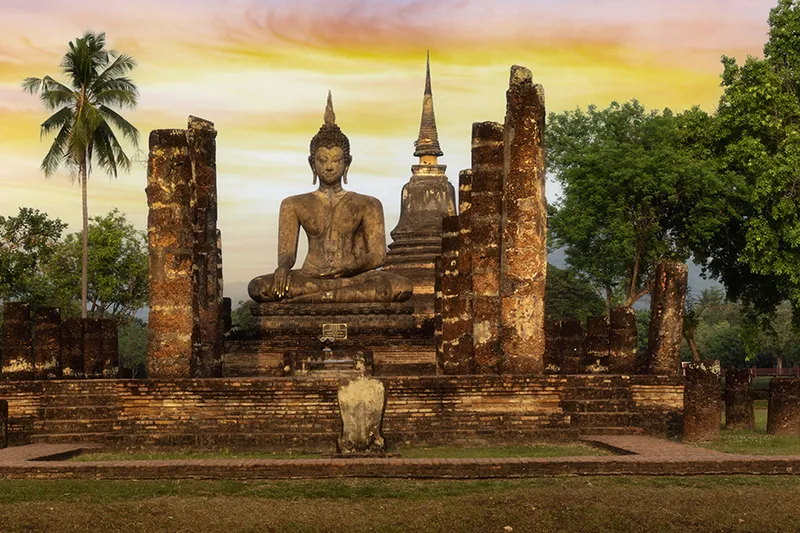
Wat Mahathat in Sukhothai Province is the most important ancient temple in the central zone of Sukhothai Historical Park. Located at the heart of the ancient city, the temple served as the religious, artistic, and symbolic center of Sukhothai. Its position reflects the ancient Indian cosmological concept of placing the sacred center at the middle of the city. For this reason, Wat Mahathat is not only a large temple complex, but also the spiritual core of the old capital, where Buddhism, kingship, art, and urban planning came together.
The importance of Wat Mahathat can be seen in both its location and its scale. The temple contains a main chedi, royal vihara, mandapas, an ordination hall, subsidiary chedis, and many smaller surrounding chedis, with the number of chedis reaching around 200. This extraordinary density of sacred monuments shows that Wat Mahathat functioned as a royal temple of the capital and a major ritual center for the Sukhothai kingdom.
The word “Mahathat” is associated with great relics, especially relics of the Buddha. Temples bearing this name usually held a central role in ancient Thai cities. Wat Mahathat in Sukhothai was therefore both the physical center of the city and the spiritual center of the people. It represented the presence of the Buddha, the legitimacy of royal patronage, and the unity of the Buddhist community.
The main chedi of Wat Mahathat is the most outstanding structure in the temple complex. It is built in the phum khao bin or lotus-bud form, a style considered one of the purest expressions of Sukhothai art. The lotus has deep Buddhist meaning. It rises from mud yet remains clean and beautiful, symbolizing purity, spiritual growth, and liberation. By choosing the lotus-bud form for the central monument of the royal temple, the builders expressed Buddhist ideals through architecture.
Surrounding the main chedi are 8 subsidiary chedis. The 4 chedis at the cardinal directions are Sukhothai-style prasat-form chedis with Khmer influence and stucco decoration related to Sri Lankan artistic influence. The 4 corner chedis are 5-spired prasat-form chedis showing influences from Pagan, Hariphunchai, and Lanna art. This arrangement makes the main chedi the center of a carefully designed sacred universe, with surrounding monuments reinforcing its symbolic power.
Around the base of the main chedi are stucco figures of Buddhist disciples walking in worship with hands joined in anjali. These figures are among the most meaningful artistic details of Wat Mahathat. They represent circumambulation around the sacred relic monument, an act of devotion still central to Buddhist worship. Through this sculptural program, the chedi becomes not only an architectural form but also a ritual space filled with visual movement and faith.
The royal vihara of Wat Mahathat once housed Phra Sri Sakyamuni, one of the largest bronze Buddha images in Thailand. This Buddha image, in the maravijaya posture, was later moved during the early Rattanakosin period to Wat Suthat Thepwararam in Bangkok. Today, the large pedestal of the image remains visible inside the vihara at Wat Mahathat. This remaining base helps visitors imagine the scale and importance of the Buddha image that once dominated the sacred hall.
Phra Sri Sakyamuni is more than an important Buddha image. It connects Sukhothai, Ayutthaya, and Rattanakosin history. The image continues to be worshipped in Bangkok, while its original base in Sukhothai preserves the memory of its first sacred setting. This relationship makes Wat Mahathat important not only for Sukhothai history, but for the broader history of Thai Buddhist art.
Another important feature of Wat Mahathat is the presence of Phra Attharot, large standing Buddha images approximately 18 sok high. These were enshrined in mandapas flanking the main chedi. The standing Buddha images gave the temple strong vertical presence and expressed the grandeur of Sukhothai Buddhist devotion. The mandapas beside the main chedi were both architectural elements and sacred spaces for major Buddha images.
Sukhothai Inscription No. 1 mentions that in the middle of Sukhothai there were viharas, golden Buddha images, Phra Attharot, large Buddha images, and beautiful Buddha images. This passage shows that the center of the city was filled with important Buddhist images and religious structures. It also confirms that Buddhism was not only a personal belief but a foundation of Sukhothai’s cultural, political, and artistic identity.
East of the royal vihara is a high vihara believed to have been built during the Ayutthaya period. Its raised lotus-molding base is about 1.5 meters high. The presence of an Ayutthaya-period structure inside Wat Mahathat shows that the temple continued to be used, remembered, and modified after the height of the Sukhothai kingdom. The site therefore contains more than one historical layer.
To the south of the main chedi is another important group of chedis centered on a large 5-spired chedi, the second largest chedi group after the main monument. Evidence from a gold inscription suggests that this chedi group enshrined the ashes of King Maha Thammaracha Lithai. This gives the southern chedi group major historical significance and connects Wat Mahathat with one of Sukhothai’s most important Buddhist kings.
King Maha Thammaracha Lithai was deeply associated with Buddhist scholarship, religious patronage, and the strengthening of Theravada Buddhism in Sukhothai. The connection between his ashes and Wat Mahathat reinforces the temple’s role as a royal Buddhist center. It also shows how temples, kingship, relics, and memory were closely linked in the Sukhothai world.
The layout of Wat Mahathat reflects the ancient Indian cosmological idea of a sacred center. The main chedi serves as the central axis, comparable to Mount Meru in Buddhist and Indian cosmology. The surrounding chedis function as subsidiary elements around the center. Circumambulation around the main chedi therefore becomes a ritual movement around the sacred axis of the temple. This makes the temple plan a system of religious meaning, not merely a collection of buildings.
The materials used at Wat Mahathat, such as laterite, brick, and stucco, show the technical skill of Sukhothai craftsmen. Laterite provided strength for foundations and columns, while brick and stucco allowed for elegant forms and refined decoration. These materials have allowed the structures to survive for centuries and still communicate the skill and faith of their builders.
Wat Mahathat should be explored slowly. Every part of the temple has meaning: the lotus-bud main chedi, the 8 surrounding chedis, the stucco disciples, the royal vihara, the base of Phra Sri Sakyamuni, the mandapas of Phra Attharot, the Ayutthaya-period high vihara, and the southern chedi group. A quick visit may show the scale of the ruins, but careful observation reveals the temple as a complete open-air textbook of Sukhothai art.
For travelers, Wat Mahathat is the best starting point for understanding Sukhothai Historical Park. It is the central monument of the old city and is located near many other important sites, including Wat Sa Si, Wat Si Sawai, Wat Traphang Ngoen, Wat Chana Songkhram, King Ramkhamhaeng Monument, and Ramkhamhaeng National Museum. Visitors can explore the area on foot, by bicycle, or by park tram.
The best times to visit Wat Mahathat are early morning and late afternoon. The light during these periods gives depth to the chedis, laterite columns, and Buddha image bases. Morning visits offer a calm atmosphere, while late afternoon creates warm light over the central monuments. For photography and historical appreciation, these times are especially rewarding.
Today, Wat Mahathat is an ancient monument managed by Sukhothai Historical Park under the Fine Arts Department, Ministry of Culture. It is not an active community temple with resident monks, so it does not have a resident abbot. The park authority is responsible for conservation, visitor management, and the protection of the monument as part of Thailand’s national cultural heritage and the World Heritage landscape of Sukhothai.
Visitors should dress respectfully, avoid climbing on ancient structures, avoid touching or writing on laterite, brick, stucco, or archaeological elements, and avoid taking any fragments from the site. Wat Mahathat is a cultural monument of national and international importance. Respectful behavior helps preserve Sukhothai for future generations.
Getting There is convenient from modern Sukhothai town to Mueang Kao Subdistrict, about 12 kilometers away. Wat Mahathat is located in the central zone of Sukhothai Historical Park, at the center of the ancient city. Visitors can reach the area by private car, rental car, local transport, bicycle, or park tram. Those staying in the old city area can easily walk or cycle to the temple.
Visitors should allow at least 45 minutes to 1 hour for Wat Mahathat because the site is large and contains many important structures. Travelers with a deeper interest in Sukhothai art, lotus-bud chedis, major Buddha images, and ancient temple planning should allow more time. Visiting Ramkhamhaeng National Museum before or after the temple will help provide useful historical and artistic context.
Wat Mahathat is therefore much more than the largest monument in Sukhothai Historical Park. It is the heart of the old city, bringing together Buddhism, kingship, architecture, sculpture, inscriptions, and memory. The lotus-bud main chedi, surrounding chedis, Phra Sri Sakyamuni, Phra Attharot, the southern 5-spired chedi group, and the many subsidiary monuments make Wat Mahathat one of the most complete places to understand the greatness of ancient Sukhothai.
| Name | Wat Mahathat |
| Location | Central Zone, Sukhothai Historical Park, Mueang Kao Subdistrict, Mueang Sukhothai District, Sukhothai Province |
| Address | Mueang Kao Subdistrict, Mueang Sukhothai District, Sukhothai 64210, Thailand |
| Coordinates | Approximately 17.0173, 99.7048 |
| Highlights | The most important temple at the center of ancient Sukhothai, with a lotus-bud main chedi, royal vihara, Phra Attharot mandapas, and many subsidiary chedis |
| History | An ancient Sukhothai-period royal temple located at the center of the old city according to Indian cosmological planning, serving as the main Buddhist center of the capital |
| Name Origin | The name Mahathat is associated with great relics and the role of the temple as the central sacred monument of the city |
| Distinctive Features | Lotus-bud main chedi, 8 surrounding chedis, stucco disciples in circumambulation, royal vihara, base of Phra Sri Sakyamuni, Phra Attharot mandapas, high vihara, and southern 5-spired chedi group |
| Travel Information | About 12 km from modern Sukhothai town to Mueang Kao. The temple is located at the center of the ancient city and can be reached by private car, local transport, bicycle, walking route, or park tram |
| Current Status | Open to visitors as a major ancient monument within Sukhothai Historical Park and the World Heritage landscape of historic Sukhothai |
| Open Days | Daily |
| Opening Hours | Monday – Friday and Sunday 06.30 – 19.30 / Saturday 06.30 – 21.00 |
| Fees | Central Zone: Thai visitors 20 THB, foreign visitors 200 THB; all-zone ticket: Thai visitors 40 THB, foreign visitors 400 THB |
| Facilities | Ticketing point, walking paths, bicycle route, park tram, parking areas, restrooms near service areas, and tourist information services |
| Main Areas / Zones | Main chedi, royal vihara, Phra Attharot mandapas, high vihara, ordination hall, 8 surrounding chedis, southern 5-spired chedi group, and subsidiary chedis |
| Caretaker | Sukhothai Historical Park, Fine Arts Department, Ministry of Culture |
| Main Contact Number | 055-697-527 |
| Official Website / Official Page | Sukhothai Historical Park, Fine Arts Department |
| Nearby Tourist Attractions | 1. Wat Sa Si, about 0.5 km 2. Wat Si Sawai, about 0.5 km 3. Wat Traphang Ngoen, about 0.3 km 4. Wat Chana Songkhram, about 0.2 km 5. King Ramkhamhaeng Monument, about 0.7 km 6. Ramkhamhaeng National Museum, about 1 km 7. Wat Si Chum, about 3 km |
| Nearby Restaurants | 1. Chanda’s Historical Garden Restaurant, about 1 km, Tel. 092-993-3408 2. Krua Krung Kao Sukhothai, about 1 km, Tel. 087-732-1669 3. Chorphaka Sukhothai, about 2 km, Tel. 088-885-5188 4. Phum Phor Coffee Restaurant, about 2 km, Tel. 064-626-3639, 055-010-356 5. Sinvana Restaurant, about 2 km, Tel. 091-840-4546 |
| Nearby Accommodations | 1. Sukhothai Garden, about 1 km, Tel. 084-751-1533 2. Thai Thai Sukhothai Resort, about 2 km, Tel. 084-932-1006 3. Scent of Sukhothai Resort, about 2 km, Tel. 083-211-8898 4. Legendha Sukhothai Resort, about 2 km, Tel. 055-697-214, 082-450-0177 5. Sawasdee Sukhothai Resort, about 3 km, Tel. 088-559-9089 |
Frequently Asked Questions (FAQ)
Q: Where is Wat Mahathat Sukhothai located?
A: Wat Mahathat is located in the central zone of Sukhothai Historical Park, Mueang Kao Subdistrict, Mueang Sukhothai District, Sukhothai Province, at the center of the ancient city.
Q: Why is Wat Mahathat important?
A: Wat Mahathat was the most important temple of ancient Sukhothai, serving as the royal temple and the religious, artistic, and symbolic center of the old capital.
Q: What style is the main chedi of Wat Mahathat?
A: The main chedi is in the phum khao bin or lotus-bud style, one of the most distinctive forms of Sukhothai art.
Q: How is Phra Sri Sakyamuni connected with Wat Mahathat?
A: Phra Sri Sakyamuni was originally enshrined in the royal vihara of Wat Mahathat before being moved to Wat Suthat Thepwararam in Bangkok. Its large original base remains at Wat Mahathat today.
Q: Does Wat Mahathat have an abbot?
A: No. Wat Mahathat is an ancient monument within Sukhothai Historical Park, not an active community temple with resident monks. It is managed by Sukhothai Historical Park under the Fine Arts Department.
Q: What are the opening hours of Wat Mahathat?
A: Wat Mahathat is open daily as part of the central zone of Sukhothai Historical Park. It opens from 06.30 to 19.30 on Monday to Friday and Sunday, and from 06.30 to 21.00 on Saturday.
Q: How much is the entrance fee for Wat Mahathat?
A: The central zone entrance fee is 20 THB for Thai visitors and 200 THB for foreign visitors. All-zone tickets are also available.
Q: What nearby attractions can be visited with Wat Mahathat?
A: Nearby attractions include Wat Sa Si, Wat Si Sawai, Wat Traphang Ngoen, Wat Chana Songkhram, King Ramkhamhaeng Monument, Ramkhamhaeng National Museum, and Wat Si Chum.
 Category: ●Places of Worship
 Group: ●Temple
Last Update : 5 MonthAgo
 Last Update : 5 MonthAgo
 Click to Access the Navigation Map GPS
Wat Mahathat Map
Recommend

 Art, Culture and Heritage
 Historical Sites and Monuments(4)
 Landmarks and Memorials(5)
 Art, Craft Centres, Tradition(11)
 Museums(5)
Temple(40)
Museums(5)
Temple(40)
 Other Sacred Sites(10)
 Suburban Living
 Village, Community(3)
 Nature and Wildlife
 National Parks and Marine Reserves(3)
 Mountain (Doi)(2)
 Dam, Reservoir, Lake(4)
 Waterfalls(8)
 Caves(4)
 River, Canal(2)
 Entertainment and Agricultural
 Farms, Parks and Ecotourism(3)
 Travel Articles, Recipes
 Travel Review, Food Review(1)


