
lovethailand home >North Travel Attractions >Sukhothai Travel Attractions >Muang Sukhothai >Muang Kao > Wat Chana Songkhram
TL;DR: Wat Chana Songkhram is located at Central Zone, Sukhothai Historical Park, Mueang Kao Subdistrict, Mueang Sukhothai District, Sukhothai Province, open Daily, hours Monday – Friday and Sunday 06.30 – 19.30 / Saturday 06.30 – 21.00.
Wat Chana Songkhram
Open Days: Daily
Opening Hours: Monday – Friday and Sunday 06.30 – 19.30 / Saturday 06.30 – 21.00
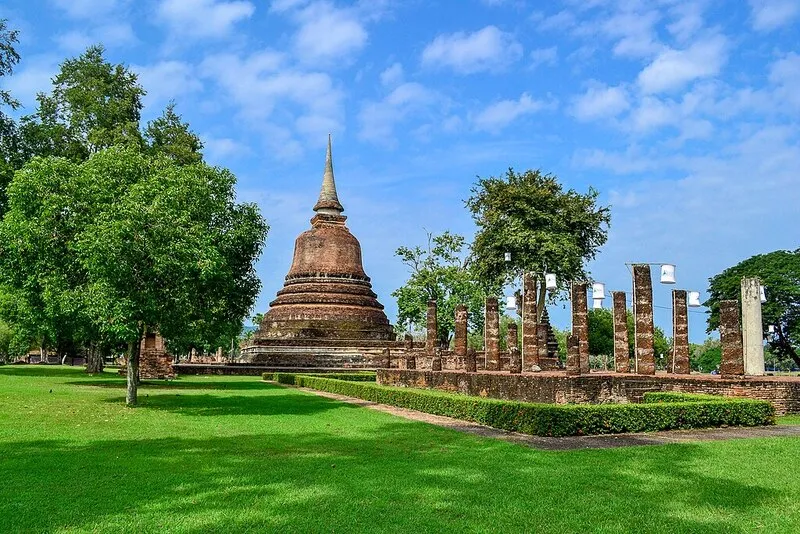
Wat Chana Songkhram in Sukhothai Province, also known as Abandoned Monument K.7, is an important ancient monument in the central zone of Sukhothai Historical Park. It is located in Mueang Kao Subdistrict, Mueang Sukhothai District, about 150 meters north of Wat Mahathat and near the southern side of Traphang Trakuan pond. Although the temple is now an abandoned monument without resident monks, its large bell-shaped chedi, vihara base, water-bound ordination hall base, and surrounding subsidiary chedis still clearly express the elegance of Sukhothai architecture. The site is especially suitable for travelers who want to study temple planning, Buddhist symbolism, and the quieter side of the old city.
Wat Chana Songkhram is also interesting because of its name and later historical memory. The temple was formerly known as Wat Ratchaburana, but its name does not appear clearly in Sukhothai inscriptions. The name Wat Chana Songkhram appears in the royal travel writing “Thiao Mueang Phra Ruang” by King Rama VI, where the temple north of Wat Mahathat was mentioned as the place known locally as Wat Chana Songkhram. This record gives the name historical significance as part of the later recognition and interpretation of Sukhothai’s ancient monuments.
The location of Wat Chana Songkhram is highly meaningful. It stands very close to Wat Mahathat, the central religious and political monument of ancient Sukhothai. The presence of a medium-sized temple so close to the city’s main sanctuary shows that Sukhothai had a dense and carefully organized sacred landscape. Temples were arranged around the city center in relation to ponds, roads, ritual axes, and major Buddhist monuments.
The temple plan of Wat Chana Songkhram is oriented along an east-west axis, a common and meaningful orientation in many Sukhothai temples. This alignment helps create a clear sequence from the vihara toward the main chedi. Visitors today can still read this layout from the remaining foundations. The arrangement reflects the way worshippers once moved through the sacred space, beginning at the vihara and focusing attention toward the chedi at the rear.
The most striking feature of Wat Chana Songkhram is its large brick bell-shaped chedi. This chedi is one of the important examples of Sukhothai bell-shaped architecture. Its structure includes the base, 3 tiers of lotus molding, the molding below the bell, the bell body, the harmika-like throne, the spire shaft, and the finial. These stacked elements create a balanced upward movement, from the solid base to the symbolic vertical peak of the monument.
The bell-shaped chedi is important both artistically and spiritually. In Sukhothai, this form is connected with Theravada Buddhist ideals and Sri Lankan influence. A chedi served as a sacred monument associated with relics, memory, and Buddhist devotion. The chedi of Wat Chana Songkhram is visually simple yet dignified, reflecting the Sukhothai preference for proportion, calmness, and balanced form rather than excessive ornament.
The lotus moldings and the molding below the bell are details worth observing. The 3 tiers of lotus molding create a strong base and a rhythmic transition to the bell body. Above them, the bell, throne, spire shaft, and finial lift the viewer’s gaze upward. This vertical structure gives the chedi both architectural stability and religious meaning, suggesting a movement from the earthly realm toward spiritual aspiration.
To the east of the main chedi is the base of a vihara. In the past, the vihara would have served as a place for worship, chanting, listening to sermons, and paying respect to a Buddha image. Although only the base remains today, its position still explains the religious sequence of the temple. Worshippers would first gather in the vihara before directing their devotion toward the main chedi behind it.
Another important feature is the base of the ordination hall located in the water. This reflects the concept of udakasima or nathisima, where water is used as a sacred boundary for monastic acts. A water-bound ordination hall is not merely a beautiful landscape feature. It expresses Buddhist discipline, purity, and the separation of sacred ritual space from ordinary surroundings.
The water surrounding the ordination hall base gives Wat Chana Songkhram a calm and distinctive atmosphere. When visitors walk around the site, they can clearly see the relationship between sacred architecture and Traphang Trakuan’s water landscape. The water opens the space visually and helps create a peaceful setting, while also functioning symbolically as a boundary of purity.
The subsidiary chedis surrounding the main chedi complete the sacred layout. These smaller chedis have both religious and visual roles. They extend the sacred field around the main monument and create rhythm and balance in the temple plan. Instead of a single isolated monument, Wat Chana Songkhram presents a coordinated group of structures arranged around the central chedi.
The plan of Wat Chana Songkhram also includes smaller shrine-like chedis flanking the main chedi on the eastern side. This feature is interesting because it resembles certain arrangements seen at Wat Chedi Chet Thaeo in Si Satchanalai. It may reflect later additions or architectural development after Sukhothai became connected with the Ayutthaya kingdom. This suggests that the monument developed over time and was not frozen in a single historical moment.
With its main chedi, vihara base, subsidiary chedis, and water-bound ordination hall base, Wat Chana Songkhram is a good example of a medium-sized Sukhothai temple with a complete sacred layout. It may not be as large as Wat Mahathat or as visually famous as Wat Si Chum, but it is highly valuable for understanding how Buddhist spaces were organized around the heart of the old city.
Artistically, the bell-shaped chedi of Wat Chana Songkhram shows the Sukhothai taste for balanced and graceful form. It does not rely on the heavy mass of Khmer-style prangs or the complexity of later decorative architecture. Instead, it emphasizes the calm body of the bell, a stable base, and a refined upward movement. This matches the broader ideals of Sukhothai art, which often values serenity, proportion, and spiritual clarity.
The location of the temple near Traphang Trakuan also connects it with Sukhothai’s water system. Traphang Trakuan is one of the important ponds in the central zone of the old city and is associated with several nearby monuments. Water in Sukhothai was not only practical for storage and urban life; it also shaped sacred landscapes, visual beauty, and religious meaning. Wat Chana Songkhram is one of the places where this relationship between water and temple planning can still be clearly understood.
Today, Wat Chana Songkhram is an abandoned ancient monument under the care of Sukhothai Historical Park, Fine Arts Department, Ministry of Culture. It is not an active community temple with resident monks, and therefore it does not have a resident abbot. The historical park authority is responsible for conservation, site management, and visitor information.
For travelers, Wat Chana Songkhram is easy to visit after Wat Mahathat or Wat Sa Si because it is located very close to the central monuments. Visitors exploring the park on foot or by bicycle can include the temple without leaving the main route. Its quieter atmosphere makes it a good place to study architecture, take photographs, and observe a Sukhothai bell-shaped chedi without the crowds found at some of the more famous sites.
Visitors should first look at the overall plan before focusing on the details. The main chedi, vihara base, water-bound ordination hall base, and subsidiary chedis together explain how the temple functioned as a sacred space. A slow walk around the monument reveals that this abandoned temple still preserves important evidence of Buddhist thought, landscape design, and Sukhothai craftsmanship.
Visitors should dress respectfully, avoid climbing on the chedi or ancient bases, avoid touching or writing on old brick surfaces, avoid entering the pond, and help preserve the calm atmosphere of the monument. Respectful behavior is part of protecting Sukhothai’s cultural heritage for future generations.
Getting There is convenient from modern Sukhothai town to Mueang Kao Subdistrict, about 12 kilometers away. Wat Chana Songkhram is located in the central zone of Sukhothai Historical Park, about 150 meters north of Wat Mahathat. Visitors can reach it on foot, by bicycle, or by park tram. From Wat Mahathat, it is only a short walk to the site.
A good route is to visit Wat Chana Songkhram together with Wat Mahathat, Wat Sa Si, King Ramkhamhaeng Monument, Wat Traphang Ngoen, Wat Si Sawai, and Ramkhamhaeng National Museum. These sites are all located in the central zone and can be connected easily. Visiting them together helps travelers understand the urban layout and the relationship between the major temples around the center of ancient Sukhothai.
Wat Chana Songkhram is therefore worth visiting and studying. It reflects Sukhothai bell-shaped chedi architecture, the relationship between temples and the old city’s water system, an east-west temple layout, and later architectural development linked with the broader historical context after Sukhothai entered the Ayutthaya sphere. Although it is now an abandoned monument, its remaining structures continue to communicate the faith, artistry, and skill of the people of ancient Sukhothai.
| Name | Wat Chana Songkhram |
| Location | Central Zone, Sukhothai Historical Park, Mueang Kao Subdistrict, Mueang Sukhothai District, Sukhothai Province |
| Address | Mueang Kao Subdistrict, Mueang Sukhothai District, Sukhothai 64210, Thailand |
| Approximate Coordinates | North of Wat Mahathat, near Traphang Trakuan, in the central zone of Sukhothai Historical Park |
| Highlights | Large bell-shaped main chedi, vihara base, water-bound ordination hall base, subsidiary chedis, and an east-west temple plan |
| History | An ancient Sukhothai-period monument formerly known as Wat Ratchaburana. The name Wat Chana Songkhram appears in King Rama VI’s travel writing “Thiao Mueang Phra Ruang,” with some architectural elements reflecting later development after Sukhothai entered the Ayutthaya context |
| Name Origin | Formerly called Wat Ratchaburana, later known as Wat Chana Songkhram through local usage and later historical records |
| Distinctive Features | Brick bell-shaped chedi with 3 tiers of lotus molding, lower bell molding, bell body, throne, spire shaft, finial, subsidiary chedis, and water-bound ordination hall base |
| Travel Information | About 12 km from modern Sukhothai town to Mueang Kao. Located about 150 meters north of Wat Mahathat in the central zone. Accessible on foot, by bicycle, or by park tram |
| Current Status | An abandoned ancient monument within Sukhothai Historical Park, open to visitors |
| Open Days | Daily |
| Opening Hours | Monday – Friday and Sunday 06.30 – 19.30 / Saturday 06.30 – 21.00 |
| Fees | Central Zone: Thai visitors 20 THB, foreign visitors 200 THB |
| Facilities | Ticketing point, walking paths, bicycle route, park tram, parking areas, and tourist information services |
| Main Areas / Zones | Bell-shaped main chedi, vihara base, water-bound ordination hall base, subsidiary chedis, smaller shrine-like chedis, and Traphang Trakuan pond area |
| Caretaker | Sukhothai Historical Park, Fine Arts Department, Ministry of Culture |
| Main Contact Number | 055-697-527 |
| Official Website / Official Page | Sukhothai Historical Park, Fine Arts Department |
| Nearby Tourist Attractions | 1. Wat Mahathat, about 0.2 km 2. Wat Sa Si, about 0.4 km 3. King Ramkhamhaeng Monument, about 0.5 km 4. Wat Traphang Ngoen, about 0.7 km 5. Wat Si Sawai, about 1 km 6. Ramkhamhaeng National Museum, about 1 km 7. Wat Si Chum, about 3 km |
| Nearby Restaurants | 1. Chanda’s Historical Garden Restaurant, about 1 km, Tel. 092-993-3408 2. Krua Krung Kao Sukhothai, about 1 km, Tel. 087-732-1669 3. Chorphaka Sukhothai, about 2 km, Tel. 088-885-5188 4. Phum Phor Coffee Restaurant, about 2 km, Tel. 064-626-3639, 055-010-356 5. Sinvana Restaurant, about 2 km, Tel. 091-840-4546 |
| Nearby Accommodations | 1. Sukhothai Garden, about 1 km, Tel. 084-751-1533 2. Thai Thai Sukhothai Resort, about 2 km, Tel. 084-932-1006 3. Scent of Sukhothai Resort, about 2 km, Tel. 083-211-8898 4. Legendha Sukhothai Resort, about 2 km, Tel. 055-697-214, 082-450-0177 5. Sawasdee Sukhothai Resort, about 3 km, Tel. 088-559-9089 |
Frequently Asked Questions (FAQ)
Q: Where is Wat Chana Songkhram located?
A: Wat Chana Songkhram is located in the central zone of Sukhothai Historical Park, Mueang Kao Subdistrict, Mueang Sukhothai District, Sukhothai Province, about 150 meters north of Wat Mahathat.
Q: What was the former name of Wat Chana Songkhram?
A: The temple was formerly known as Wat Ratchaburana and is also identified as Abandoned Monument K.7 within Sukhothai Historical Park.
Q: What is Wat Chana Songkhram famous for?
A: It is known for its large brick bell-shaped chedi, vihara base, water-bound ordination hall base, subsidiary chedis, and east-west temple layout.
Q: Does Wat Chana Songkhram have an abbot?
A: No. Wat Chana Songkhram is an abandoned ancient monument within Sukhothai Historical Park, not an active community temple. It is managed by Sukhothai Historical Park under the Fine Arts Department.
Q: How is Wat Chana Songkhram related to Traphang Trakuan?
A: The temple is located near the southern side of Traphang Trakuan, and its water-bound ordination hall base reflects the use of water as part of sacred temple planning and the udakasima concept.
Q: What are the opening hours of Wat Chana Songkhram?
A: Wat Chana Songkhram is open daily as part of the central zone of Sukhothai Historical Park. It opens from 06.30 to 19.30 on Monday to Friday and Sunday, and from 06.30 to 21.00 on Saturday.
Q: What type of visit is Wat Chana Songkhram suitable for?
A: It is suitable for walking tours, studying Sukhothai bell-shaped chedi architecture, learning about ancient temple planning, photography, and visiting nearby monuments in the central zone.
Q: What nearby attractions can be visited with Wat Chana Songkhram?
A: Nearby attractions include Wat Mahathat, Wat Sa Si, Wat Traphang Ngoen, Wat Si Sawai, King Ramkhamhaeng Monument, Ramkhamhaeng National Museum, and Wat Si Chum.
 Category: ●Places of Worship
 Group: ●Temple
Last Update : 4 MonthAgo
 Last Update : 4 MonthAgo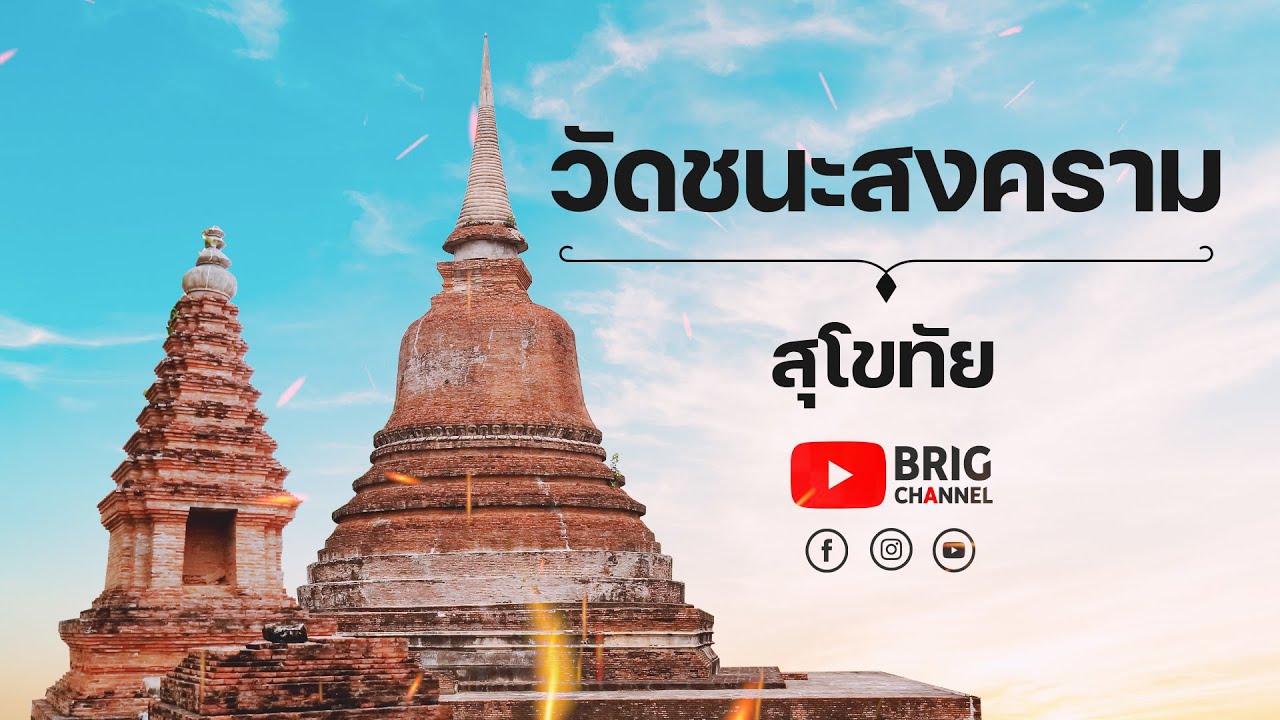
 Click to Access the Navigation Map GPS
Wat Chana Songkhram Map
Recommend

 Art, Culture and Heritage
 Historical Sites and Monuments(4)
 Landmarks and Memorials(5)
 Art, Craft Centres, Tradition(11)
 Museums(5)
Temple(40)
Museums(5)
Temple(40)
 Other Sacred Sites(10)
 Suburban Living
 Village, Community(3)
 Nature and Wildlife
 National Parks and Marine Reserves(3)
 Mountain (Doi)(2)
 Dam, Reservoir, Lake(4)
 Waterfalls(8)
 Caves(4)
 River, Canal(2)
 Entertainment and Agricultural
 Farms, Parks and Ecotourism(3)


