
lovethailand home >North Travel Attractions >Sukhothai Travel Attractions >Si Samrong >Sam Ruean > Wat Sopharam
TL;DR: Wat Sopharam is located at Sam Ruean Subdistrict, Si Samrong District, Sukhothai Province 64120, Thailand, open Daily, hours Morning – Evening For General Worship Visits.
Wat Sopharam
Open Days: Daily
Opening Hours: Morning – Evening For General Worship Visits
Wat Sopharam in Sam Ruean Subdistrict, Si Samrong District, Sukhothai Province, is a community Buddhist temple under the Mahanikaya monastic order and one of the meaningful religious and cultural sites in the Si Samrong area. The temple is closely connected with the local community of Ban Lam Yuan and is known for its long history, its former names “Wat Rong Yuan” and “Wat Lam Yuan,” and its large outdoor Buddha image, Phra Phuttha Barami Si Sukhothai. For travelers, Wat Sopharam offers more than a short temple stop; it is a place where local history, Buddhist devotion, community memory, and Sukhothai-style religious art come together in a calm rural setting.
The most important point to understand about Wat Sopharam is that its identity is rooted in local settlement history. The temple was formerly known as Wat Rong Yuan or Wat Lam Yuan because the area was once associated with Vietnamese settlers who migrated and made their homes here. Like many traditional Buddhist communities in Thailand, the temple became the heart of the settlement. It served as a place for religious ceremonies, merit-making, moral teaching, community gatherings, and cultural continuity. Although the temple was later renamed Wat Sopharam, its older names remain important because they preserve the memory of the people who helped shape this area.
Wat Sopharam is located in Sam Ruean, a subdistrict of Si Samrong District in Sukhothai Province. The surrounding environment is quieter and more local than the heavily visited historical park zone of Sukhothai. This gives the temple a different character from the major archaeological monuments. Visitors who come here will experience a living temple that continues to function as a religious center for the community, rather than a site preserved only as an ancient ruin. The atmosphere is simple, peaceful, and suitable for travelers who want to understand present-day Buddhist life in Sukhothai alongside the province’s well-known historical heritage.
Historically, Wat Sopharam received its royal consecrated boundary, known in Thai as wisungkhammasima, in 1827. This is an important marker in the development of a Buddhist temple because it allows the temple to properly conduct monastic ceremonies within its consecrated area. In 1957, the temple’s name was changed to “Wat Sopharam,” giving it a new identity while still preserving its deeper historical roots. The name change reflects the temple’s continued development as a spiritual center for the local community, but it did not erase the older cultural memory connected with Wat Rong Yuan and Wat Lam Yuan.
The former names of the temple are especially valuable for travelers interested in cultural history. They reveal how religious places often preserve traces of migration, settlement, and cultural blending. The story of Wat Sopharam shows that Sukhothai is not only a province of ancient royal history and UNESCO-listed monuments; it is also a place where local communities, ethnic memories, and Buddhist institutions have interacted over generations. A visit to this temple therefore helps broaden the way travelers understand Sukhothai, moving beyond the image of an ancient capital to include living communities and local faith.
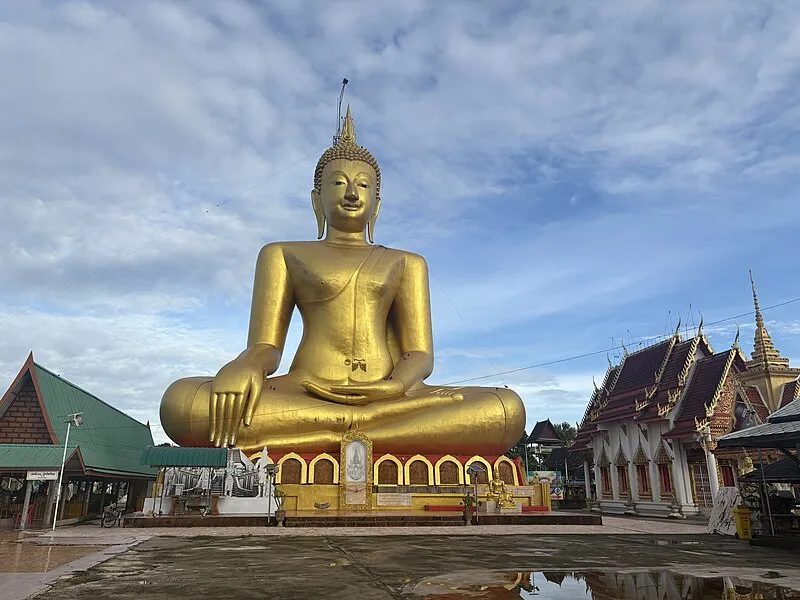
The main highlight of Wat Sopharam is Phra Phuttha Barami Si Sukhothai, a large outdoor seated Buddha image in the Maravijaya posture. The Buddha image was built in 1993 through the cooperation and faith of the abbot, monks, and Buddhist devotees in the community. Its golden appearance, open-air setting, and Sukhothai-inspired artistic style make it the visual and spiritual focal point of the temple. Many local people and visitors also refer to it as the Great Sukhothai Buddha image of Wat Sopharam.
The Maravijaya posture carries deep Buddhist meaning. It represents the moment when the Buddha overcame Mara and the forces of temptation before attaining enlightenment. For many worshippers, paying respect to a Buddha image in this posture symbolizes inner strength, clarity, perseverance, and victory over obstacles. At Wat Sopharam, this meaning is reinforced by the story of how the image was built through collective faith. The Buddha image is not only a sacred object; it is also a visible symbol of community cooperation and shared devotion.
The artistic style of Phra Phuttha Barami Si Sukhothai connects the temple with the broader identity of Sukhothai Buddhist art. Sukhothai-style Buddha images are widely admired for their graceful proportions, calm expression, and spiritual softness. Even though Wat Sopharam is not located inside the main historical park, the presence of this Buddha image links the temple to the province’s long Buddhist artistic tradition. Travelers who appreciate Thai religious art can therefore see Wat Sopharam as part of the continuing cultural landscape of Sukhothai.
Within the temple grounds, historical traces such as old foundations of the ordination hall, vihara, chedi, and older Buddha images are associated with the temple’s long past. These elements help visitors understand that Wat Sopharam has not emerged only as a modern attraction. It has grown through many generations of religious life, community use, renovation, and local memory. The older remains and the large contemporary Buddha image together create a layered temple landscape where past and present are visible in the same space.
Wat Sopharam continues to play an important role in the life of the local Buddhist community. It is a place for merit-making, Buddhist observances, ceremonies on major holy days, and annual religious activities. During important Buddhist occasions such as Visakha Bucha Day, Asalha Bucha Day, Buddhist Lent, the end of Buddhist Lent, and Kathin season, temples like Wat Sopharam become gathering places for villagers and devotees. These occasions allow visitors to see how Buddhism remains integrated into everyday community life in rural Sukhothai.
For foreign travelers, Wat Sopharam is a useful place to experience a quieter side of Sukhothai. Many visitors know the province mainly through Sukhothai Historical Park, Wat Mahathat, Wat Si Chum, and other ancient monuments. Those sites are essential for understanding the old kingdom, but Wat Sopharam provides another perspective: a living temple where monks, villagers, and worshippers continue to maintain Buddhist traditions today. This makes the temple suitable for travelers who want a more complete and human view of Sukhothai.
The temple is also a good stop for travelers who prefer meaningful, low-crowd destinations. Unlike the main historical attractions, Wat Sopharam offers a calm setting where visitors can spend time quietly, take photographs respectfully, pay homage to the Buddha image, and observe local temple life. The best time for photography is usually in the morning or late afternoon, when the light is softer and the golden Buddha image appears especially serene. Visitors should dress modestly and behave respectfully because this is an active religious place.
Getting There is easiest by private car, rental car, or local hired transport. From Sukhothai town or the Sukhothai Historical Park area, travelers can head toward Si Samrong District and continue to Sam Ruean Subdistrict. The temple can be found by searching for “Wat Sopharam Si Samrong Sukhothai” or by using the coordinates 17.18587, 99.86556. Travelers using public transport can first reach Si Samrong town and then continue to the temple by local transport or private hire.
Wat Sopharam can be combined with several other attractions in Sukhothai Province. Travelers interested in history may continue to Sukhothai Historical Park, Wat Mahathat, Wat Si Chum, and Ramkhamhaeng National Museum. Those who prefer local routes can include nearby Si Samrong cafés, local restaurants, Tha Le Luang, or other community temples. This route works well for travelers who want to balance famous heritage sites with quieter local experiences.
Visitors should remember that Wat Sopharam is a functioning Buddhist temple. Modest clothing is recommended, especially when entering worship areas. Shoulders and knees should be covered as a sign of respect. Visitors should avoid loud behavior, should not interrupt ceremonies, and should ask permission before photographing monks or private religious activities. Shoes should be removed before entering certain sacred areas. These basic practices help ensure that the visit remains respectful to both the temple and the local community.
From a cultural perspective, Wat Sopharam is an example of how a local temple can preserve history without necessarily being a large archaeological monument. Its story includes migration, name changes, consecrated religious status, community devotion, and the construction of a major Buddha image in the late 20th century. These elements make the temple valuable for travelers who want to understand how Thai Buddhist temples function as archives of local memory, not only as places of worship.
The temple’s identity is strengthened by its relationship with Ban Lam Yuan and the wider Sam Ruean community. A temple like Wat Sopharam helps people mark important moments in life, from merit-making and religious festivals to community gatherings and acts of charity. It is also a place where younger generations can learn about local history through stories, rituals, and participation. For this reason, Wat Sopharam should be seen not only as a destination but also as a living cultural institution.
Travelers who come to Wat Sopharam will find a place that represents both faith and continuity. The large Buddha image provides an immediate visual impression, while the older name of the temple reveals a deeper story of settlement and cultural blending. The quiet temple grounds allow visitors to reflect on the role of Buddhism in local life, and the surrounding district offers an opportunity to explore Sukhothai beyond its most famous sites. This combination makes Wat Sopharam a rewarding stop for those who appreciate temples with authentic community meaning.
In summary, Wat Sopharam is a meaningful Buddhist temple in Si Samrong District, Sukhothai Province. It is known for its former names Wat Rong Yuan and Wat Lam Yuan, its long connection with the local community, its royal consecrated boundary granted in 1827, its renaming in 1957, and its large Buddha image Phra Phuttha Barami Si Sukhothai built in 1993. For foreign travelers, it offers a calm and culturally rich experience that complements the more famous historical attractions of Sukhothai.
| Name | Wat Sopharam |
| Location | Sam Ruean Subdistrict, Si Samrong District, Sukhothai Province 64120, Thailand |
| Address | Road 101, Sam Ruean Subdistrict, Si Samrong District, Sukhothai Province |
| Coordinates | 17.18587, 99.86556 |
| Highlights | Phra Phuttha Barami Si Sukhothai, a large outdoor seated Buddha image in the Maravijaya posture with Sukhothai-style artistic influence |
| History | The temple has a history of more than 200 years, received its royal consecrated boundary in 1827, and was renamed Wat Sopharam in 1957 |
| Name Origin | Formerly known as Wat Rong Yuan or Wat Lam Yuan, reflecting its connection with Vietnamese settlers who once lived in the area |
| Distinctive Features | A living community temple with historical traces of old religious structures and a large Buddha image that serves as a spiritual landmark |
| Travel Information | Best reached by private car or rental car. From Sukhothai town or Sukhothai Historical Park, head toward Si Samrong District and continue to Sam Ruean Subdistrict. The coordinates can be used for navigation. |
| Current Status | An active community Buddhist temple with ongoing religious activities |
| Open Days | Daily |
| Opening Hours | Morning – Evening For General Worship Visits |
| Main Areas / Zones | Phra Phuttha Barami Si Sukhothai, worship areas, ceremonial spaces, and areas connected with older temple remains |
| Abbot / Caretaker | Phra Khru Phinit Thammarat, Abbot of Wat Sopharam |
| Main Contact Number | 082-599-5451 |
| Official Website / Official Page | Facebook Pages: Wat Sopharam Sukhothai / Wat Sopharam Si Samrong, Sam Ruean, Sukhothai |
| Nearby Tourist Attractions | 1. Wat Nong Wong Royal Temple, about 12 km 2. Tha Le Luang, Sukhothai, about 25 km 3. Phra Mae Ya Shrine, about 30 km 4. Ramkhamhaeng National Museum, about 32 km 5. Sukhothai Historical Park, about 33 km 6. Wat Mahathat, Sukhothai, about 34 km 7. Wat Si Chum, about 36 km |
| Nearby Restaurants | 1. Kor Kai Si Samrong, Rim Yom Branch, about 6 km, Tel. 096-687-5874 2. Ta Phut Noodle Restaurant, about 7 km 3. Ahan Pa Ban Thap Phueng, about 10 km 4. Hom Muen Li, about 8 km 5. ORDINA, about 9 km 6. LORO CAFE, about 9 km |
| Nearby Accommodations | 1. San Rak Resort Sukhothai, about 7 km, Tel. 081-971-9709 2. Sukruthai Resort, about 9 km, Tel. 081-020-3111 3. Chai Villa Sukhothai, about 10 km 4. OYO 75596 The Sirisuk House, about 10 km 5. Sukhothai Resort, about 22 km |
Frequently Asked Questions (FAQ)
Q: Where is Wat Sopharam located?
A: Wat Sopharam is located in Sam Ruean Subdistrict, Si Samrong District, Sukhothai Province, Thailand.
Q: What were the former names of Wat Sopharam?
A: The temple was formerly known as Wat Rong Yuan or Wat Lam Yuan, names connected with Vietnamese settlers who once lived in the area.
Q: What is the main highlight of Wat Sopharam?
A: The main highlight is Phra Phuttha Barami Si Sukhothai, a large outdoor seated Buddha image in the Maravijaya posture.
Q: Why is Wat Sopharam historically important?
A: The temple has a history of more than 200 years, received its royal consecrated boundary in 1827, and preserves local memories of settlement and Buddhist community life.
Q: When was Phra Phuttha Barami Si Sukhothai built?
A: Phra Phuttha Barami Si Sukhothai was built in 1993 through the faith and cooperation of the temple and local Buddhist devotees.
Q: How can travelers get to Wat Sopharam?
A: The easiest way is by private car or rental car. Travelers can navigate to Si Samrong District, then continue to Sam Ruean Subdistrict using the temple name or coordinates 17.18587, 99.86556.
Q: Is Wat Sopharam suitable for foreign travelers?
A: Yes. It is suitable for travelers interested in Buddhist temples, local culture, quiet worship sites, and a living community temple outside the main historical park area.
Q: What nearby attractions can be visited with Wat Sopharam?
A: Travelers can combine the visit with Wat Nong Wong, Tha Le Luang, Phra Mae Ya Shrine, Sukhothai Historical Park, Wat Mahathat, and Wat Si Chum.
 Category: ●Places of Worship
 Group: ●Temple
Last Update : 5 MonthAgo
 Last Update : 5 MonthAgo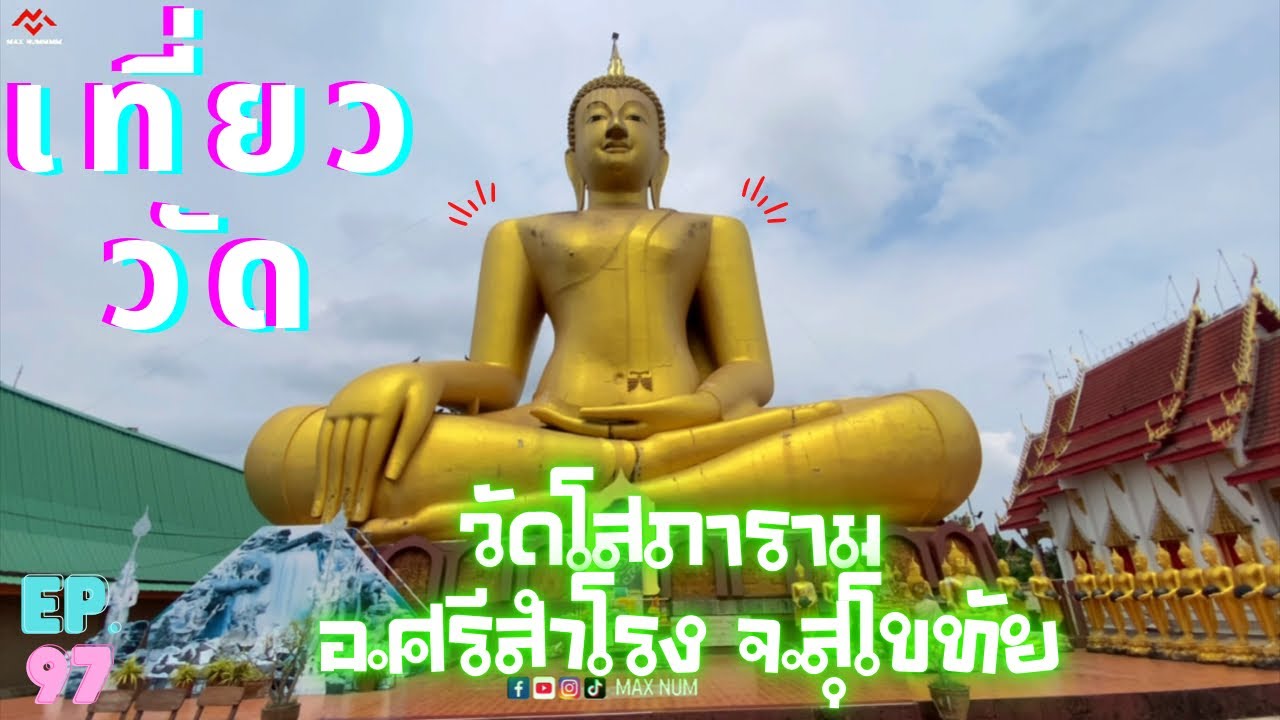
 Click to Access the Navigation Map GPS
Wat Sopharam Map
Recommend

 Art, Culture and Heritage
 Historical Sites and Monuments(4)
 Landmarks and Memorials(5)
 Art, Craft Centres, Tradition(11)
 Museums(5)
Temple(40)
Museums(5)
Temple(40)
 Other Sacred Sites(10)
 Suburban Living
 Village, Community(3)
 Nature and Wildlife
 National Parks and Marine Reserves(3)
 Mountain (Doi)(2)
 Dam, Reservoir, Lake(4)
 Waterfalls(8)
 Caves(4)
 River, Canal(2)
 Entertainment and Agricultural
 Farms, Parks and Ecotourism(3)
 Travel Articles, Recipes
 Travel Review, Food Review(1)


