
lovethailand home >North Travel Attractions >Phetchabun Travel Attractions >Muang Phetchabun >Wang Chom Phu > Ordination Tradition
TL;DR: Ordination Tradition, open Traditionally held in the period before Buddhist Lent, hours According to the ordination schedule of each family and local temple.
Ordination Tradition
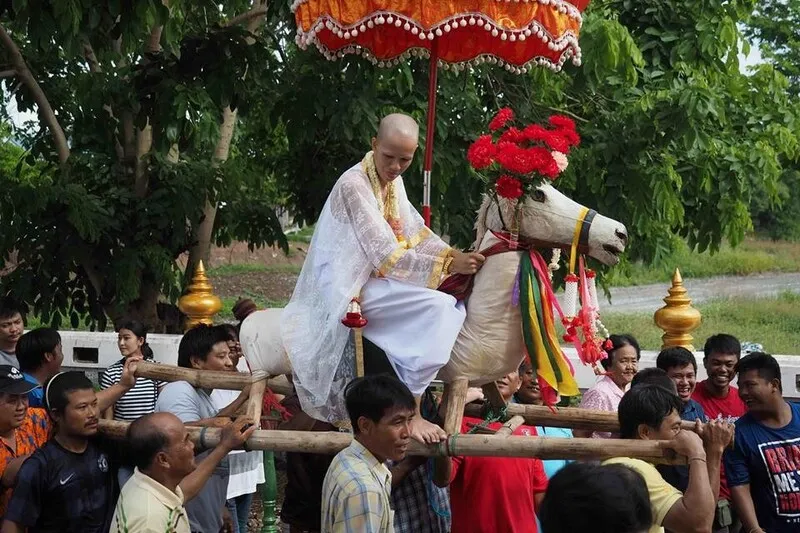
Open Days: Traditionally held in the period before Buddhist Lent
Opening Hours: According to the ordination schedule of each family and local temple
The ordination tradition of Phetchabun Province is one of the most meaningful Thai cultural practices associated with the period before Buddhist Lent. For the people of Phetchabun, ordination is far more than a religious ceremony. It is an important rite of passage for young men, a way of repaying parental gratitude, and a cultural process that marks maturity, discipline, and readiness for adult life within the community.
From the past to the present, families in Phetchabun have continued to value ordination very highly. A long-standing local belief holds that a man should remain ordained for at least one full Buddhist Lent before disrobing. Only then is he regarded as a complete and fully respected adult in the eyes of the community. This belief reflects the idea that ordination is not merely symbolic. It is expected to shape character, increase social trust, and prepare a young man for responsibilities such as work, family, and marriage.
One of the most important parts of the tradition is preparation. A young man who has reached the age for full ordination, generally 20 years old, must go to the temple and practice important liturgical texts such as the Seven Legends, the Nak recitation, and other ritual passages until he can perform them fluently. This preparation is not simply memorization. It shows commitment, respect for the ritual process, and readiness to enter the monkhood properly.
Before the ordination day, the candidate also performs an act of respect toward elders. Carrying flower cones, incense, and candles, he visits older relatives to ask forgiveness, seek blessings, and formally inform them of his intention to ordain. This is one of the most emotionally meaningful stages of the tradition because it emphasizes gratitude, humility, and the close bond between ordination and family life.
On the afternoon or evening before the ordination, there is usually a Nak procession. The host family decorates elephants, horses, carts, or other vehicles beautifully, and the Nak joins a festive procession through nearby villages before returning to the temple for the Nak blessing ceremony. This creates a lively and joyful atmosphere, allowing the community to share in the merit and celebrate the ordination together.
The Nak blessing ceremony is a key cultural moment. It shifts the mood from festivity to reflection and reminds the candidate of the meaning of monkhood, the gratitude owed to parents, and the seriousness of entering the Buddhist path. In this sense, the tradition balances celebration with inner preparation, making ordination both a public and deeply personal event.
On the ordination day itself, the candidate formally requests higher ordination from the preceptor and presents the required monastic requisites. After the ordination is complete, the host family usually offers a meal to the monks and continues with merit-making activities. The entire process demonstrates how ordination in Phetchabun is not an individual matter alone. It is supported by monks, relatives, neighbors, and the wider temple community.
Historically, ordination also had strong educational value. In earlier times, when secular education was less accessible, entering the monkhood gave young men an important opportunity to study, read, and learn Buddhist teachings. Even though society has changed, this legacy remains visible in the local belief that a man who has ordained becomes more patient, disciplined, thoughtful, and aware of life’s realities.
The ordination tradition also reveals the strong role of temples in community life. In Phetchabun, the temple is not merely the place where the final ritual happens. It is the center of training, rehearsal, blessing, social connection, and moral teaching. Every stage, from recitation practice to the procession and the formal ordination, shows the close relationship between religion and daily life in the province.
For cultural travelers, this tradition offers a deeper understanding of Phetchabun beyond well-known tourist attractions. It reflects gratitude, respect for elders, Buddhist devotion, and the importance of moral training before adulthood. Unlike large public festivals, ordination traditions allow visitors to see the emotional and social life of real communities at a close range.
Getting There depends on the temple and community where the ordination is being held. Since ordinations in Phetchabun are arranged by individual families and local temples rather than in one fixed provincial location, visitors who wish to observe such ceremonies should contact temples or local communities in advance, especially during the period before Buddhist Lent.
In summary, the ordination tradition of Phetchabun is one of the province’s most meaningful expressions of Thai Buddhist culture. It brings together family gratitude, community participation, temple-centered learning, and the moral formation of young men. For anyone seeking to understand the cultural heart of Phetchabun, this tradition is an essential subject of study.
| Tradition Name | Ordination Tradition of Phetchabun Province |
| Festival Period | Before Buddhist Lent |
| Main Character | A rite of passage for young men linked to faith, family, and social recognition |
| Cultural Importance | A young man is traditionally expected to ordain for at least one Buddhist Lent before being regarded as a fully mature adult |
| Ordination Age | Generally 20 years old for full ordination |
| Preparation | The candidate studies ritual texts such as the Seven Legends and Nak recitations at the temple |
| Key Rituals | Asking forgiveness from elders, Nak procession, Nak blessing ceremony, formal request for ordination, and offering food to monks after the ceremony |
| Nak Procession | Usually held one day before ordination, with decorated elephants, horses, carts, or other vehicles carrying the Nak through nearby communities |
| Cultural Value | Reflects gratitude, respect for elders, the role of temples in community life, and Buddhist moral training |
| Travel Information | Visitors should check with local temples or communities in Phetchabun in advance because ordinations are not held at a single fixed site |
| Current Status | Still practiced in many communities across Phetchabun, especially before Buddhist Lent |
Frequently Asked Questions (FAQ)
Q: When is the ordination tradition in Phetchabun usually held?
A: It is commonly held during the period before Buddhist Lent.
Q: Why is ordination considered important in Phetchabun?
A: It is believed to mark full maturity, social trustworthiness, and readiness for adult responsibilities, including family life.
Q: How do young men prepare before ordination?
A: They go to the temple to practice important ritual texts such as the Seven Legends and Nak recitations, and they also ask forgiveness and blessings from elders.
Q: What happens before the ordination day?
A: One day before ordination, there is usually a Nak procession through nearby communities, followed by the Nak blessing ceremony at the temple.
Q: What does this tradition teach?
A: It teaches gratitude, discipline, patience, respect for elders, and a deeper understanding of Buddhist principles.
Q: How can visitors observe this tradition respectfully?
A: Visitors should contact local temples or host communities in advance and follow the customs of the family and temple holding the ordination ceremony.
 Category: ●Art, Culture and Heritage
 Group: ●Art, Craft Centres, Tradition
Last Update : 3 MonthAgo
 Last Update : 3 MonthAgo
Recommend

 Historical Sites and Monuments(4)
 Landmarks and Memorials(3)
Art, Craft Centres, Tradition(4)
Landmarks and Memorials(3)
Art, Craft Centres, Tradition(4)
 Art Gallery(1)
 Educational Places
 Library(1)
 Educational Gardens, Farm(3)
 Places of Worship
 Temple(31)
 Other Sacred Sites(8)
 Suburban Living
 Village, Community(4)
 Nature and Wildlife
 National Parks and Marine Reserves(4)
 Mountain (Doi)(11)
 Dam, Reservoir, Lake(14)
 Waterfalls(21)
 Hot Springs(1)
 Caves(11)
 Flower Field(1)
 River, Canal(12)
 Other natural attractions(13)
 Entertainment and Agricultural
 Zoos and Aquariums(1)
 Farms, Parks and Ecotourism(4)
 Outdoor and Adventure Activities(2)
 Travel Articles, Recipes
 Travel Review, Food Review(1)


