
lovethailand home >Central Travel Attractions >Chai Nat Travel Attractions >Sankhaburi >Pho Ngam > Monkey Park at Wat Dhammikawat (Wat Khang Khao)
TL;DR: Monkey Park at Wat Dhammikawat (Wat Khang Khao) is located at Wat Dhammikawat (Wat Khang Khao), Phong Ngam Subdistrict, Sankhaburi District, Chai Nat Province, open Daily, hours Open during daytime hours.
Monkey Park at Wat Dhammikawat (Wat Khang Khao)
Open Days: Daily
Opening Hours: Open during daytime hours
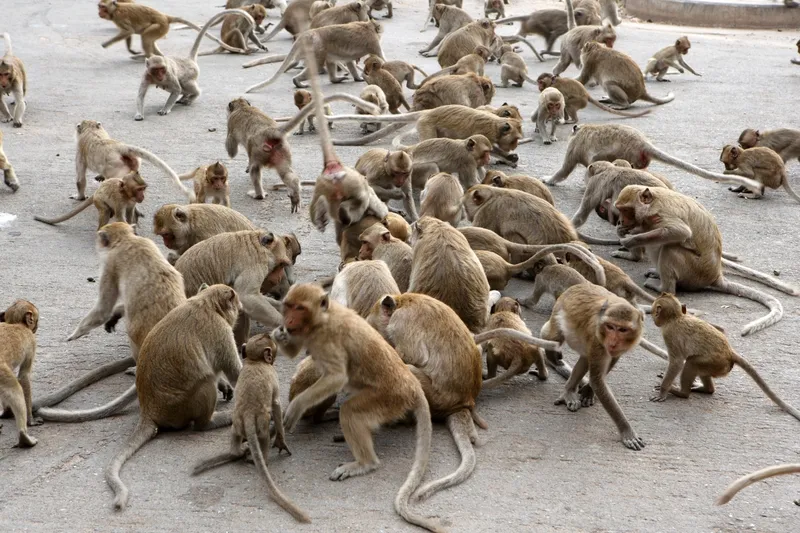
Monkey Park at Wat Dhammikawat (Wat Khang Khao) is a nature-based attraction with a distinctive charm in Sankhaburi District, Chai Nat Province. The main appeal of this place does not come from elaborate decoration, but from the natural character of the temple grounds, which remain filled with large trees, dense shade, and a sizeable troop of monkeys living in the area. Over time, this has become a memorable image for many visitors. The atmosphere inside the temple is calm, peaceful, and well suited to those who want to experience the charm of a local attraction that still preserves its traditional simplicity very clearly.
This monkey park is located within the grounds of Wat Dhammikawat in Phong Ngam Subdistrict, Sankhaburi District, Chai Nat Province. The temple itself is notable for its natural landscape, with many large rubber trees and other tall trees providing shade throughout the day. Combined with the monkeys that live naturally within the temple area, this has led travelers to refer to the site as the “Monkey Park” of Sankhaburi, making it an interesting stop for those traveling along the Sing Buri–Chai Nat route.
The charm of Monkey Park at Wat Dhammikawat lies in seeing the monkeys living in a real natural environment rather than in an enclosed animal display or a commercial zoo. Visitors therefore get to experience an atmosphere in which nature and wildlife still remain closely connected. The monkeys living here usually gather in groups among the large trees and around the temple grounds, so the sight of monkeys jumping from branch to branch or moving around the temple has become a defining feature that leaves a strong impression on many visitors.
The interest of this place does not come from the monkeys alone, but also from the surrounding temple atmosphere, which is rich in natural elements. In front of the temple, the Noi River flows past, making the surrounding area more humid and pleasantly cool. When the breeze moves through the trees and across the water, it adds even more shade and freshness to the temple. Many visitors therefore see Monkey Park at Wat Dhammikawat not only as a place to stop and watch monkeys, but also as a place to rest their eyes and minds while enjoying nature in the rural atmosphere of Chai Nat.
Wat Dhammikawat itself also holds spiritual significance for the local community. Within the temple grounds stands a cast image of Luang Pho Thao, a Buddha image that local people deeply respect. Visitors who come here therefore often do not come only to see the monkeys, but also stop to pay respects to Luang Pho Thao for good fortune. This makes Monkey Park at Wat Dhammikawat different from ordinary animal-viewing spots, as it is a place where nature, community life, and religious faith are harmoniously connected.
In terms of background, Monkey Park at Wat Dhammikawat developed from the natural conditions of the temple grounds, which were well suited to monkeys living there naturally. Because the temple area is densely shaded with large trees and has a peaceful environment, monkeys gradually came in and increased in number over time until they became a familiar sight for local residents and passersby. As time passed, the identity of the monkey park became inseparably tied to Wat Dhammikawat, and it became one of the places that helped make Phong Ngam Subdistrict and Sankhaburi District more widely known.
From an ecological perspective, the grounds of Wat Dhammikawat have features that clearly support small wildlife habitats, including tall tree cover, the dense shade of rubber groves, and the presence of a nearby water source. Such an environment allows monkeys to live suitably in terms of shelter, movement, and food-seeking. The fact that the monkeys continue to live here consistently reflects a relationship between nature and the community that has not been completely severed.
The troop of monkeys living within Wat Dhammikawat is the central feature of this place. These monkeys are somewhat familiar with people because they have lived near the community and temple for a long time. Visitors can therefore often spot them quite easily, especially during the quieter parts of the day. Even so, the enjoyment and charm of watching monkeys should be accompanied by caution, because they are still wild animals with natural behavior. Visitors should keep an appropriate distance, avoid provoking them, and avoid holding food or items that may attract the monkeys too closely.
Another charm of Monkey Park at Wat Dhammikawat is its tranquility, which differs from larger tourist attractions. Those who come here will not find many commercial activities, but instead will experience the simplicity of a rural temple where nature is the main element. This simplicity is what makes many people feel that a visit to this monkey park is more valuable than simply stopping for photos and moving on, because it gives people the opportunity to spend real time with nature.
In terms of tourism in Sankhaburi District, Monkey Park at Wat Dhammikawat is another destination that adds depth to local travel. Besides the district’s reputation for temples and old communities, having a monkey park within a temple area makes the travel route more varied. Travelers who enjoy a blend of nature and culture often see this as an interesting stop, because they can watch monkeys, relax under the shade of trees, and pay respects to sacred objects within the temple all in one visit.
For those who enjoy photography, Monkey Park at Wat Dhammikawat offers a number of interesting scenes, including monkeys on tree branches, the long shadows cast by tall rubber trees across the temple grounds, views of the Noi River in front of the temple, and the simple atmosphere of the surrounding community. These scenes do not offer the grand scale of major tourist attractions, but instead provide a beauty rooted in nature and everyday life, which is exactly the charm that many travel photographers seek.
In another sense, this monkey park also reflects the relationship between people and animals in a rural community very clearly. The monkeys are not separated from the temple grounds, but have become part of the landscape that people are familiar with. Many local residents therefore regard these monkeys as part of the area’s identity. The site is important not only for visitors, but also as a place the community feels connected to and wants to preserve.
Those who visit Monkey Park at Wat Dhammikawat should take their time and walk through the area without rushing, because the appeal of this place does not come from trying to complete a checklist of activities, but from gradually absorbing the surrounding atmosphere: the sounds of nature, the movement of the monkeys, the cool shade of the large trees, and the peace of the temple. Spending time slowly in the area helps one understand why this monkey park remains such a charming place in the memories of many people.
In terms of its current value, Monkey Park at Wat Dhammikawat remains important as a local attraction that allows people to connect with nature at close range without having to travel to a major park or conservation area. It is therefore highly suitable for those who want to explore Chai Nat in a quiet, simple, and distinctive way. It also reflects that tourism does not always need large-scale built attractions. Sometimes what is special lies in seeing that the relationship between nature, wildlife, and community life is still actively present in the same place.
For families traveling with children, Monkey Park at Wat Dhammikawat also has value as an accessible place for nature learning. Children can see monkeys in a real environment, learn how temple grounds and natural spaces can serve as wildlife habitats, and understand the importance of respecting the space of wild animals at the same time. An experience like this makes travel more than just leisure; it becomes learning that happens in a real place.
Getting There Monkey Park at Wat Dhammikawat is about 16 kilometers from the Sankhaburi District Office. Travelers can use the Sing Buri–Chai Nat route along the inner irrigation canal road. When reaching the Phong Ngam area, there is a junction leading into Wat Dhammikawat, and from that junction it is about another 500 meters to the temple grounds. Those traveling by private car will find it the most convenient, as they can easily continue on to other places in Sankhaburi District or Chai Nat Province. It is also not difficult to reach for those coming from Sing Buri.
In summary, Monkey Park at Wat Dhammikawat (Wat Khang Khao) is a tourist attraction defined by the simple beauty of nature and community life. Its main highlight is the large troop of monkeys living within the temple grounds among tall trees and the refreshing atmosphere created by the Noi River flowing past the front of the temple. Combined with the local devotion to Luang Pho Thao, this place is not merely a spot for watching monkeys, but a setting where nature, religion, and the local identity of Sankhaburi come together in a memorable way.
| Summary | Monkey Park at Wat Dhammikawat (Wat Khang Khao) is a nature-based attraction within Wat Dhammikawat in Phong Ngam Subdistrict, Sankhaburi District, Chai Nat Province, where a large troop of monkeys lives naturally among rubber trees and large shade trees. |
| Highlights | A large troop of monkeys living naturally, a shady atmosphere under large trees, the Noi River flowing in front of the temple, and the cast image of Luang Pho Thao revered by local residents |
| History / Period | The monkey park developed naturally as monkeys settled in the temple area because the environment, with many large trees and suitable natural conditions, supported their habitat. |
| Address | Wat Dhammikawat (Wat Khang Khao), Phong Ngam Subdistrict, Sankhaburi District, Chai Nat Province |
| Getting There | About 16 km from the Sankhaburi District Office. Use the Sing Buri–Chai Nat route along the inner irrigation canal road. There is a junction leading into Wat Dhammikawat, and from the junction it is about 500 meters to the temple grounds. |
| Open Days | Daily |
| Opening Hours | Open during daytime hours |
| Facilities | Walking areas within the temple grounds, a place to pay respects to Luang Pho Thao, and shaded resting areas under large trees |
| Zones | Rubber groves and large trees serving as the monkeys’ habitat, the area in front of the temple beside the Noi River, and the area for paying respects to Luang Pho Thao |
| Nearby Attractions | 1. Sankhaburi Market – approximately 16 km 2. Sankhaburi District Office – approximately 16 km 3. Noi River – directly in front of the temple 4. Phong Ngam community – in the same area 5. Inner irrigation canal route – along the same travel route |
| Nearby Restaurants | 1. Lapassarin Cafe – approximately 15 km. Tel. 082-642-3919 2. Krua Chef Pong Made-to-Order Restaurant – approximately 16 km 3. Dee Na Restaurant, Sankhaburi – approximately 16 km 4. Neua Tun Thung Thong – approximately 16 km 5. chawahouse cafe – approximately 16 km |
| Nearby Accommodations | 1. Chainat Thani Hotel – approximately 30 km 2. Riverside Chainat Hotel – approximately 30 km 3. Baan Ton Jaeng Resort – approximately 28 km 4. Chaophaya Thara Riverside Hotel – approximately 30 km 5. 111 Resort Chainat – approximately 28 km |
Frequently Asked Questions (FAQ)
Q: Where is Monkey Park at Wat Dhammikawat located?
A: The monkey park is located within Wat Dhammikawat, also known as Wat Khang Khao, in Phong Ngam Subdistrict, Sankhaburi District, Chai Nat Province.
Q: What is the highlight of Monkey Park at Wat Dhammikawat?
A: Its main highlight is the large troop of monkeys living naturally within the temple grounds, where there are large trees and rubber groves providing excellent shade.
Q: What else is interesting at Wat Dhammikawat besides the monkeys?
A: In addition to the monkeys, the Noi River flows in front of the temple, creating a refreshing atmosphere, and inside the temple there is a cast image of Luang Pho Thao that local people deeply respect.
Q: How far is Monkey Park at Wat Dhammikawat from Sankhaburi District?
A: The monkey park is about 16 kilometers from the Sankhaburi District Office.
Q: How do I get to Monkey Park at Wat Dhammikawat?
A: Use the Sing Buri–Chai Nat route along the inner irrigation canal road. When you reach the junction leading into Wat Dhammikawat, continue for about 500 meters to reach the temple grounds.
Q: Who is Monkey Park at Wat Dhammikawat suitable for?
A: It is suitable for nature lovers, families who want to take children to learn about animals, and travelers who want to relax in the shady atmosphere of a rural temple.
Q: What should visitors be careful about when visiting Monkey Park at Wat Dhammikawat?
A: Visitors should keep an appropriate distance from the monkeys, avoid provoking them, and be careful with food or personal belongings, because the monkeys are still wild animals with natural behavior.
 Category: ●Entertainment and Agricultural
 Group: ●Animal camps and shows
Last Update : 6 MonthAgo
 Last Update : 6 MonthAgo
 Click to Access the Navigation Map GPS
Monkey Park at Wat Dhammikawat (Wat Khang Khao) Map

 Art, Culture and Heritage
 Historical Sites and Monuments(1)
 Landmarks and Memorials(1)
 Art, Craft Centres, Tradition(2)
 Museums(2)
 Educational Places
 Museum for Study(1)
 Places of Worship
 Temple(21)
 Other Sacred Sites(4)
 Nature and Wildlife
 Mountain (Doi)(2)
 Dam, Reservoir, Lake(1)
 River, Canal(1)
 Zoos and Aquariums(1)
Animal camps and shows(3)
Zoos and Aquariums(1)
Animal camps and shows(3)
 Waterpark(1)


