
lovethailand home >Central Travel Attractions >Kanchanaburi Travel Attractions >Sangkhla Buri >Nong Lu > Wat Somdet
TL;DR: Wat Somdet is located at Ban Lai Nam, Nong Lu Subdistrict, Sangkhlaburi District, Kanchanaburi, open Daily, hours 07:00 – 17:00.
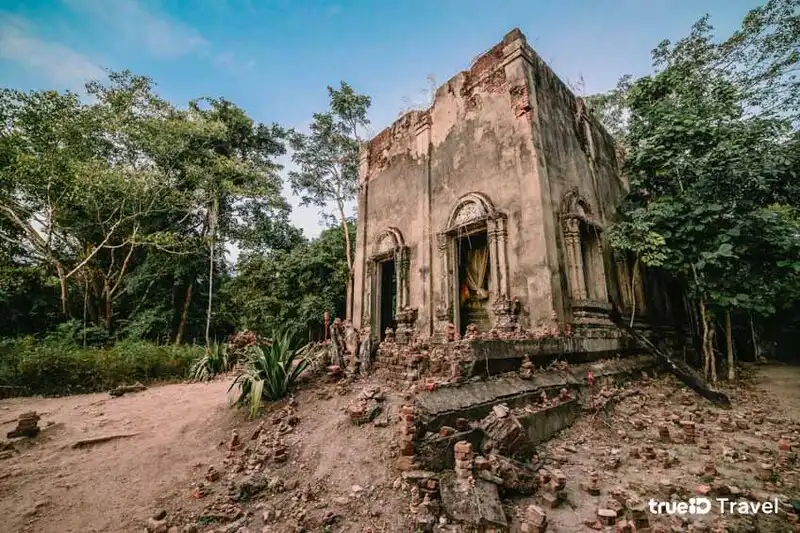
Wat Somdet
Open Days: Daily
Opening Hours: 07:00 – 17:00
Wat Somdet (Ban Lai Nam, Sangkhlaburi) is a Mon-Thai temple shaped by a lineage of faith, a “good site” recognized by Somdet Phra Wanrat of Wat Bowonniwet Vihara, and the steady support of Luang Por Uttama. A visit here is not only about paying respect, but also about observing Mon–Burmese aesthetics, reading the settlement history of Nong Lu, and understanding the deep relationship between the temple and the Mon community of Sangkhlaburi.
Wat Somdet in Nong Lu Subdistrict, Sangkhlaburi District, Kanchanaburi Province, tells the story of a border town without requiring lengthy explanation. Simply walking through the temple’s key elements—the sermon hall, the ordination hall, the stupa, and the reclining Buddha—reveals cultural codes that connect multiple communities: Thai residents, Mon-Thai communities, and Karen groups who have lived in the same landscape for generations. The significance of this temple is not limited to being a convenient stop before entering Sangkhlaburi town; it functions as a kind of social framework that helps organize community relationships through rituals, merit-making, and shared use of sacred space in everyday life.
The name “Wat Somdet” has a clear historical and symbolic origin. The temple is named after the ecclesiastical title (Somdet) associated with Somdet Phra Wanrat of Wat Bowonniwet Vihara, who visited this area around 1966 and remarked to Luang Por Uttama that the hill was a good location for establishing a temple. Wat Somdet was later founded in accordance with that view. This account reflects how senior monks “read the land” not merely as a set of elevations, but as a place with social potential—a potential to become a gathering point for people, and a necessity for a temple within a border community where movement, travel, and adaptation are constant realities. In this sense, the word “Somdet” is not only an honorific; it positions the temple as a stable and credible landmark of faith in the eyes of the community.
The temple stands in Ban Lai Nam, Nong Lu Subdistrict. By commonly shared local description, it lies about 3 kilometers before the Sangkhlaburi District Office, making it easier to access than some temples or sacred sites that require boat transfers or deeper routes. This accessibility matters for the temple’s role, because a temple on a main passage tends to serve both local residents and visitors. Wat Somdet therefore functions as a cultural “gateway” that helps newcomers understand the town more clearly—especially since Sangkhlaburi is a multicultural area with multiple languages, diverse customs, and layered histories of settlement.
As a border town, Sangkhlaburi carries meanings beyond the label of a tourist destination. The town is shaped by mountains, waterways, and cross-border routes. Many residents grew up with travel, trade, and reliance on natural resources, so diversity is not a decorative image but a real social structure. In this context, a temple does more than host religious rites; it becomes an institution that enables different groups to “understand one another” through shared rituals—making offerings, observing Buddhist holy days, kathina ceremonies, funerary rites, and gatherings during festivals. When a community holds multiple identities, the temple becomes a cultural lingua franca that prevents differences from turning into conflict, and instead transforms them into cooperation at the community level.
The role of Luang Por Uttama is a key lens for understanding Wat Somdet. He is widely revered in Sangkhlaburi and surrounding areas. His relationship with the community extends beyond the religious sphere to include the patient mediation that allows different ethnic groups to share space peacefully. In many respects, Wat Somdet reflects his vision that a temple should be a public space of faith—a place where people of different languages can make merit together, and where the community can have a clear and steady “center” that anchors social life.
Architecturally, the first feature that distinguishes Wat Somdet from many urban temples is the natural presence of Mon-Thai and Burmese aesthetics within a single site. This is not an ornamental choice made for novelty; it emerges from the cultural roots of the community that lives here. The temple’s sermon hall is Mon-style, and it is described as a structure created by Luang Por Uttama to serve as a venue for religious ceremonies involving senior monks and Buddhists in the Sangkhlaburi area. Because the sermon hall is central to community activity, its form and atmosphere become an “architectural language” that signals a living Mon cultural base in the town—not merely a name printed in tourist brochures.
In terms of use, the sermon hall is more open than other parts of the temple. It supports gatherings, listening to Dhamma talks, collective merit-making, and activities during festivals. A Mon-style sermon hall is therefore not only an aesthetic highlight; it helps people feel that the space belongs to them, that their faith has a place to stand and is acknowledged. In multicultural societies, this sense of belonging is crucial, because it allows co-existence to be built on respect rather than mere tolerance.
Beyond the sermon hall lies the ordination hall and the stupa area, which form the heart of worship as a Buddhist sacred complex. The stupa is said to be Mon-style, built by Luang Por Uttama, and it held the ceremonial raising of the stupa’s finial on Wednesday, April 11, 2001 (the 3rd waning day of the 4th lunar month). Details like these give the temple a sense of “time” and a specific “event” that ties into collective memory. The finial-raising is not only a religious rite; it marks the success of communal effort in creating a sacred monument, affirming that the stupa is not the work of a single person, but the result of a citywide network of faith.
At the back of the temple stands a reclining Buddha in the Parinirvana posture, lying on the right side with eyes gently closed, the right hand supporting the head, the left arm resting along the body, and the feet aligned in a composed overlap. This posture symbolizes ultimate truth, impermanence, and letting go. The placement of the reclining Buddha at the rear can feel like a concluding chapter of the temple walk: visitors begin in the realm of community life, move into the ritual core, and then finish with an image that points toward the cessation of suffering—as if walking from the world of people into the world of Dhamma, gradually and quietly.
Another element often noticed upon arrival is the pavilion across the road from the temple, where Buddha images in various postures are arranged in a striking row. This expands sacred space beyond the temple wall and reflects a community-oriented idea that religious life is not strictly separated from daily routines. People can pay respects while passing by, pause for a moment, and move on—allowing faith to blend into real-life rhythms rather than being confined only to major ceremonial occasions.
When speaking of Wat Somdet’s relationship with the Mon community, what stands out is the temple’s function as a living place of identity. The Mon community in Sangkhlaburi retains distinctive language, attire, foodways, and rituals. The temple’s Mon-Thai architectural and cultural atmosphere allows younger generations to recognize their roots through a space that is actively used, not through a museum display. Visiting the temple on important days, making merit together, or simply meeting and greeting one another on the grounds becomes a form of cultural transmission that does not require formal instruction; it is absorbed through repeated practice across seasons and years.
In a border town shaped by economic change, tourism, and the movement of people, a temple often provides emotional stability. Wat Somdet, in this sense, becomes a place where the Nong Lu community and those passing through can regain footing. Travelers may see it as a brief stop, but for locals it remains a place to return to—to dedicate merit, to pray about family or work, or to seek quiet when life feels unsettled. This kind of relationship means the temple is not a site for special occasions only; it is a social structure that functions continuously.
Another reason Wat Somdet is compelling for cultural travel is that it helps visitors read “Mon-ness” without turning it into an over-sold commodity. Many travelers know Sangkhlaburi through images of the Mon Bridge and misty mornings, but if one wants to understand why that bridge holds meaning and how the Mon community endures, walking into a temple that the community genuinely uses offers more answers. The temple makes visible the co-existence of Buddhist belief, respect for elders, merit-making practices, and social etiquette that hold people together.
If you want to see Wat Somdet more deeply, pay attention to small details: the languages spoken around the grounds, modest dress and occasional Mon attire, the way offerings are prepared or arranged in forms that may differ from central Thai temples, and the calm rhythm of how people use space. These are tangible cultural cues that turn a temple visit into a contextual reading of the town rather than a simple photo stop.
In contemporary history, Sangkhlaburi is often discussed in relation to the transformation of the landscape following the construction of Vajiralongkorn Dam (Khao Laem Dam), which affected several riverside communities. Although accounts of Wat Somdet emphasize its founding from Somdet Phra Wanrat’s recognition of the site and Luang Por Uttama’s role in development, understanding the temple fully benefits from linking it to Sangkhlaburi’s larger story. When a town faces structural change, people need places that help them steady their lives and reorganize their world. Temples in border towns often perform that role, and Wat Somdet is one of the spaces through which continuity is sustained.
Experientially, Wat Somdet suits a visit that is not rushed. The temple’s elements can be explored in sequence, beginning with the Mon-style sermon hall, continuing through the ordination hall and stupa, and then moving to the rear to pay respects at the reclining Buddha. This pace allows visitors not only to “check in” but to absorb the site’s meaning. If time permits, sitting quietly for a short moment in a calm corner can make it easier to understand why temples in border towns often matter beyond photography.
Temple etiquette is straightforward: dress modestly, avoid sleeveless tops and shorts or skirts above the knee, remove shoes before entering worship areas, and keep voices low near those who are meditating or praying. If taking photos, avoid blocking worshippers, and refrain from using flash near Buddha images to maintain respect for the sacred environment.
Getting There Wat Somdet can be reached from Sangkhlaburi town center by heading toward Nong Lu Subdistrict. The temple is located in Ban Lai Nam and is commonly described as being about 3 kilometers before the District Office along the main route. Driving a private car is the most convenient option, especially if you plan to continue to nearby attractions such as Uttamanusorn Bridge (Mon Bridge), the Phutthakhaya Pagoda, the submerged old temple site, or the Three Pagodas Pass within the same day. Without a private car, visitors can use local shared transport, hired vehicles, or motorcycle taxis in the Sangkhlaburi area. It can also be helpful to ask your accommodation to arrange transport, especially very early in the morning or in the evening for greater time certainty.
For travelers coming from Bangkok, plan extra time because the distance is long and the final sections include mountain curves. Driving without rushing is safer. If you want the most pleasant atmosphere, arrive in Sangkhlaburi before late afternoon to settle into your accommodation, then plan your temple visit for a time with comfortable light and fewer crowds. Early mornings are typically calmer and better for focused worship, while late afternoons are comfortable for walking and photography in softer light.
If you want a fuller multicultural picture of Sangkhlaburi, consider using Wat Somdet as a starting point, then continue to key places in town: Uttamanusorn Bridge (Mon Bridge) to see community life, the Phutthakhaya Pagoda to connect with another axis of faith, and the submerged old temple area to understand how large-scale development reshaped the town’s landscape. This kind of route helps transform travel from a list of photo points into a coherent reading of the town through a central narrative.
| Name | Wat Somdet, Ban Lai Nam, Nong Lu, Sangkhlaburi |
| Address | Ban Lai Nam, Nong Lu Subdistrict, Sangkhlaburi District, Kanchanaburi |
| Summary | A Mon-Thai temple in Sangkhlaburi named after the title “Somdet Phra Wanrat” of Wat Bowonniwet Vihara, who is remembered for identifying the hill as a suitable temple site around 1966. Developed under the influence of Luang Por Uttama, the temple became a shared spiritual and cultural space for Thai, Mon, and Karen communities, with notable Mon-style architecture, a Mon-style stupa, and a reclining Buddha in the Parinirvana posture. |
| Highlights | 1) The temple name and origin story linked to Somdet Phra Wanrat and the recognition of a “good site” for founding a temple 2) A Mon-style sermon hall associated with Luang Por Uttama and community ceremonies across groups 3) A Mon-style stupa and the stupa finial-raising ceremony (April 11, 2001) remembered as a community milestone 4) A reclining Buddha in the Parinirvana posture at the rear of the temple 5) A pavilion across the road displaying Buddha images in multiple postures, extending sacred space into everyday movement 6) Strong ties to the Mon community of Nong Lu, where identity is practiced as living culture |
| Abbot Or Acting Head (Latest) | Phra Somjit Khossiko |
| Facilities | Worship areas, a sermon hall for community activities, and on-site parking (subject to actual conditions) |
| Current Status | Open for visits and worship (check on-site notices on the day of travel) |
| Nearby Tourist Attractions With Distance | 1) Uttamanusorn Bridge (Mon Bridge) – approx. 4 km 2) Phutthakhaya Pagoda (Sangkhlaburi) – approx. 4 km 3) Submerged Old Temple Area (Old Wat Wang Wiwekaram) – approx. 6 km 4) Sangkhlaburi Market Area – approx. 4 km 5) Three Pagodas Pass – approx. 25 km |
| Popular Restaurants Nearby With Distance And Phone | 1) Pae Mit Sampan – approx. 5 km – 034-595-261 2) Rung Arun Restaurant – approx. 4 km – 034-595-175 3) Cafe Green By Forgetmenot – approx. 4 km – 034-595-015 4) Sri Daeng Restaurant – approx. 4 km – 034-595-088 5) Lee’s Kitchen Korean Restaurant – approx. 4 km – 096-232-5540 6) Krua Je Lee (Shabu / Mookata / A La Carte) – approx. 4 km – 098-267-0948 |
| Popular Accommodations Nearby With Distance And Phone | 1) Samprasob Resort – approx. 4 km – 085-811-8711 2) P. Guest House And Country Resort – approx. 4 km – 081-450-2783 3) Suanmagmai Resort – approx. 5 km – 034-595-111 4) Sweetville Home – approx. 6 km – 063-232-9101 5) Sangkla Resort – approx. 6 km – 089-916-4242 |
Frequently Asked Questions (FAQ)
Q: Is Wat Somdet open every day, and what are the opening hours?
A: The temple is generally open daily. The commonly stated hours are 07:00 – 17:00. Visit early for a quieter atmosphere, or in the afternoon for a comfortable walk around the grounds and architecture.
Q: Who is Wat Somdet named after, and what does the name mean?
A: The name reflects the ecclesiastical title associated with Somdet Phra Wanrat of Wat Bowonniwet Vihara, remembered for identifying the hill as a suitable temple site around 1966. The name communicates both reverence and the temple’s intended role as a stable landmark of faith for the community.
Q: How is Luang Por Uttama connected to Wat Somdet?
A: He is described as a key force in developing the temple, particularly through Mon-style structures and the stupa, and by shaping the temple as a shared space for Thai, Mon, and Karen communities through rituals, merit-making, and communal religious activities.
Q: What are the main worship or sightseeing points inside the temple?
A: Key points include the Mon-style sermon hall, the ordination hall and Mon-style stupa area, and the reclining Buddha in the Parinirvana posture at the rear, as well as the pavilion across the road displaying Buddha images in multiple postures.
Q: How does Wat Somdet relate to the Mon community in Sangkhlaburi?
A: The temple serves as a living cultural anchor where Mon identity continues through real practices—shared merit-making, rituals, and everyday use of space—while also connecting different community groups through respectful co-existence.
Q: What should visitors wear and how should they behave at Wat Somdet?
A: Dress modestly (avoid sleeveless tops and short bottoms above the knee), remove shoes before entering worship areas, keep voices low, and avoid using flash near Buddha images or disturbing people who are meditating or praying.
 Category: ●Places of Worship
 Group: ●Temple
Last Update : 8 MonthAgo
 Last Update : 8 MonthAgo
 Click to Access the Navigation Map GPS
Wat Somdet Map
Recommend

 Art, Culture and Heritage
 Historical Sites and Monuments(13)
 Landmarks and Memorials(5)
 Art, Craft Centres, Tradition(7)
 Museums(7)
 Art Gallery(1)
Temple(37)
Art Gallery(1)
Temple(37)
 Church(2)
 Other Sacred Sites(6)
 Research and Development
 Royal Project(1)
 Suburban Living
 Village, Community(5)
 Local Market(1)
 Nature and Wildlife
 National Parks and Marine Reserves(11)
 Mountain (Doi)(6)
 Dam, Reservoir, Lake(9)
 Waterfalls(19)
 Hot Springs(3)
 Caves(20)
 River, Canal(3)
 Other natural attractions(4)
 Entertainment and Agricultural
 Zoos and Aquariums(2)
 Animal camps and shows(4)
 Farms, Parks and Ecotourism(11)
 Cinema(1)
 Outdoor and Adventure Activities(2)
 Travel Articles, Recipes
 Travel Review, Food Review(1)


