
lovethailand home >Central Travel Attractions >Kanchanaburi Travel Attractions >Tha Muang >Muang Chum > Wat Phichai Thammararam (Chuk Phi)
TL;DR: Wat Phichai Thammararam (Chuk Phi), open Daily, hours 06:00 – 18:00. Highlights include History of land expropriation and relocation of a community’s spiritual center.
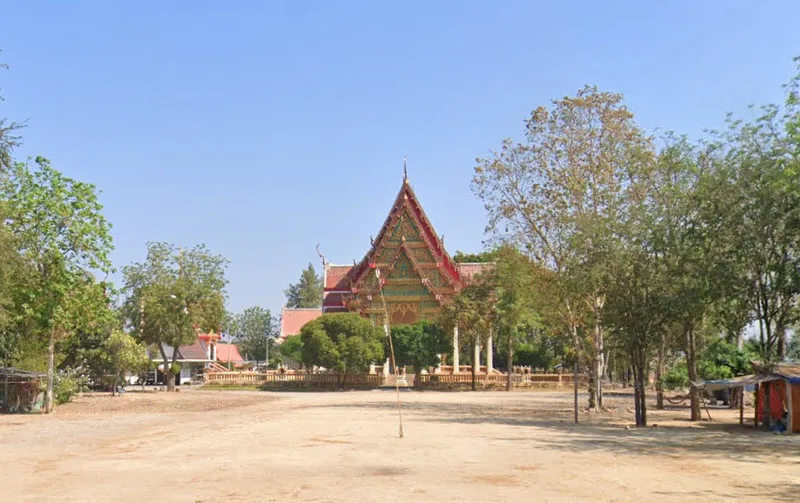
Wat Phichai Thammararam (Chuk Phi)
Open Days: Daily
Opening Hours: 06:00 – 18:00
Wat Phichai Thammararam (Chuk Phi) is an ancient temple in Kanchanaburi Province that holds significant importance both in terms of local history and as a spiritual center for the surrounding community. The temple was formerly known as “Wat Chuk Phi,” a name that does not appear in any official written records but has been passed down through oral tradition by village elders over generations. This name has become a shared memory of the local community and is widely accepted as the temple’s original name.
According to oral accounts and local assumptions, Wat Chuk Phi was likely established at least during the early Rattanakosin period, or possibly earlier, in the form of a monastic residence or forest monastery where monks regularly resided. At that time, the temple had not yet been formally registered, but it functioned as a spiritual center for the local population. It served as a place for religious ceremonies, merit-making activities, and a refuge for villagers during both ordinary times and significant life events.
For many generations, Wat Chuk Phi prospered and played an integral role in the daily lives of the surrounding communities. Villagers regularly gathered at the temple to make merit, observe religious precepts, and practice meditation. The temple was not only a religious site but also a place for social interaction, learning, and the transmission of moral values from one generation to the next. As a result, the relationship between the temple and the community became deeply rooted and enduring.
A major event that permanently altered the temple’s history occurred with the construction of Vajiralongkorn Dam, later renamed Mae Klong Dam. This large-scale development project required extensive land expropriation, including the entire area of Wat Chuk Phi. The temple’s land, totaling 30 rai, 1 ngan, and 6 square wah, was officially expropriated on March 13, 1969, for dam construction. This event had a profound emotional impact on both the temple and the community that had been closely connected to it for generations.
Following the expropriation, Phra Palad Chan Kalyanadhammo played a crucial role in uniting the community’s faith. Together with local villagers, he organized the purchase of a new plot of land and oversaw the construction of a new temple. The newly established temple was named “Wat Phichai Thammararam,” symbolizing the triumph of faith and the continued presence of Buddhist teachings despite major upheaval. The temple stands as a testament to the collective determination of the community to preserve its spiritual and cultural roots.
An important ceremony during the establishment of the new temple was the ritual invocation and enshrinement of the temple’s sacred Buddha images: Luang Pho Sila Laeng and Luang Pho Yai Sitthichok, which were installed in the mandapa of the new temple. This act was not merely a physical relocation of sacred objects, but a transfer of the community’s spiritual heart, ensuring that Wat Phichai Thammararam would continue to serve as a refuge of faith and devotion.
Luang Pho Sila Laeng is a highly revered Buddha image, admired for its simple yet powerful artistic style that reflects both antiquity and accumulated sacredness. Luang Pho Yai Sitthichok, the principal Buddha image of the temple, is venerated as a symbol of auspiciousness and success. Together, these two images form the spiritual core of Wat Phichai Thammararam and serve as focal points for worshippers who visit the temple.
Today, Wat Phichai Thammararam offers a serene and peaceful atmosphere, making it well suited for merit-making, prayer, and meditation practice. The temple’s architecture reflects the simplicity of rural Thai temples, combined with orderly spatial planning. It continues to play an important role in the lives of nearby residents and provides visitors with an environment conducive to reflection and inner calm.
Getting There Wat Phichai Thammararam is most conveniently accessed by private vehicle. From Bangkok, take Borommaratchachonnani Road toward Nakhon Pathom, pass the Nakhon Chai Si intersection, continue toward Ratchaburi, and then proceed into Kanchanaburi Province. Once near Mae Klong Dam, follow local directional signs to the temple, which is located not far from the dam’s water control gates. The final stretch follows local roads that are easily accessible by car.
| Summary | An ancient temple relocated entirely due to dam construction |
| Highlights | History of land expropriation and relocation of a community’s spiritual center |
| Abbot / Administrator | - |
| Current Status | Open to the public for worship and visits |
| Nearby Accommodations | 1) Whitehouse Resort Kanchanaburi (30 km) Tel. 0818480836 2) The Vista Pool Villa (32 km) Tel. 034510959 3) BanRuen Resort (34 km) Tel. 0899674686 4) West View Villa (35 km) Tel. 034612222 5) Love In Kan Resort (30 km) Tel. 0968507293 |
| Nearby Restaurants | 1) Krua Mae Klong Dam (29 km) Tel. 0969255986 2) KAAN Riverkwai Restaurant (30 km) Tel. 0999393745 3) Keereetara Riverside (31 km) Tel. 034518888 4) Rakkanna Noodle & Café (30 km) Tel. 0800616888 5) On’s Thai-Issan Vegan (31 km) Tel. 0873642264 |
| Nearby Attractions | 1) Bridge over the River Kwai (30 km) 2) Death Railway (30 km) 3) Sai Yok Noi Waterfall (50 km) 4) Sai Yok National Park (50 km) 5) Vajiralongkorn Dam / Mae Klong Dam |
Frequently Asked Questions (FAQ)
Q: What was the former name of Wat Phichai Thammararam (Chuk Phi)?
A: The temple was formerly known as “Wat Chuk Phi,” a name preserved through oral tradition.
Q: When was Wat Chuk Phi established?
A: It is believed to have been established during the early Rattanakosin period as a monastic residence.
Q: Why was the temple relocated?
A: The original site was expropriated in 1969 for the construction of Vajiralongkorn Dam.
Q: What are the important Buddha images at the temple?
A: Luang Pho Sila Laeng and Luang Pho Yai Sitthichok.
Q: What type of tourism is Wat Phichai Thammararam suitable for?
A: Cultural tourism, historical exploration, and meditation-oriented visits.
 Category: ●Places of Worship
 Group: ●Temple
Last Update : 9 MonthAgo
 Last Update : 9 MonthAgo
 Click to Access the Navigation Map GPS
Wat Phichai Thammararam (Chuk Phi) Map
Recommend

 Art, Culture and Heritage
 Historical Sites and Monuments(13)
 Landmarks and Memorials(5)
 Art, Craft Centres, Tradition(7)
 Museums(7)
 Art Gallery(1)
Temple(37)
Art Gallery(1)
Temple(37)
 Church(2)
 Other Sacred Sites(6)
 Research and Development
 Royal Project(1)
 Suburban Living
 Village, Community(5)
 Local Market(1)
 Nature and Wildlife
 National Parks and Marine Reserves(11)
 Mountain (Doi)(6)
 Dam, Reservoir, Lake(9)
 Waterfalls(19)
 Hot Springs(3)
 Caves(20)
 River, Canal(3)
 Other natural attractions(4)
 Entertainment and Agricultural
 Zoos and Aquariums(2)
 Animal camps and shows(4)
 Farms, Parks and Ecotourism(11)
 Cinema(1)
 Outdoor and Adventure Activities(2)
 Travel Articles, Recipes
 Travel Review, Food Review(1)


