
lovethailand home >North Travel Attractions >Chiang Mai Travel Attractions >San Kamphaeng >Ton Pao > Wat Nong Khong
TL;DR: Wat Nong Khong is located at Ban Nong Khong, Village No. 2, Ton Pao Subdistrict, San Kamphaeng District, Chiang Mai Province.

Wat Nong Khong
Operating day: Daily
Operating time: 08.00 - 17.00
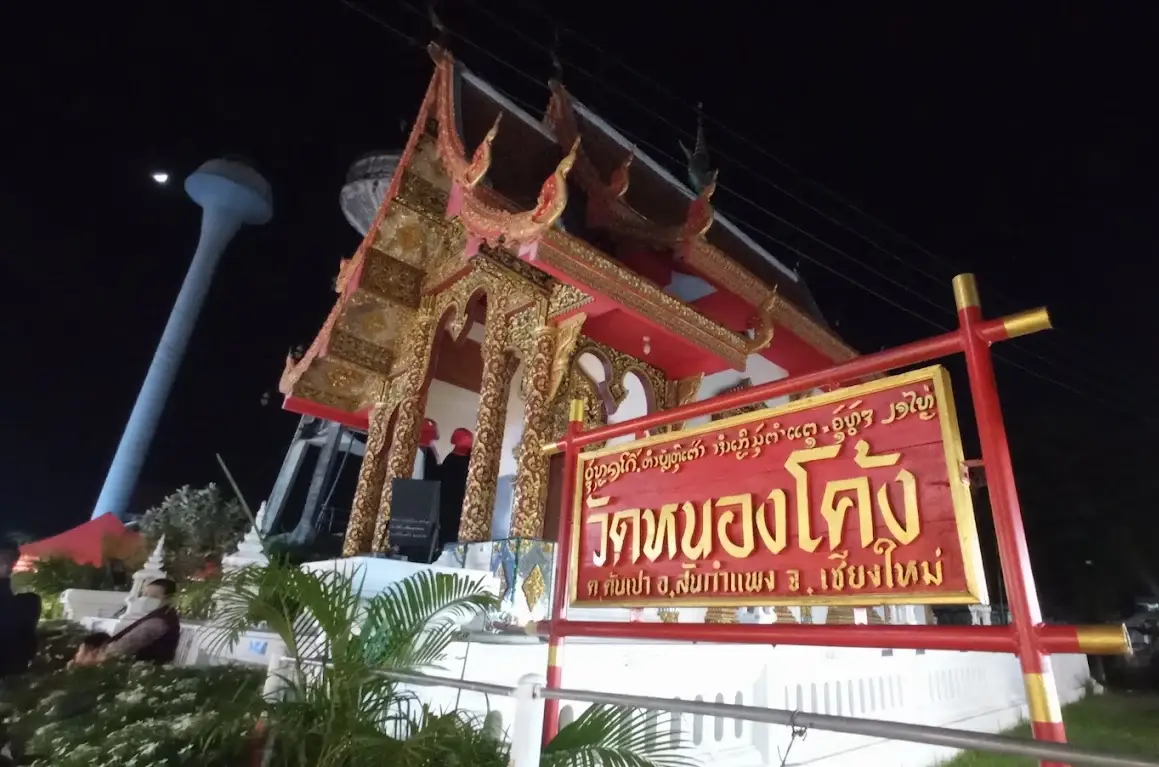
Wat Nong Khong is a local Buddhist temple under the Mahanikaya sect, located at 148 Ban Nong Khong, Village No. 2, Ton Pao Subdistrict, San Kamphaeng District, Chiang Mai Province 50130. The temple serves as the spiritual center of Ban Nong Khong, a community known for Lanna lantern craftsmanship and San Kamphaeng handicrafts. Wat Nong Khong is therefore meaningful not only as a Buddhist temple, but also as part of the cultural landscape where religion, village life, craft knowledge, and community identity meet.
Ban Nong Khong is located in Ton Pao Subdistrict, an important cultural and craft area of San Kamphaeng District. Ton Pao is associated with Bo Sang umbrellas, mulberry paper, Lanna lanterns, and various forms of local craftsmanship. Wat Nong Khong stands within this living cultural environment, surrounded by community roads, houses, schools, local craft activities, and village traditions. A visit to the temple gives travelers a quieter and more grounded understanding of Ton Pao beyond its better-known craft attractions.
The temple history records that Wat Nong Khong was built around 762 CE according to temple-history forms, while the provincial temple register records the official establishment in 1864. This kind of difference is common in older community temples, where local memory may preserve an earlier religious site or monastic presence, while official registration records a later administrative date. For visitors, the key point is that Wat Nong Khong is an old community temple with a long relationship with Ban Nong Khong.
The name “Nong Khong” reflects the relationship between community identity and landscape. “Nong” suggests a pond, wetland, or water-related place, while “khong” suggests a curve or bend in the landscape or local route. The temple name is directly connected with the village name, preserving local memory through the temple. This naming pattern is common in Lanna communities, where temples often carry the identity of the village that established and supported them.
Wat Nong Khong is a local temple under the Mahanikaya sect. A community temple of this kind remains closely connected with everyday village life. It supports worship, Buddhist holy days, Kathin, forest robe offerings, ordinations, funerals, Buddhist Lent, the end of Buddhist Lent, and merit-making activities that bring villagers together throughout the year.
The abbot of Wat Nong Khong is Phra Athikan Parames Subhattho. Recent community temple data also lists 5 resident monks. This confirms the temple’s continuing role as an active Buddhist temple with monks in residence and regular religious use. In a village temple, the abbot’s role is important for monastic care, ceremonies, temple maintenance, and the relationship between monks and local devotees.
Important structures and sacred objects recorded for Wat Nong Khong include a sala bat, monks’ quarters, a two-storey scripture hall, and a carved wooden pulpit decorated with lacquer and gold. The sala bat supports merit-making and community activities. The monks’ quarters support monastic residence. The scripture hall preserves the temple’s relationship with Buddhist learning, while the carved pulpit reflects local craftsmanship and reverence for Dhamma teaching.
The scripture hall of Wat Nong Khong is especially interesting. It is described as a two-storey building with a masonry lower floor and a wooden upper floor. Its gable features floral woodcarving decorated with lacquer and gold. In Lanna Buddhist culture, a scripture hall is not only a storage place for manuscripts and religious texts, but also a symbol of respect for the Dhamma. The mixed construction of masonry and wood shows local building knowledge and the importance placed on preserving religious texts.
The carved wooden pulpit is another important feature. A pulpit is used by monks for preaching and teaching. Its floral carving and gilded decoration show the community’s respect for Dhamma listening. Such religious woodwork is valuable not only as decoration, but also as evidence of the craftsmanship and devotional culture of Lanna temples.
Wat Nong Khong also has a meaningful connection with local education. Community history notes that the temple’s sala bat was once used as a temporary classroom for children from Villages No. 1 and No. 2 of Ton Pao. This reflects the historic role of Thai temples as centers of learning before permanent school facilities were widely available. Wat Nong Khong therefore contributed to the community not only through religion, but also through local education and social development.
Ban Nong Khong is well known for Lanna lantern craftsmanship and San Kamphaeng handicrafts. The Nong Khong Lantern and San Kamphaeng Handicraft Festival reflects the community’s identity as a place of lantern-making and local craft knowledge. Since Wat Nong Khong stands in this craft village, the temple is naturally connected with both Buddhist faith and the creative knowledge of local artisans.
The community project “Khuang Phaya Phum Panya Ban Nong Khong” further shows how Ban Nong Khong continues to promote local wisdom. The project includes craft demonstrations, cultural activities, lantern decoration, and community-based tourism. In this context, Wat Nong Khong functions as a spiritual anchor of the village, while the surrounding community presents its living craft heritage.
For visitors, the main appeal of Wat Nong Khong is its authentic village-temple character and its recorded heritage features. The two-storey scripture hall, carved wooden pulpit, sala bat, monks’ quarters, and quiet temple courtyard make it a worthwhile stop for travelers interested in Lanna temple culture. Rather than a large commercial attraction, the temple offers a closer view of how Buddhism continues in a working community.
The atmosphere of Wat Nong Khong is calm and local. Visitors can pay respect, make merit, walk through the temple grounds, and then continue to nearby craft areas in Ban Nong Khong, Ban Ton Pao, and Bo Sang. The temple is best appreciated slowly, with attention to its role in village life and its connection with community heritage.
Religious activities at Wat Nong Khong include Kathin, forest robe offerings, Buddhist holy days, Buddhist Lent, the end of Buddhist Lent, and other major Buddhist observances. Recent information also mentions a Chula Kathin ceremony at the temple, with traditional elements such as weaving, dyeing, and preparing ceremonial rice within one night before dawn. This reflects strong community participation and continuity of Buddhist-Lanna merit-making traditions.
Wat Nong Khong can be included in several cultural routes around Ton Pao and San Kamphaeng. Visitors can combine the temple with Ban Nong Khong’s lantern community, Ban Ton Pao’s mulberry paper craft area, Bo Sang Umbrella Village, Wat Bo Sang, Wat Phra Pan, Wat Ton Phueng, or Wat Buak Pet. For a broader cultural route, MAIIAM Contemporary Art Museum and Baan Jang Nak can also be added.
Getting There from Chiang Mai city is convenient by private car, rental car, or local hired transport. Take the Chiang Mai–San Kamphaeng route toward Ton Pao Subdistrict, then continue to Ban Nong Khong, Village No. 2. The temple is located at 148 Ban Nong Khong, Ton Pao Subdistrict, San Kamphaeng District, Chiang Mai. Travelers already visiting Bo Sang or Ton Pao can add Wat Nong Khong without a long detour.
A half-day itinerary can include Wat Nong Khong, Ban Nong Khong, Ban Ton Pao, Bo Sang Umbrella Village, and Wat Bo Sang. A fuller itinerary can add Wat Phra Pan, Wat San Pa Kha, Wat San Mahok Fa, MAIIAM Contemporary Art Museum, or Baan Jang Nak. This route gives travelers a wider view of San Kamphaeng through temples, village crafts, community wisdom, and contemporary art.
Visitors should dress modestly, keep noise low, avoid disturbing monks or local devotees, and behave respectfully in the temple grounds. If a ceremony, funeral, or merit-making activity is taking place, visitors should give space to the participants and avoid intrusive photography. Wat Nong Khong remains an active community temple, so respectful conduct is essential.
Wat Nong Khong deserves a place in San Kamphaeng’s cultural travel routes because it combines a long temple history, a living village-temple role, a two-storey scripture hall, carved religious woodwork, a sala bat once connected with local education, and a strong connection with the Lanna lantern heritage of Ban Nong Khong. For travelers who want to understand Ton Pao beyond Bo Sang umbrellas alone, this temple offers a calm and meaningful view of Lanna Buddhist community culture.
| Name | Wat Nong Khong |
| Location | Ban Nong Khong, Village No. 2, Ton Pao Subdistrict, San Kamphaeng District, Chiang Mai Province |
| Address | 148 Ban Nong Khong, Village No. 2, Ton Pao Subdistrict, San Kamphaeng District, Chiang Mai 50130, Thailand |
| Type | Local Buddhist temple under the Mahanikaya sect |
| Highlights | Village temple of Ban Nong Khong, two-storey scripture hall, sala bat, monks’ quarters, carved wooden pulpit with lacquer and gold decoration, and connection with Lanna lantern heritage |
| History | Temple history records construction around 762 CE, while the provincial temple register records official establishment in 1864 |
| Name Origin | Linked with Ban Nong Khong, a village name that preserves local memory of landscape, water, and the old village setting |
| Abbot / Caretaker | Phra Athikan Parames Subhattho |
| Resident Monks | 5 monks |
| What To See / Worship | Two-storey scripture hall, carved wooden pulpit, sala bat, monks’ quarters, worship area, temple courtyard, and the local atmosphere of Ban Nong Khong |
| Main Areas / Structures | Sala bat, monks’ quarters, two-storey scripture hall, worship area, temple courtyard, and community merit-making area |
| Sacred / Artistic Features | Carved wooden pulpit with floral patterns, lacquer and gold decoration, and a scripture hall with a wooden upper floor and floral carved gable |
| Community Context | Ban Nong Khong is a Ton Pao community known for Lanna lantern craftsmanship, local handicrafts, and community-based cultural activities |
| Religious Activities | Kathin, forest robe offerings, Chula Kathin, Buddhist holy days, Buddhist Lent, the end of Buddhist Lent, and major Buddhist observances |
| Community Importance | Spiritual center of Ban Nong Khong, used for Buddhist ceremonies, merit-making, community activities, and historically connected with local education through the use of the sala bat as a temporary classroom |
| Travel Information | From Chiang Mai city, take the Chiang Mai–San Kamphaeng route toward Ton Pao, then continue to Ban Nong Khong, Village No. 2; best accessed by private car, rental car, or local hired transport |
| Current Status | Active community Buddhist temple used for local religious ceremonies |
| Main Contact Number | 053-339-167 |
| Main Areas / Zones | 1. Worship area and temple courtyard 2. Sala bat 3. Monks’ quarters 4. Two-storey scripture hall 5. Community religious activity area |
| Nearby Tourist Attractions | 1. Ban Nong Khong / Lanna Lantern Craft Community, about 1 km 2. Ban Ton Pao / Mulberry Paper Craft Area, about 2 km 3. Bo Sang Umbrella Village, about 3 km 4. Wat Bo Sang, about 3 km 5. MAIIAM Contemporary Art Museum, about 5 km |
| Nearby Restaurants | 1. Baan Im Tong Branch 1, about 1 km 2. Solao Baan Je Ton Pao Branch, about 3 km, Tel. 099-397-9946 3. Bo Sang Cafe, about 3 km, Tel. 087-710-5232 4. Saphai Mae Nuan Pla Phao Bo Sang, about 4 km, Tel. 096-083-2539 5. Je Su Yentafo Bo Sang San Kamphaeng Old Road Branch, about 4 km, Tel. 064-225-2878 |
| Nearby Accommodations | 1. The Vet Boutique Hotel, about 3 km, Tel. 052-011-179 2. Chiangmai Lanna Modern Loft Hotel, about 4 km, Tel. 062-181-9696, 063-465-7785, 082-347-2527 3. Doltara Chiang Mai Boutique Resort, about 6 km, Tel. 086-348-0692 4. LaMoon Cottage SanKampang, about 7 km, Tel. 094-723-5395 5. The Puka Boutique Resort, about 8 km, Tel. 053-965-499 |
Frequently Asked Questions (FAQ)
Q: Where is Wat Nong Khong located?
A: Wat Nong Khong is located at 148 Ban Nong Khong, Village No. 2, Ton Pao Subdistrict, San Kamphaeng District, Chiang Mai Province 50130.
Q: What type of temple is Wat Nong Khong?
A: Wat Nong Khong is a local Buddhist temple under the Mahanikaya sect and serves as the community temple of Ban Nong Khong.
Q: What is important about Wat Nong Khong’s history?
A: Temple history records construction around 762 CE, while the provincial temple register records official establishment in 1864, making it an old community temple of Ton Pao.
Q: Who is the abbot of Wat Nong Khong?
A: The abbot of Wat Nong Khong is Phra Athikan Parames Subhattho.
Q: What are the highlights of Wat Nong Khong?
A: Highlights include the two-storey scripture hall, sala bat, monks’ quarters, carved wooden pulpit with lacquer and gold decoration, and the temple’s connection with Ban Nong Khong’s Lanna lantern heritage.
Q: How is Wat Nong Khong connected with Lanna lantern culture?
A: The temple stands in Ban Nong Khong, a Ton Pao community known for Lanna lantern craftsmanship and San Kamphaeng handicrafts, so it is closely connected with local craft identity.
Q: What nearby places can be visited with Wat Nong Khong?
A: Nearby places include Ban Nong Khong’s lantern craft community, Ban Ton Pao, Bo Sang Umbrella Village, Wat Bo Sang, and MAIIAM Contemporary Art Museum.
 Category: ●Places of Worship
 Group: ●Temple
Last Update : 2 MonthAgo
 Last Update : 2 MonthAgo
 Click to Access the Navigation Map GPS

 Muang Chiang Mai(121)Chom Thong(47)Mae Chaem(25)Chiang Dao(33)Doi Saket(68)Mae Taeng(85)Mae Rim(69)Samoeng(29)Fang(71)Mae Ai(59)Phrao(70)San Pa Tong(103)San Kamphaeng(66)San Sai(73)Hang Dong(73)Hot(32)Doi Tao(22)Omkoi(11)Saraphi(74)Wiang Haeng(15)Chai Prakan(28)Mae Wang(32)Mae On(22)Doi Lo(33)Galyani Vadhana(1)


