

 Home
Home Chiang Mai(










Rating: 4.2/5 (5 votes)
 |
|  Map
Map 
 Have Map
  No Map
Chiang Mai attractions
Attractions in Thailand
Open Days: Every day
Opening Hours: 08:00–17:00
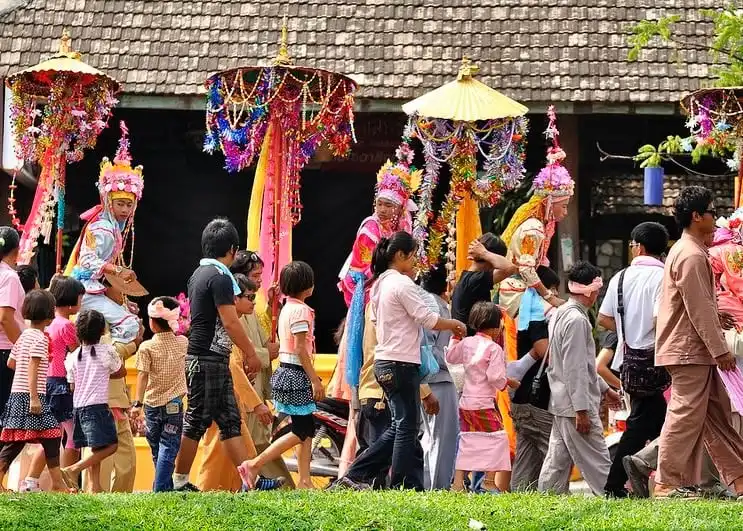
Poi Noi, Poi Luang, Poi Khao Sang, and Poi Lor — Four Important Ceremonial Traditions in Lanna Culture In Lanna society, the word “poi” refers to religious celebrations or merit-making events connected to temples and the community. Each type of “poi” reflects the way of life, beliefs, and deep spiritual ties between people and the temple. Although the same word is used, the nature and meaning of each kind of “poi” are clearly different in terms of scale, role in the community, and religious significance. This article introduces four common forms of poi in Lanna culture: Poi Noi, Poi Luang, Poi Khao Sang, and Poi Lor.
Poi Noi — A Small, Intimate Merit-Making Ceremony “Poi Noi” is a small-scale religious ceremony, often referring to an ordination celebration (poi buat) or “poi pek” held within the family or among close relatives. It is a private, joyous event mainly shared by the parents of the ordinand, relatives, and close friends. There are no large crowds or grand arrangements like a full village celebration, which is why it is called “Poi Noi,” meaning a small poi or a modest ceremony.
The atmosphere of Poi Noi is usually warm and friendly. Relatives and nearby villagers come to share merit, take part in a small ordination procession, listen to gentle traditional music, and enjoy home-cooked local food. Even though the event may not be grand or spectacular, it carries great emotional meaning and reflects the close-knit bonds among family members and loved ones.
Poi Luang — A Grand Communal Celebration “Poi Luang” is a large-scale consecration ceremony — a major community event clearly bigger than Poi Noi. It is usually organized to celebrate important religious structures of the village, such as an ordination hall (ubosot), viharn (assembly hall), monk’s living quarters, stupas, or other permanent religious constructions that villagers have worked together to complete.
Poi Luang often lasts for several days. The event is filled with Buddhist rituals such as almsgiving, listening to sermons, offering meals to monks, and presenting elaborate offerings. There are also processions, sacred offerings, traditional music, and various forms of entertainment, creating a festival-like atmosphere throughout the village.
Therefore, Poi Luang is not just an ordinary religious event. It represents the collective identity of the Lanna community, reflecting unity, strong faith, and the pride of villagers who have joined forces to create lasting religious landmarks that serve as spiritual centers for generations to come.
Poi Khao Sang — A Ceremony to Dedicate Merit to the Departed “Poi Khao Sang” refers to a merit-making ceremony dedicated to those who have passed away. It reflects the values of gratitude and remembrance of ancestors in Lanna culture. Children and relatives prepare rice, food, daily necessities, and other offerings to present to monks on behalf of the deceased.
On the day of the ceremony, monks are invited to receive offerings, which may take place in the morning or around midday. After the merit-making, the family dedicates the spiritual merit to the souls of the departed, believing that the merit will bring them peace, happiness, and spiritual nourishment in the next existence.
In some communities, Poi Khao Sang may also include small-scale traditional performances or folk entertainment. This helps prevent the atmosphere from becoming too somber. People can both make merit, remember those who have passed away, and at the same time relax and enjoy a modest communal gathering.
Poi Lor — A Funeral Ceremony of Highest Honor for Revered Monks and Leaders “Poi Lor” is one of the most prestigious funeral traditions in Lanna culture. It is reserved for highly respected monks, senior ecclesiastical figures, or significant leaders such as village lords, rulers, or individuals of great importance to the community.
The distinctive feature of Poi Lor is the construction of an elaborate funerary pavilion or “prasat sop,” often built in the form of a beautiful four-gabled structure, intricately decorated and highly ornate. It is likened to a royal chariot or celestial palace carrying the deceased to a higher spiritual realm. When the cremation ceremony takes place, the funerary pavilion is “rolled” or pulled from its resting place to the cremation ground, which is why this ceremony is called “Poi Lor” (“lor” meaning to roll or wheel along).
Organizing Poi Lor requires considerable manpower and resources. Villagers, relatives, and disciples join together to arrange the ceremony with the utmost honor. It is regarded as the final act of deep respect and one of the greatest marks of distinction that can be given to the deceased.
Summary of the Four Types of “Poi” in Lanna Tradition
| Type of Poi | Meaning | Key Characteristics |
| Poi Noi | A small-scale religious event such as an ordination ceremony or family-based celebration | Held within the family and close circle of relatives; simple, intimate, and not large in scale |
| Poi Luang | A grand consecration ceremony for major religious structures of the village | Lasts several days; includes Buddhist rituals, processions, performances, and many participants from the community |
| Poi Khao Sang | A merit-making ceremony dedicated to the deceased | Relatives prepare rice, food, and offerings for monks, then dedicate the merit to ancestors; sometimes includes small performances |
| Poi Lor | A funeral ceremony of high honor for senior monks or distinguished figures | Features an ornate multi-gabled funerary pavilion; the pavilion is rolled to the cremation site as a final tribute to the deceased |
Frequently Asked Questions (FAQ)
Q: What does the word “poi” mean in the Lanna language?
A: In Lanna, “poi” refers to religious and communal celebrations linked to temples and Buddhism. It can mean ordination ceremonies, consecration events for religious structures, merit-making for the deceased, or even grand funerals, depending on the type of poi.
Q: How is Poi Noi different from Poi Luang?
A: Poi Noi is a small family-centered ceremony, often for ordination or private celebrations with close relatives. Poi Luang, by contrast, is a large communal event celebrating important religious structures such as ubosots, viharns, or stupas, usually lasting several days and involving many participants.
Q: What is the main purpose of Poi Khao Sang?
A: The main purpose of Poi Khao Sang is to dedicate merit to those who have passed away. Families prepare rice, food, and offerings for monks, then dedicate the resulting merit to their ancestors, believing it brings peace and spiritual benefit to the departed.
Q: For whom is Poi Lor held, and why is it important?
A: Poi Lor is held for senior monks, revered clerics, or important community figures such as local rulers or leaders. Its highlight is the construction of an ornate funerary pavilion that is rolled to the cremation site. This ceremony is considered a final and highest honor for the deceased and a profound expression of gratitude from the community.
Q: Are these forms of poi still practiced today?
A: Yes. In many northern communities that still preserve traditional Lanna ways, Poi Noi, Poi Luang, Poi Khao Sang, and Poi Lor are still observed, though some aspects may be adapted to modern contexts. While the scale or format may change, the core spiritual meanings and values behind these traditions continue to be passed down.
 Category:
  Group:
  Last Update: 8 HourAgo
Comment
 Nearby Attractions
| Keyword (Advance) |
 Facebook Fanpage
 Region
 Historical Sites and Monuments(
 Landmarks and Memorials(
 Royal Palace(
 Museums(
 Educational Places
 Museum for Study(
 Educational Gardens, Farm(
 Training Center(
 University
 Places of Worship
 Temple(
 Mosque(
 Other religious and spiritural sites(
 Research and Development
 Royal Project(
 Suburban Living
 Village, Community(
 Local Market(
 Nature and Wildlife
 National Parks and Marine Reserves(
 Mountain (Doi)(
 Dam, Reservoir, Lake(
 Waterfalls(
 Hot Springs(
 Caves(
 River, Canal(
 Other natural attractions(
 Entertainment and Agricultural
 Zoos and Aquariums(
 Animal camps and shows(
 Stadium(
 Farm, Parks, Gardens and Ecotourism(
 Waterpark(
 Theater(
 Outdoor and Adventure Activities(
 Shopping
 Shopping and Night Market(
 Restaurant
 Michelin Star(
 Michelin Guide(
 Call Customer Service in Tourism
 Call Customer Service in Tourism(
 Travel Articles, Recipes
 Travel Review, Food Review(
 Food Menu, North Recipes(
 Thai Desserts, North Recipes(