
 Home
Home North(
 Chiang Mai(


Rating: 4.3/5 (6 votes)
 |
|  Map
Map 
 Have Map
  No Map
Nakhon Pathom attractions
Attractions in Thailand
Open Days: Open Daily
Opening Hours: 09:00 AM - 05:00 PM
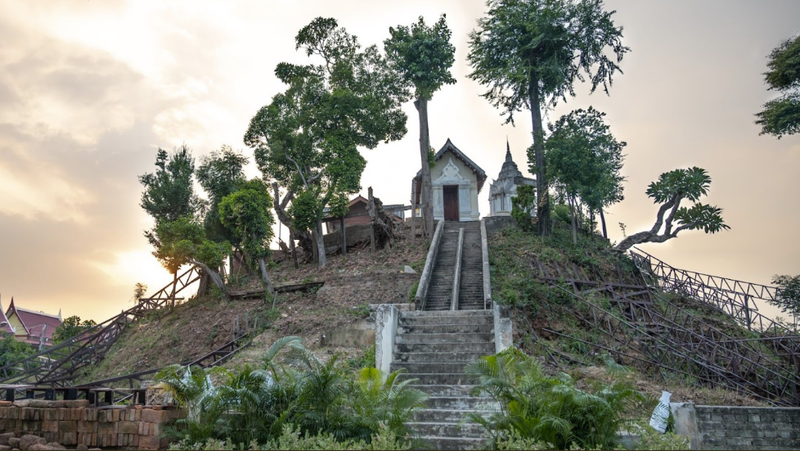
Noen Wat Phra Ngam is an important archaeological site in the heart of Nakhon Pathom that helps explain the picture of the ancient Dvaravati city with greater clarity. This site is located within Wat Phra Ngam, also known as Wat Soda Phuttharam, near Nakhon Pathom Railway Station and not far from Phra Pathom Chedi. It is therefore a worthwhile destination for those interested in history, art, and travelers who want to understand Nakhon Pathom more deeply than simply coming to pay respect at the great stupa alone.
What makes this place remarkable is not only its antiquity, but the fact that this mound once concealed the remains of a large Dvaravati-period stupa beneath layers of soil. When excavations were carried out, many important antiquities were discovered, including broken stone Buddha images, Dhamma wheel boundary stones, crouching deer sculptures, bronze Buddha images, and exceptionally beautiful terracotta votive tablets. These discoveries became important evidence in the history of Nakhon Pathom.
Viewed in a broader context, Noen Wat Phra Ngam is not just a minor ruin within a temple compound. It is one of the places that confirms Nakhon Pathom once served as a true religious and cultural center during the Dvaravati period. The antiquities found here closely resemble those discovered around Phra Pathom Chedi, showing the connection between sacred spaces and the ancient communities that flourished in this area many centuries ago.
The name Wat Phra Ngam itself carries historical meaning and is not simply a pleasant-sounding name. Prince Damrong Rajanubhab explained that the temple came to be called Wat Phra Ngam because the terracotta Buddha images excavated from this area were exceptionally beautiful. The temple’s name therefore reflects the fame of the art discovered here and suggests that this place may once have been a site where fine Buddhist artworks were created or enshrined.
The antiquities discovered at Noen Wat Phra Ngam are important on several levels. In terms of art history, the terracotta votive tablets and terracotta Buddha heads demonstrate delicate craftsmanship and distinctive Dvaravati artistic features. In religious terms, the Dhamma wheel and crouching deer are direct symbols associated with Buddhism. In terms of urban history, these objects show that Nakhon Pathom was not merely the site of a great stupa, but also an area surrounded by a network of religious monuments arranged in an organized way.
Considering the character of the archaeological mound, it is clear that this area was once a fairly large religious site. Local people formerly called it Khao Wat Phra Ngam, a large earthen mound that gradually deteriorated over time. It was only later that the area was seriously surveyed and excavated. Early surveys were associated with the French archaeologist Lucien Fournereau in the late 19th century, and the site was later examined by Prince Damrong Rajanubhab, which brought the name of Noen Wat Phra Ngam clearly into Thai historical and archaeological studies.
Another notable point is that the antiquities from Wat Phra Ngam were not left neglected. Many pieces have been preserved at the National Museum, while others are kept at Phra Pathom Chedi. This allows visitors to continue their exploration in a meaningful way. In other words, one can begin by seeing the actual site of discovery at Noen Wat Phra Ngam, and then continue on to view the antiquities displayed in museums or around Phra Pathom Chedi, linking the place itself with the physical evidence found there.
From the visitor’s perspective, the atmosphere at Noen Wat Phra Ngam is quite different from popular tourist attractions that remain lively all day. Here, the mood is calm, simple, and full of the charm of a historic site in an old city. Even though it lies close to local communities and the railway station, once you step into the temple grounds, the pace feels slower. It is a place well suited for an unhurried walk, observing the landscape, the setting of the temple, and taking time to understand the meaning of the site rather than simply checking in for a photograph.
Those who enjoy cultural tourism will find Noen Wat Phra Ngam especially valuable because it is not merely a photo spot. It is a learning site that connects Dvaravati art, the ancient city of Nakhon Pathom, Phra Pathom Chedi, and the development of Buddhism in central Thailand. If combined with visits to Phra Pathom Chedi, Sanam Chandra Palace, the National Museum at Phra Pathom Chedi, or Wat Phai Lom, a single trip can provide a much fuller understanding of Nakhon Pathom.
In terms of its present-day significance, Noen Wat Phra Ngam continues to serve as both a religious space and a place of historical memory for Nakhon Pathom. On one level, Wat Phra Ngam remains a royal temple with an active role in Buddhism. On another, the archaeological mound within the temple stands as a tangible reminder of the past, helping present-day visitors see that the roots of Nakhon Pathom as an important city did not begin only in the Rattanakosin period or with modern transportation, but stretch much deeper into the world of Dvaravati.
The special character of Wat Phra Ngam lies in the coexistence of two living layers within the same place. The first is the temple as it functions today, with its ordination hall, monks, and surrounding community. The second is the layer of archaeological remains and traces of the old city that reveal the past of the central river basin through real evidence. Seeing these two layers together gives a visit to Wat Phra Ngam much greater meaning than simply looking at old bricks or an earthen mound on the surface.
For readers interested in Thai history, Noen Wat Phra Ngam also holds national significance because archaeological sites like this are important pieces in reconstructing the story of the Dvaravati period, a time when Buddhism, art, and urban planning developed prominently in central Thailand. Evidence found in Nakhon Pathom, especially around Phra Pathom Chedi and Wat Phra Ngam, is therefore often used to explain the development of ancient states in the western Chao Phraya basin.
Visitors who intend to explore the site should plan their time appropriately. Morning to late morning is the most suitable period for walking around, as the weather is not yet too hot. Those arriving by train will find it convenient because Nakhon Pathom Railway Station is not far from the temple. Those traveling by car can easily combine the visit with Phra Pathom Chedi and Sanam Chandra Palace in a single day, making it a well-rounded Nakhon Pathom city trip that combines religion, history, and the atmosphere of the old town.
Travel to Noen Wat Phra Ngam can be done in several ways. If traveling by train, get off at Nakhon Pathom Railway Station and continue by local transport or on foot over a short distance. If traveling by car, use Wat Phra Ngam Royal Temple in the Phra Pathom Chedi area, Mueang Nakhon Pathom District, as your destination. From there, it is easy to continue to Phra Pathom Chedi, Sanam Chandra Palace, or restaurants around the city, as all are located within the same general area.
Another important point to understand is that Noen Wat Phra Ngam is not a place like an amusement park or a landmark that requires only a few minutes to complete. If visited with intention, the site gradually reveals its meaning through the landscape, historical narratives, and its connections with other important places in Nakhon Pathom. The more background a visitor has in Dvaravati history, or the more interest they have in viewing real antiquities in museums afterward, the richer and more memorable the visit becomes.
In summary, Noen Wat Phra Ngam is one of the places that should not be overlooked when visiting Nakhon Pathom. It offers not only antiquity, but also value as evidence of a living past that still connects with the present. It is a place that helps visitors understand Nakhon Pathom as an ancient Dvaravati city, a center of Buddhism, and a city that has preserved traces of its historical memory within contemporary life in a very compelling way.
| Place Summary | A Dvaravati-period archaeological site within Wat Phra Ngam, also known as Wat Soda Phuttharam, in central Nakhon Pathom, near Nakhon Pathom Railway Station and Phra Pathom Chedi. |
| Highlights | A large Dvaravati-period stupa was discovered here along with many important antiquities, including Dhamma wheel stones, crouching deer sculptures, stone Buddha images, bronze Buddha images, and terracotta votive tablets famous for their beauty. |
| History / Period | A Dvaravati-period archaeological site, approximately more than 1,000 years old. It originally appeared as a large earthen mound, locally known as Khao Wat Phra Ngam, and is one of the important pieces of evidence for the ancient city of Nakhon Pathom. |
| Current Abbot / Caretaker | Phra Udomdhammamethi (Somsak Ratanapanyo, Pali Scholar Level 9) |
| Address | 45 Phra Pathom Chedi Subdistrict, Mueang Nakhon Pathom District, Nakhon Pathom 73000, Thailand |
| Coordinates | 13.8231082, 100.0522552 |
| Travel | Easy to reach by both car and train. The site is about 500 m from Nakhon Pathom Railway Station and about 500 - 700 m from Phra Pathom Chedi, making it suitable for a one-day trip in central Nakhon Pathom. |
| Open Days / Opening Hours | Open Daily, 09:00 AM - 05:00 PM |
| Current Status | Still an important archaeological site within Wat Phra Ngam Royal Temple and a valuable place for studying Dvaravati history in Nakhon Pathom city. |
| Main Contact Number | 0 3475 2847, 0 3424 4505 |
| Nearby Tourist Attractions | 1. Dvaravati Si Nakhon Pathom Walking Street, about 100 m 2. Nakhon Pathom Railway Station, about 500 m 3. Phra Pathom Chedi, about 700 m 4. Sanam Chandra Palace, about 1.1 km 5. Wat Phai Lom, Nakhon Pathom, about 1.5 km |
| Nearby Restaurants | 1. Dayicecream, about 200 m. Tel. 086-332-8091 2. Jiah Pia Jap by Fai, about 300 m. Tel. 034-251-286 3. Ban Salapao Kanchanaburi, Nakhon Pathom Branch, about 400 m. Tel. 061-573-7201 4. Khao Lam Mae Luk Chan, about 500 m. Tel. 096-295-6591 5. Khanom Khai Kit Charoen, Nakhon Pathom Market, about 500 m. Tel. 083-044-6803 6. Warden Matcha Bar and Space, about 500 m. Tel. 061-445-5395 |
| Nearby Accommodations | 1. Xen Hotel Nakorn Pathom, about 1.3 km. Tel. 034-900-500 2. Hop Inn Nakhon Pathom, about 1.4 km. Tel. 02-659-2899 3. The Proud Exclusive Hotel, about 1.4 km. Tel. 034-255-555 4. Ban Phak Ruean Pathom 2, about 1.6 km. Tel. 089-836-3324 5. Mida Dhavaravati Grande Hotel, about 1.8 km. Tel. 034-966-700 6. Diary Suite Hotel, about 2.1 km. Tel. 034-244-335 |
Frequently Asked Questions (FAQ)
Q: What is Noen Wat Phra Ngam?
A: Noen Wat Phra Ngam is a Dvaravati-period archaeological site within Wat Phra Ngam, also known as Wat Soda Phuttharam, in Nakhon Pathom. It is the place where a large stupa and many important antiquities were discovered.
Q: Why is Noen Wat Phra Ngam important?
A: The site is important because it helps confirm the role of Nakhon Pathom as a major center of Dvaravati culture and is closely connected to the antiquities found around Phra Pathom Chedi.
Q: What antiquities were found here?
A: Antiquities discovered here include broken stone Buddha images, Dhamma wheel stones, crouching deer sculptures, bronze Buddha images, and terracotta votive tablets well known for their beauty.
Q: Why is it called Wat Phra Ngam?
A: The name Wat Phra Ngam is associated with the terracotta Buddha images excavated from this area. Prince Damrong Rajanubhab explained that they were exceptionally beautiful, which led to the temple’s name.
Q: Is Noen Wat Phra Ngam far from Phra Pathom Chedi?
A: No. It is located in central Nakhon Pathom and is about 500 - 700 m from Phra Pathom Chedi, so both places can be visited conveniently on the same trip.
Q: Can I travel to Noen Wat Phra Ngam by train?
A: Yes. Nakhon Pathom Railway Station is very close to the temple, so visitors can get off the train and continue by local transport or on foot over a short distance.
Q: What time is Noen Wat Phra Ngam open to visitors?
A: Published visitor information states that it is open daily from 09:00 AM to 05:00 PM.
Q: Where should I visit next after Noen Wat Phra Ngam?
A: You can continue your trip to Phra Pathom Chedi, Sanam Chandra Palace, Wat Phai Lom, Dvaravati Si Nakhon Pathom Walking Street, and museums in central Nakhon Pathom, all within a convenient one-day route.
 Noen Wat Phra Ngam Map
 Category:
  Group:
  Last Update: 13 HourAgo
Comment
 Nearby Attractions
| Keyword (Advance) |
 Region
|
 Muang Nakhon Pathom(