

 Home
Home Chiang Mai(







Rating: 4/5 (5 votes)
 |
|  Map
Map 
 Have Map
  No Map
Kanchanaburi attractions
Attractions in Thailand
Open Days: Seasonal Opening and Guided Tour Slots by the National Park (Please check availability and make a reservation in advance)
Opening Hours: 08.00 – 16.00 (Approximate hours for on-site contact/registration; the cave activity itself takes several hours and always requires officials to accompany visitors)
Tham Sao Hin Cave is one of Kanchanaburi’s true adventure destinations—the kind that is clearly not meant for a casual “quick stop.” Visiting here requires real planning: contacting the responsible unit, arranging your group, preparing the right gear, and accepting that reaching the cave’s highlights demands substantial time and physical effort. The cave is located near the far end of the Lam Huai Khlong Ngu watershed, and it is not a dry cave with easy concrete walkways. Instead, it features a year-round flowing stream with alternating shallow and deep sections, so the experience can include trekking, wading, and moving through wet, slippery terrain. For safety and to minimize impact on the environment, visitors must be accompanied by officials every time.
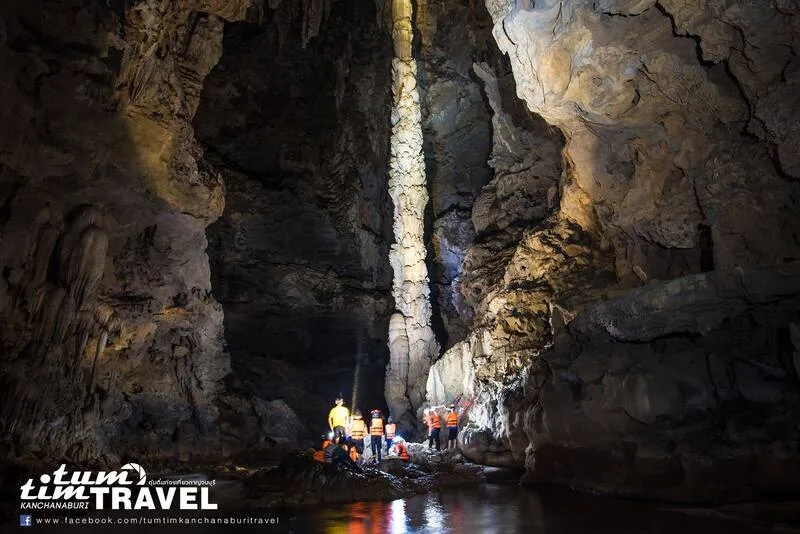
If you ask why people willingly push through the effort to reach Tham Sao Hin, the answer is usually the same: the sight of a colossal limestone pillar rising inside the cave. This pillar formed through natural limestone deposition over millions of years, becoming a shape that feels like “architecture built by nature.” It is not simply big in a photo-friendly way; it is big enough that the human scale instantly shrinks when you look up. In the central chamber, sources often cite a height from the floor to the cave ceiling of about 62.5 meters, and it has been described as exceptionally tall when compared with recorded discoveries from earlier field information. That is why this place is remembered not just as a cave with stalactites and stalagmites, but as a cave where the “stone pillar” takes center stage, framed by countless formations around it—turning the entire scene into a quiet, awe-inspiring natural sculpture gallery.
The beauty of Tham Sao Hin does not come from decorative lighting like easily accessible show caves. It comes from the cave’s natural condition, with “running water” continuing to shape the ecosystem and interior landscape throughout the year. The humidity makes some rock surfaces look glossy, certain areas become slippery, and the sound of flowing water becomes a constant background that makes the journey feel like a gradual movement toward the heart of the terrain. At the same time, that humidity and slipperiness are exactly why officials must accompany every visit. Decisions about route choice, pace, crossing deeper sections, or when to rest should not be left to visitors to “figure out” on their own without a team leader who knows the area and can manage overall risk.
From the start, it helps to understand that going to Tham Sao Hin is closer to caving exploration than to ordinary sightseeing. Travel notes commonly state that officials must accompany every entry, and that the overall activity can take about 6 – 7 hours. This time is not only spent inside the cave; it can include reaching the forest zone, walking long stretches, wading, and moving through different cave sections. As fatigue builds up, the risk of slipping or cramping increases automatically. That is why physical preparation and disciplined group movement matter, and why these rules are a key reason this type of visit can remain safe.
From a geological perspective, many limestone caves form when rainwater seeps through soil and rock layers, becoming mildly acidic and gradually dissolving limestone over long periods. Small voids expand into chambers and passage networks, developing into a complete cave system. When mineral-rich water drips through the ceiling and falls, minerals slowly precipitate, creating stalactites above and stalagmites below. The wonder of these formations lies in two words: “slow” and “long-term.” This means that touching formations with bare hands is not only about leaving dirt behind; oils and sweat can interfere with mineral deposition over time. A cave like Tham Sao Hin, with high humidity and flowing water, depends on strict conservation discipline because the cave environment is more delicate than it may appear at first glance.
Preparation for Tham Sao Hin should be approached like a field expedition rather than a simple photo trip. Essential gear often mentioned includes reliable lighting for cave entry and a life jacket, because water depth varies by section and can change with the season or recent rainfall. The life jacket is not for “fun swimming”—it reduces risk when you encounter deeper water or when currents make balance difficult. Footwear should be sturdy, secure, and designed for wet terrain, with strong grip and a fit that will not slip off easily. Clothing should dry quickly, avoid heavy water absorption, and allow free movement. Waterproof bags for phones and valuables are critical, because if essentials fail in the forest zone, the rest of the trip can collapse and may even affect safety if communication is compromised.
Another point people often underestimate is “energy and drinking water.” Many assume caves are cool and therefore they will not feel thirsty, but an activity lasting 6 – 7 hours can cause significant sweat loss—especially during trekking and wading when you rely heavily on stabilizing muscles. Carrying enough water and drinking in intervals helps reduce cramp risk, one of the major dangers of moving through water in caves. If you travel as a group, planning compact, high-energy snacks that are easy to eat without creating waste is also important. Choose items that do not melt or leak easily and can be packed out entirely, because even small pieces of trash can quickly damage the experience and the condition of a sensitive natural area.
Getting There In practical terms, a visit to Tham Sao Hin begins by heading toward Thong Pha Phum District in Kanchanaburi, then entering the operational area of Lam Khlong Ngu National Park and the relevant ranger unit according to the official scheduling and coordination system. Common route descriptions from Bangkok mention using major highways into Kanchanaburi, then continuing toward Thong Pha Phum along the province’s main roads before turning onto routes leading into the park zone and the ranger unit that serves as the coordination point. The final segment is typically more rural and mountainous, so you should allow extra time, drive cautiously, and ensure your vehicle is in good condition—especially during rainy periods or on slippery roads. It is also wise to build in buffer time for registration, a safety briefing, and gear checks before starting the actual activity.
In practice, many travelers choose to stay one night in the Thong Pha Phum area or nearby before starting the activity the next morning. If you drive a long distance and then immediately begin trekking, fatigue accumulates quickly and increases risk unnecessarily. Staying overnight also makes it easier to organize meals, water, and essential items systematically, reducing the chance of forgetting critical gear such as a headlamp or life jacket. It also gives the group time to review key teamwork rules such as moving in a line, checking on each other regularly, and communicating clearly at higher-risk points.
What makes Tham Sao Hin a place you should not approach impulsively is the way water conditions can change with the seasons. During the rainy season or after heavy rainfall, water levels in the creek system and inside the cave can rise quickly, turning previously passable sections into dangerous zones. That is why access is typically tied to the park’s safety assessment and staff judgment at that time. A simple rule helps: verifying the current status before departure is not merely about convenience—it is about safety, and it respects the management system responsible for protecting visitors’ lives in a serious natural environment.
Once you reach the cave, the “beauty” arrives in a different way than in typical tourist caves. The moment that often quiets people down is when they begin to perceive the scale of the chamber, the height of the ceiling, and the density of formations shaped like sculpted pieces. Even though caves are dark, that darkness actually allows your headlamp to “frame” details with depth. When light hits wet rock surfaces, the sheen adds life to textures, and many visitors feel like they are walking through a one-of-a-kind natural gallery that cannot be replicated exactly the same way again.
For the best experience, the most reliable advice is to follow the pace set by officials, avoid rushing, do not overtake, and do not separate from the group. Splitting up in a wet cave with flowing water and slippery sections is a risk that is never worth it. Use your hands only where officials indicate it is safe to hold, and avoid touching stalactites and stalagmites directly. Preserving the cave in its original condition is part of Tham Sao Hin’s core appeal—people endure the difficulty to see “real nature,” not graffiti, damage, or evidence of careless behavior from earlier visitors.
Seen as a “trip with a story,” Tham Sao Hin offers challenge, spectacle, and a powerful lesson about nature. You must cooperate with the management system, respect rules, maintain discipline with your own body, and accept that this place is not meant for everyone. If you dislike getting wet, do not enjoy long treks, fear darkness, or have health limitations, another activity in Kanchanaburi may be more suitable. But if you are a nature traveler who wants to witness something rare and you are ready to take responsibility for a field-style journey, Tham Sao Hin often feels deeply “worth it” in a way that cannot be captured by only a few photos.
| Name | Tham Sao Hin Cave |
| Location | Lam Khlong Ngu National Park, Thong Pha Phum District, Kanchanaburi |
| Address | Park contact point / coordination unit area, Cha Lae Subdistrict, Thong Pha Phum District, Kanchanaburi (Please follow the official meeting point arranged by park staff) |
| Place Summary | A cave with a year-round stream, famous for its massive limestone pillar and an exceptionally high chamber. Entry is an adventure-style activity that always requires officials to accompany visitors, with careful preparation needed. |
| Highlights | Giant limestone pillar, chamber height around 62.5 m (reported in older records), year-round flowing stream, abundant speleothems, guided caving-style experience with officials |
| Period | Limestone cave formation developed over millions of years; a reported height measurement is mentioned in records around 1995 (B.E. 2538) |
| Key Evidence | Distinctive references to the giant pillar and chamber height (~62.5 m) appear in tourism/field notes, along with the requirement that officials accompany every entry for safety. |
| Getting There | By car: Travel to Kanchanaburi → continue to Thong Pha Phum → proceed to Lam Khlong Ngu National Park/official meeting point → begin the guided trek/wading route to the cave (reservation and official accompaniment required) |
| Current Status | Open via scheduled activity slots based on the park’s safety assessment (Always confirm opening status and conditions before traveling) |
| Facilities | Official contact point/meeting area and facilities as managed on-site (may change by season) |
| Fees | According to the park’s official announcement and the activity/official arrangements in each period (Please confirm in advance) |
| Contact Number | 084-913-2381 (public-sector tourism contact information) |
| Popular Accommodations Nearby | 1) Accommodation in Thong Pha Phum area (approx. 60 km) 2) Accommodation near Khao Laem Dam area (approx. 70 km) 3) Accommodation in Sai Yok area (approx. 110 km) 4) Accommodation in Sangkhla Buri area (approx. 120 km) 5) Accommodation in Kanchanaburi town area (approx. 180 km) |
| Popular Restaurants Nearby | 1) Restaurants in Thong Pha Phum area (approx. 60 km) 2) Restaurants near Khao Laem Dam area (approx. 70 km) 3) Restaurants in Sai Yok area (approx. 110 km) 4) Restaurants in Sangkhla Buri area (approx. 120 km) 5) Restaurants in Kanchanaburi town area (approx. 180 km) |
| Nearby Tourist Attractions | 1) Thong Pha Phum National Park (approx. 80 km) 2) Khao Chang Phueak (seasonal activity area) (approx. 80 km) 3) Jok Kradin Waterfall (approx. 80 km) 4) Khao Laem Dam (Vajiralongkorn Dam) (approx. 70 km) 5) Attractions in the Thong Pha Phum – Sangkhla Buri zone (distance depends on route) |
Frequently Asked Questions (FAQ)
Q: Who is Tham Sao Hin suitable for?
A: It is best for travelers with outdoor experience who enjoy adventure activities, are comfortable with wading and long-duration trips, and are ready to follow officials’ rules strictly.
Q: Why must officials accompany every trip?
A: The cave has a year-round stream with alternating depths and wet, slippery terrain. Officials help manage the route, pace, and risk assessment, significantly improving safety.
Q: How many hours does the cave activity usually take?
A: It is often described as taking about 6 – 7 hours in total, depending on conditions, water level, and the group’s pace, so you should plan extra time and energy.
Q: What are the most essential items to bring?
A: Reliable cave lighting (headlamp and backup), a life jacket, grippy water footwear, waterproof protection for valuables, and enough drinking water for the whole activity.
Q: Is Tham Sao Hin open all year?
A: Access generally depends on the park’s safety assessment because water level and weather can change the risk. Always confirm opening status and book in advance.
Q: What conservation rules should visitors follow?
A: Do not touch formations, do not write on cave walls, pack out all trash, and never separate from the group. The cave system is delicate, and discipline protects both visitors and the natural environment.
 Tel: 018566518
 Tham Sao Hin Cave Map
 Category:
  Group:
  Last Update: 2 HourAgo
Comment
 Nearby Attractions
| Keyword (Advance) |
 Region
|
 Muang Kanchanaburi(