

 Home
Home Chiang Mai(










Rating: 3/5 (7 votes)
 |
|  Map
Map 
 Have Map
  No Map
Chiang Mai attractions
Attractions in Thailand
Open Days: Recommended to contact/arrange an appointment in advance (this is an operational area of the Royal Project Foundation)
Opening Hours: Recommended 08.00–17.00 (hours may change depending on field operations/season – please confirm before visiting)
Huai Phak Phai Royal Project (Huai Phak Phai Royal Rose Garden) is one of those Chiang Mai getaways that feels different from checklist-style travel. The highlight here isn’t flashy attractions, but the calm sense of a real working development area on highland foothills, paired with a natural beauty that doesn’t try too hard. The project sits on a sloping mountainside with a natural stream running through it, at roughly 540–600 meters above sea level, which keeps the air noticeably cooler than the lowlands. Some references place the average temperature around 22°C — a big reason many visitors like to stop by, walk slowly, and let the quiet reset their headspace.
The site lies in Mae Ha Village, Ban Pong Subdistrict, Hang Dong District, Chiang Mai. In earlier accounts, the community context was described as relatively disadvantaged, with farming yields often uncertain and not especially high. In 1980, the Royal Project Foundation established the Huai Phak Phai Royal Project Development Center on about 81 rai, with a broader operational area described at around 1,200 rai. The landscape was often portrayed as degraded forestland that the foundation was permitted to develop — not as a tourism facility first, but as a long-term effort to improve livelihoods in ways that fit the land and the realities of highland living.
The development work is described as covering 3 villages under its responsibility: Mae Ha Village (Village No. 3 and No. 5) and Pang Yang Village (Village No. 6). In the commonly cited figures, this included about 321 households and roughly 1,766 residents. Those numbers help frame what this place really is: a project built around people’s everyday lives. Over time, that “working reality” became part of its appeal — a learning destination that welcomes visitors, as long as they respect the rules, the pace, and the purpose of the space.
What makes Huai Phak Phai especially interesting is how it is often presented as a cross-agency collaboration. Narratives mention support from the Land Development Office Region 6 in Chiang Mai for improving farmland, involvement from Kasetsart University through staff and technical support, and research-related support from Taiwan, including experts who advised on cultivating different crops. For a casual visitor, this might sound like background detail — but it’s also the reason the area gradually shifted from fragile subsistence conditions toward something more stable and system-based.
In terms of crop promotion, the project is described as supporting 3 main categories: field crops (such as animal-feed corn, garlic, upland rice, ginger, transplanted paddy rice, and soybeans), vegetables (such as Chinese cabbage and cabbage), and fruit trees (such as mango, lychee, and avocado). Some accounts add that the highest-return crops for farmers were ginger (in the vegetable/field-crop mix) and lychee (in fruit). The point isn’t just the list — it’s the logic of matching crops to local conditions and market realities over time.
A major constraint in local farming has been described as reliance on rainfall during the wet season. Although there is a natural stream, it reportedly runs lower than much of the farmland, limiting how easily water can be brought up for cultivation. Combined with later changes in land tenure, available farmland reportedly became more limited. In that context, the project is often described as focusing on maximizing land use under real constraints of terrain, water, and ownership patterns — not ideal conditions.
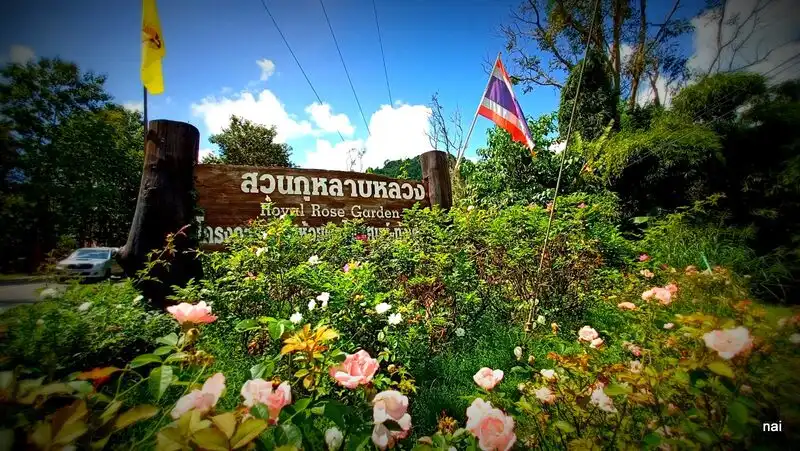
One signature highlight that many people remember is the Huai Phak Phai Royal Rose Garden. In 1989, the Royal Project Foundation selected a portion of the center (commonly cited around 27 rai) to develop dedicated rose operations. This included soil-and-water conservation planning and small water storage ponds, with the garden positioned as a center to collect and study rose varieties from Thailand and abroad, run demonstration plots, support trial cultivation, and provide training on rose cultivation for students, staff, and interested visitors.
Walking through the rose garden feels different from a purely decorative show garden because the rose plots are described as planted along the hillside, so the layers and perspective reflect the land itself rather than a studio design. Another detail frequently cited is the scale of the collection: not fewer than 209 rose varieties, with emphasis on research, conservation, and propagation. The propagated varieties are also described as being supplied onward to other Royal Project development centers, supporting wider economic benefits for farmers across different areas.
For a relaxed visit, Huai Phak Phai works best when you take it slow — especially in the morning or late afternoon when the light and air are at their best. The most commonly recommended season is October through February, when weather tends to be comfortable for walking. No matter when you go, the core principle stays the same: this is a working development and learning area. Please keep noise low, don’t litter, don’t damage plants, and follow posted rules. This is the kind of place that works best when visitors arrive with a “co-exist” mindset, not a “maximize value” mindset.
Getting There Huai Phak Phai Royal Project (Royal Rose Garden) is located at Mae Ha Village, Ban Pong Subdistrict, Hang Dong District, on the Samoeng–Hang Dong route around Kilometer Marker 17, then turn in about 300 meters. From Chiang Mai city, 2 commonly cited routes are: Chiang Mai – Mae Rim – Samoeng – Hang Dong (about 32 km), or Chiang Mai – Hang Dong – Samoeng (about 43 km). It’s wise to allow extra time because parts of the route are winding hillside roads, and in the rainy season the surface can be slippery with occasional fog.
Huai Phak Phai is a strong choice for travelers who want a quieter Northern Thailand day trip — a place where you can enjoy the beauty of roses and also understand the long-running highland development work happening behind the scenes. If you arrive without rushing, and let the place tell its story at its own pace, you can leave feeling genuinely rested — without needing a packed schedule.
| Name | Huai Phak Phai Royal Project (Huai Phak Phai Royal Rose Garden) |
| Location | Mae Ha Village, Ban Pong Subdistrict, Hang Dong District, Chiang Mai (Samoeng–Hang Dong route, around KM 17; turn in about 300 m.) |
| Characteristics | Foothill slope with a natural stream; cooler air (approx. 540–600 m asl). Royal Project development center with a Royal Rose Garden; rose plots planted along the hillside; suitable for relaxed visits and learning. |
| Period | Huai Phak Phai Royal Project Development Center established in 1980; Royal Rose Garden developed on part of the site in 1989. |
| Key Evidence | Center area cited at ~81 rai with broader operations cited at ~1,200 rai; responsibility cited for 3 villages (~321 households; ~1,766 people). Rose variety collection cited at not fewer than 209 varieties for research, conservation, and propagation. |
| Name Origin | Named after the local area/waterway: “Huai Phak Phai” (a local stream/area name), which became the name of the Royal Project center and its rose garden. |
| Travel | Samoeng–Hang Dong route, around KM 17; turn in ~300 m. From Chiang Mai: (1) Chiang Mai – Mae Rim – Samoeng – Hang Dong (~32 km) or (2) Chiang Mai – Hang Dong – Samoeng (~43 km). |
| Current Status | Operates as a Royal Project development/learning area and welcomes visitors for nature-based relaxation (recommended to confirm latest access details and arrange in advance). |
| Contact Number | 099-135-1118 |
| Nearby Tourist Attractions with Distance | Royal Park Rajapruek — approx. 10–18 km Chiang Mai Night Safari — approx. 10–18 km Wat Phra That Doi Kham — approx. 12–20 km Grand Canyon Chiang Mai (Hang Dong) — approx. 8–16 km Kad Farang Village — approx. 8–16 km Note: Distances are approximate for trip planning. Please verify exact distances on a map before departure. |
| Popular Restaurants Nearby | Fernpresso at Lake — approx. 10–20 km — Tel. 096-768-8689 The Higher Room (Veranda High Resort) — approx. 12–22 km — Tel. 053-365007 Have-A-Hug Fusion Farm — approx. 15–25 km — Tel. 053-121-268 Caviart Cafe (Kad Farang) — approx. 8–16 km — Tel. 080-860-7774 Ginger Farm Kitchen (Hang Dong area) — approx. 12–22 km — Tel. 052-080-928 |
| Popular Accommodations Nearby | Veranda High Resort Chiang Mai — approx. 12–22 km — Tel. 053-365007 North Hill City Resort — approx. 18–30 km — Tel. 053-333-111 Belle Villa Resort, Chiang Mai — approx. 2–8 km — Tel. 089-433-5990 Belle Villa Resort — approx. 2–8 km — Tel. 053-365-318 Rabeang Pasak Treehouse Resort — approx. 35–55 km — Tel. 093-040-6494 |
| Facilities | Rose garden walking areas, learning/demonstration zones (as managed by the center), parking (by service points), restrooms (by service zones). |
| Fees | — (Entrance/activities may vary by season and management policies. Please check the latest announcements before visiting.) |
Frequently Asked Questions (FAQ)
Q: Who is Huai Phak Phai Royal Project best suited for?
A: It’s ideal for visitors who want a quieter, slower Chiang Mai outing — people who enjoy strolling through gardens and nature, and who want to see a Royal Project development area up close without crowded tourist scenes.
Q: When is the best time to visit the Huai Phak Phai Royal Rose Garden?
A: The period most often recommended is October through February, when the weather is typically comfortable for walking. It’s still a good idea to check current weather and the latest site updates before you go.
Q: If I plan a day trip, how much time should I allow?
A: Allow a bit more travel time than you might expect, as sections of the hillside route can be winding, and during the rainy season roads may be slippery with occasional fog. Morning or late afternoon is usually the most comfortable for walking and photos.
Q: Is there anything to see besides the rose garden?
A: Yes. The area is also a Royal Project development center with ongoing work in crop support, resource management, and community development. If you enter learning zones, please follow site rules and arrange in advance when required.
Q: Do I need to book or call ahead?
A: It’s recommended to call ahead every time, since this is a working operational area and access conditions or visiting hours may change depending on field operations and seasonal factors.
 Huai Phak Phai Royal Project (Huai Phak Phai Royal Rose Garden) Map
 Category:
  Group:
  Last Update: 11 HourAgo
Comment
 Nearby Attractions
| Keyword (Advance) |
 Facebook Fanpage
 Region
 Art, Culture and Heritage
 Historical Sites and Monuments(
 Landmarks and Memorials(
 Royal Palace(
 Art, Craft Centres, Tradition(
 Museums(
 Educational Places
 Museum for Study(
 Educational Gardens, Farm(
 Training Center(
 University
 Places of Worship
 Temple(
 Mosque(
 Other religious and spiritural sites(
 Suburban Living
 Village, Community(
 Local Market(
 Nature and Wildlife
 National Parks and Marine Reserves(
 Mountain (Doi)(
 Dam, Reservoir, Lake(
 Waterfalls(
 Hot Springs(
 Caves(
 River, Canal(
 Other natural attractions(
 Entertainment and Agricultural
 Zoos and Aquariums(
 Animal camps and shows(
 Stadium(
 Farm, Parks, Gardens and Ecotourism(
 Waterpark(
 Theater(
 Outdoor and Adventure Activities(
 Shopping
 Shopping and Night Market(
 Restaurant
 Michelin Star(
 Michelin Guide(
 Call Customer Service in Tourism
 Call Customer Service in Tourism(
 Travel Articles, Recipes
 Travel Review, Food Review(
 Food Menu, North Recipes(
 Thai Desserts, North Recipes(