
 Home
Home North(
 Chiang Mai(


Rating: 3.6/5 (9 votes)
 |
|  Map
Map 
 Have Map
  No Map
Nonthaburi attractions
Attractions in Thailand
Open Days: Open only during selected periods in December-January and for pre-arranged group visits
Opening Hours: Saturday-Sunday, 14:00-18:00 during the public opening period
Prathom Nonthaburi Palace is one of the most quietly remarkable historical residences in the greater Bangkok area. Hidden inside Soi Akani, also known as Ngamwongwan 2, this elegant wooden palace is not simply an old house in Nonthaburi. It is a relocated fragment of Wang Phetchabun, a former royal residence once situated in the Ratchaprasong area of Bangkok. For visitors interested in architecture, royal history, and preserved domestic heritage, this is a place with unusual depth and a strong sense of continuity between old Bangkok and present-day Nonthaburi.
The palace belonged to Somdet Chao Fa Chudadhuj Dharadilok, Prince of Phetchabun, a son of King Chulalongkorn, Rama V, and Queen Saovabha Phongsri. He is also remembered as the founder of Poh-Chang Academy of Arts. That royal and artistic background gives the residence significance beyond its physical beauty. Prathom Nonthaburi is closely tied to the cultural life of the late royal era, especially in the fields of architecture, music, and refined domestic design.
The original palace was built in 1919 and was the first residence constructed within Wang Phetchabun after Prince Chudadhuj returned from England. He named it after the Thai musical composition “Homrong Pathom Dusit,” which later became associated with the shorter name “Prathom.” At the time, the palace stood at Ratchaprasong, on land now occupied by the CentralWorld area. That alone gives the building extraordinary historical resonance, since it preserves a part of Bangkok’s lost aristocratic landscape.
In 1984, Her Serene Highness Princess Sudhisiri Sobha, daughter of Prince Chudadhuj, obtained permission to dismantle and relocate parts of the palace to its present site in Nonthaburi. This was not a casual reconstruction. Each wooden element had to be numbered carefully before dismantling so the building could be reassembled with accuracy. Because of that painstaking method, the palace today still retains its original timber structure almost entirely, making it far more than a replica. It remains, in a very real sense, the same historic building in a new location.
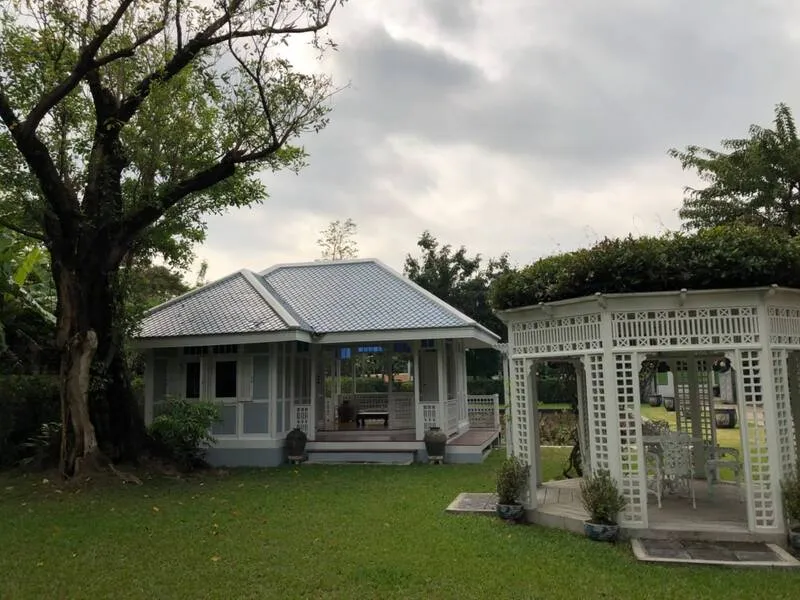
Architecturally, Prathom Nonthaburi is especially compelling because it reflects an early Thai encounter with Western domestic design. The building stands on raised stilts in the Thai manner, yet it also includes steep rooflines, connected interior rooms, high ceilings, attic space, and ventilation features that respond to both climate and modern lifestyle influences. Built from teak and painted a soft dove-grey, with blue stained glass and kite-shaped roof tiles, the residence presents a refined hybrid identity that feels both unmistakably Thai and subtly cosmopolitan.
The main living area is on the second floor, where the original layout included a bedroom, reception room, and bathroom. Above it is an attic level once used for storage. Between the main residence and a smaller waterside structure stands an octagonal pavilion, while a large lotus pond opens up the front setting. Nearby, a newer elevated building was added later. Although it is not a complete reproduction of the original style, it complements the historic residence well, and its gilded enclosed hall is one of the notable visual highlights of the compound.
One of the palace’s most important cultural objects is a historic harp brought back from England by Prince Chudadhuj. The instrument is more than a century old and is central to the identity of the site. It reflects the prince’s deep interest in Western music and helps explain why musical performance remains closely associated with the palace today. The presence of this harp gives the residence a rare atmosphere: it is not only a preserved building, but also a place where sound, memory, and royal biography continue to intersect.
Prathom Nonthaburi is not open to casual daily tourism throughout the year. This limited access is part of what makes the experience feel special. Public visits are usually associated with the annual “Tea at the Palace” event held around December and January. During this period, visitors may enjoy guided access to the palace along with harp performances, traditional puppetry, and a carefully curated cultural atmosphere that suits the residence beautifully. Outside that period, visits are generally possible only through advance coordination for groups.
That seasonal opening format makes the palace feel less like a conventional museum and more like a living cultural house that reveals itself only at selected moments. Instead of functioning as a standard all-day attraction, it offers a slower, more intimate encounter with heritage. Visitors are able to appreciate not only the physical structure, but also the refined mood created by music, tea culture, and the rhythm of a carefully staged seasonal opening.
For travelers exploring Nonthaburi beyond temples, malls, and riverside stops, this palace adds a very different layer to the city. It is particularly appealing to those who enjoy hidden historical sites, domestic architecture, and less commercial cultural experiences. The contrast between the quiet palace compound and the surrounding urban Ngamwongwan district makes the visit feel even more striking.
Getting There is relatively easy. The palace is located at 45/5 Soi Akani (Ngamwongwan 2), Talat Khwan, Mueang Nonthaburi. Visitors arriving by car can access it via Ngamwongwan Road near Khae Rai intersection. Those using public transport can continue from nearby transit points in the Ministry of Public Health or Nonthaburi Civic Center area and then take a local taxi or short connecting ride into Ngamwongwan 2. Because the site is in a residential urban neighborhood rather than a large commercial tourism zone, checking the opening schedule in advance is strongly recommended.
Prathom Nonthaburi Palace is a strong reminder that some of the most meaningful heritage places near Bangkok are not necessarily the most visible ones. Its value lies in the survival of original materials, its royal connections, its unusual architectural balance between Thai and Western forms, and its rare cultural atmosphere. For anyone interested in historical houses, hidden heritage, or refined cultural travel in Nonthaburi, this is one of the city’s most distinctive addresses.
| Name | Prathom Nonthaburi Palace |
| Location | 45/5 Soi Akani (Ngamwongwan 2), Talat Khwan, Mueang Nonthaburi, Nonthaburi 11000 |
| Highlights | Historic teak royal residence, century-old harp, Thai-Western hybrid architecture, annual tea-at-the-palace event |
| History | Built in 1919 at Wang Phetchabun in Ratchaprasong and relocated to Nonthaburi in 1984 |
| Name Origin | Named after the Thai musical piece “Homrong Pathom Dusit” |
| Key Character | A raised teak residence blending Thai architectural character with early Western residential influence |
| Travel Information | Access via Ngamwongwan Road and Soi Ngamwongwan 2 near Khae Rai; public-transport visitors can continue from nearby transit points in central Nonthaburi |
| Current Status | Operational as a historic residence, but not open for general daily visitation |
| Open Days | Saturday-Sunday during December-January and selected special opening periods |
| Opening Hours | 14:00-18:00 during the public opening period |
| Fees | No admission fee |
| Facilities | Guided viewing space, seasonal cultural event area, reception area for arranged visits |
| Main Areas / Zones | Main Residence, Waterside Pavilion, Octagonal Pavilion, Lotus Pond, New Residence, Gilded Hall, Harp Display Area |
| Main Contact Number | 02-261-4777-8, 02-261-6769 |
| 1. Nearby Tourist Attractions | 1. The Mall Lifestore Ngamwongwan 1 km 2. The Pantip at Ngamwongwan 1 km 3. Wat Bua Khwan Royal Monastery 3 km 4. Wat Sangkhathan 8 km 5. Wat Chaloem Phra Kiat Worawihan 11 km |
| 2. Nearby Restaurants | 1. Insho Japanese Restaurant 2 km Tel. 080-650-9988 2. Eat Am Are, The Mall Ngamwongwan 1 km Tel. 080-374-0689 3. Fuji Japanese Restaurant, The Mall Ngamwongwan 1 km Tel. 083-791-6297 4. Rich Rich Restaurant 2 km Tel. 084-166-1842 5. 19 Café Ngamwongwan 19 3 km Tel. 093-382-0889 |
| 3. Nearby Accommodations | 1. Mida Hotel Ngamwongwan 4 km Tel. 02-591-7227 2. Regent Ngamwongwan Hotel 4 km Tel. 083-305-7679 3. L Residence Ngamwongwan 5 km Tel. 063-596-5500 4. Aliz Hotel 5 km Tel. 089-813-9399 5. The Legacy Hotel 6 km Tel. 087-707-5999 6. Riverine Place Hotel & Residence 8 km Tel. 02-966-6111 |
Frequently Asked Questions
Q: Is Prathom Nonthaburi Palace open every day?
A: No. It is not open for general daily visits and is usually accessible only during selected opening periods around December-January or through arranged group visits.
Q: Is there an entrance fee?
A: The published visitor information states that there is no admission fee during the public opening period.
Q: What is the most important highlight inside the palace?
A: One of the most significant objects is the century-old harp associated with Prince Chudadhuj, along with original teak architectural elements from Wang Phetchabun.
Q: When is the best time to visit?
A: The best time is during the seasonal public opening in December-January, when cultural activities such as harp performances and guided viewing are usually part of the experience.
Q: Who would enjoy this place most?
A: It is especially suitable for visitors interested in royal history, preserved architecture, historical houses, music heritage, and quieter cultural travel.
Q: Is it easy to reach from Bangkok?
A: Yes. The palace is in the Ngamwongwan area of central Nonthaburi and is accessible by car or by continuing from nearby public-transport points.
 Tel: 022614777-8, 025897173
 Prathom Nonthaburi Palace Map
 Category:
  Group:
  Last Update: 7 MinuteAgo
Comment
 Nearby Attractions
| Keyword (Advance) |
 Region
|
 Muang Nonthaburi(