

 Home
Home Chiang Mai(










Rating: 3.4/5 (7 votes)
 |
|  Map
Map 
 Have Map
  No Map
Chiang Mai attractions
Attractions in Thailand
Open Days: Daily (recommended to reconfirm before visiting)
Opening Hours: Approximately 08.00–17.00 (daytime is best for visibility and walking)
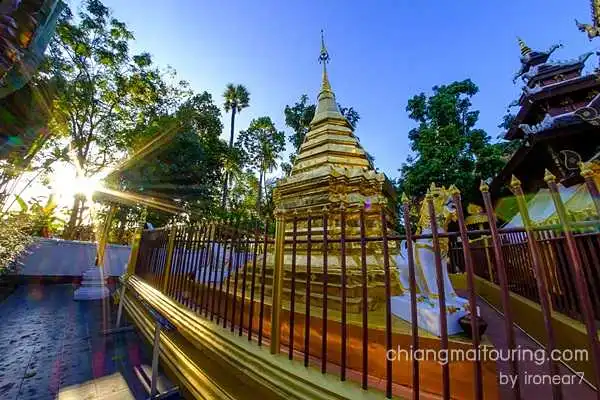
Wat Rong Khum Chedi (Chedi Ngam) is one of the oldest archaeological monuments in Chiang Mai Province, well known among local communities for its elegant Lanna-style bell-shaped stupa. What makes this site compelling is not merely its age, but the way its architectural form has endured through centuries, allowing visitors to clearly observe the proportions, structure, and craftsmanship typical of northern Thai religious architecture from the early Lanna period.
The chedi is estimated to be around 500–600 years old and is believed to have been constructed during the 21st Buddhist century (approximately 1458–1557 CE). Architecturally, it follows the traditional Lanna bell-shaped stupa form and is often compared to Phra That Hariphunchai in Lamphun Province. However, Wat Rong Khum’s chedi is noticeably taller and more slender in proportion, giving it a distinctive vertical elegance when viewed from the base up to the throne section.
Despite its dignified form, the chedi bears visible marks of time. The stucco decorations surrounding the structure have largely eroded, and parts of the brickwork—originally bonded with clay—have weakened due to prolonged exposure to wind, rain, and occasional earthquakes. In addition, evidence of illegal excavations in the past can still be seen, particularly on the eastern and western sides, where the structure was drilled several times in search of ancient relics. These factors have contributed to cracks that have gradually widened over the years.
The survival of Wat Rong Khum Chedi as a recognizable and respected landmark is largely due to continuous community care. Luang Pu Kruba Chao Boon Pan Thampanyo, together with local devotees, carried out restoration works in stages, focusing on preserving structural stability rather than altering the original form. One significant restoration took place in 1987 (B.E. 2530), when a circumambulatory platform was constructed by covering part of the chedi’s base with brick and mortar to reinforce the foundation and create a proper space for ritual walking and worship.
For visitors, it is recommended to take time to slowly walk around the chedi, as the slender proportions and overall symmetry become more apparent when viewed from different angles. Observing the cracks, erosion, and restoration traces also provides insight into how the monument has been preserved through collective effort rather than complete reconstruction. Visitors should refrain from climbing, touching fragile surfaces, or disturbing worshippers, and photography should be done respectfully.
Getting There From Chiang Mai city, there are two main routes. The first follows the irrigation canal road, passing through Hang Dong District, San Klang Subdistrict, and Nam Bo Luang Subdistrict in San Pa Tong District, then continuing toward Ban Kiew La Noi, the local administrative and community center, before entering the temple area. The second route uses Highway 108 (Chiang Mai–Hot), starting from the airport/Central Airport Plaza intersection, passing Hang Dong District for about 10 km, then turning right at the irrigation canal intersection near the Bank for Agriculture and Agricultural Cooperatives (San Pa Tong branch), continuing along the canal road through Yu Wa Subdistrict for approximately 6 km. Using GPS navigation is recommended, especially near the final local roads.
| Name | Wat Rong Khum Chedi (Chedi Ngam) |
| Location | San Pa Tong District, Chiang Mai Province (Ban Kiew La Noi / irrigation canal area) |
| Key Characteristics | Lanna-style bell-shaped chedi with a tall, slender proportion, often compared to Phra That Hariphunchai |
| Period | Estimated 21st Buddhist century (approx. 500–600 years old) |
| Historical Significance | Well-preserved overall form from base to throne level, despite erosion, cracking, and traces of past illegal excavations |
| Entrance Fee | Free (donations welcome) |
| Facilities | Walking area around the chedi; parking and other facilities depend on current site conditions |
| Current Status | Generally open for visits and worship (recommended to check local conditions before traveling) |
| Local Contact | Ban Mae Subdistrict Municipality: +66 53-835-965 |
Frequently Asked Questions (FAQ)
Q: How old is Wat Rong Khum Chedi?
A: It is generally believed to be around 500–600 years old and was likely built during the 21st Buddhist century.
Q: What architectural style does the chedi represent?
A: It is a Lanna-style bell-shaped chedi, often compared to Phra That Hariphunchai, but with a taller and more slender appearance.
Q: How many main routes are there from Chiang Mai city?
A: There are two main routes: via the irrigation canal road, or via Highway 108 (Chiang Mai–Hot) and then turning toward San Pa Tong.
Q: Why does the chedi show cracks and damage?
A: The damage is due to its age, exposure to wind and rain, occasional earthquakes, and evidence of illegal excavations in the past.
Q: Who should be contacted for local information?
A: Ban Mae Subdistrict Municipality at +66 53-835-965.
 Wat Rong Khum Chedi (Chedi Ngam) Map
 Category:
  Group:
  Last Update: 21 HourAgo
Comment
 Nearby Attractions
| Keyword (Advance) |
 Region
|
 Muang Chiang Mai(