
 Home
Home North(
 Chiang Mai(


Rating: 3.3/5 (11 votes)
 |
|  Map
Map 
 Have Map
  No Map
Chachoengsao attractions
Attractions in Thailand
Open Days: Daily
Opening Hours: Please contact the temple directly
Wat Plaeng Phai, also known as Wat Plaeng Phai Vipassana Ram, is located in Lat Krathing Subdistrict, Sanam Chai Khet District, Chachoengsao. It is a community temple under the Mahanikaya order, noted for its strong role in religious education and community-based activities. The temple was founded on 9 January 1984, received its Wisungkhamsima on 30 June 1995, and features a “deer viewing area/deer park” within the temple grounds—a highlight that many visitors come specifically to see. With a calm, peaceful atmosphere, it is ideal for paying respects, walking around the main monastic buildings, and spending a relaxed half-day without rushing.
Wat Plaeng Phai, widely known as “Wat Plaeng Phai Vipassana Ram,” sits in Lat Krathing Subdistrict, Sanam Chai Khet District, Chachoengsao. As a Mahanikaya community temple, it is one of the area’s important religious centers, linking faith, learning, and community life in a tangible way. The overall feel is that of a spacious local temple where visitors can stroll comfortably. Its main buildings follow a modern temple layout, and the deer viewing area inside the grounds has become an easy-to-remember attraction, encouraging people to stop by to pay respects and unwind in a natural setting at the same time.
The appeal of Wat Plaeng Phai is not grand, tourist-temple spectacle, but the sense that it is a “living temple” that continues to serve real community needs. You can see how the space is used continuously—from the courtyard that supports merit-making events and local traditions to the monastic education area that reflects the temple’s educational role. As you walk slowly through the grounds, you will notice that the site is not arranged solely for photo-taking. Instead, it has been developed as a practical center for religious activities and a shared community space. The visit often feels “simple yet substantial” because each part exists for a real purpose, not merely as a decorative backdrop.
Historically, Wat Plaeng Phai has clear establishment records. The temple was founded on 9 January 1984, with land donated for temple construction by Win Tumprasert. This marked a key starting point that helped elevate a local faith site into an officially established temple. Later, the temple received Wisungkhamsima on 30 June 1995. The boundary measures 17.5 meters in width and 37.5 meters in length. This matters to the temple’s overall standing, because Wisungkhamsima reflects formal readiness for Sangha rites, especially ordination within a properly designated boundary in accordance with monastic discipline and Thai Sangha administration, strengthening the temple’s role as a stable religious center for the local community.
Another core reason the temple is significant locally is its educational role. In 1987, the temple opened a Phra Pariyattidhamma school (Dhamma division) to support Buddhist studies and training in discipline and doctrine. Having a monastic school within a local temple reflects meaningful community investment in religion, because monastic education requires more than buildings—it needs teachers, structured learning, daily care for monks and novices, and ongoing support from devotees. When a temple carries an educational mission alongside merit-making and ceremonies, it becomes a “center that can endure,” not merely a place used only during festivals.
Today, the abbot of Wat Plaeng Phai is Phra Maha Wattanachai Waddhanachayo (P.Th.3). He serves as the temple’s principal administrator, overseeing management and governance. This leadership supports the continuity of the temple’s development, including religious functions, maintenance of the grounds, and community-oriented activities, especially during festivals and merit-making events that require coordination with the temple.
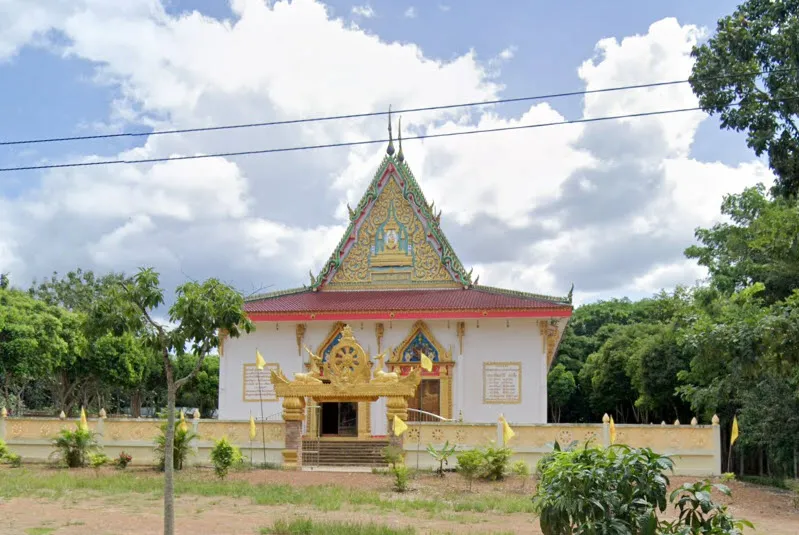
If you plan to make merit and explore the temple in detail, the main monastic buildings deserve extra time—especially the ordination hall (ubosot). It is a reinforced-concrete structure measuring 17.5 meters wide and approximately 38 meters long, built around 1987. The building reflects a contemporary temple style while retaining recognizable Thai traditional influence. The layered rooflines, tiled roofing, and roof ornaments give the ubosot a dignified appearance without needing oversized scale. Notable details include gable decorations and Buddhist symbols, which function as a “visual language” expressing the temple’s identity, showing that the design emphasizes symbolic meaning as much as external beauty.
Inside the ubosot, a principal Buddha image is enshrined, along with five teak-wood Buddha images that many visitors specifically mention. A distinctive detail is that these five teak images are associated with relic enshrinement: the Buddha relics were brought from Myanmar. This gives the ubosot a wider, regional “Buddhist connection,” and for many visitors it adds narrative depth to worship, beyond simply following routine customs.
Beyond the ubosot, the temple also has a sermon hall (sala kan parian), a reinforced-concrete structure about 22 meters wide and 30 meters long, built around 1995. This is often the most actively used building in a community temple, supporting sermons, merit-making, funerary rites, community meetings, and large gatherings. If you want to feel the temple’s everyday rhythm, try observing the atmosphere during mornings on weekends or Buddhist holy days, when the relationship between the temple and local residents becomes most visible.
The temple also includes a chanting hall, reported as a reinforced-concrete building about 10 meters wide and 18 meters long, constructed around 1982, as well as monks’ residences and a merit-making pavilion. These areas form the “support system” that keeps a temple functioning day to day. A temple is not only a worship space; it also needs facilities for living, studying, conducting religious duties, and hosting community events. When these elements are complete, religious activities run more smoothly and the temple can adapt to different community needs.
One of the most popular areas for visitors is the “deer viewing area/deer park” within Wat Plaeng Phai Vipassana Ram. This natural-style space is open to the public, and visitors may also donate deer feed according to personal merit-making intentions. The deer area softens the atmosphere of the visit, making it especially suitable for families with children, elderly visitors, or anyone seeking a gentle activity between worship and walking. Having this kind of space inside a local temple makes the experience feel more “complete”—combining merit-making, calmness, and a short nature walk without needing to travel far.
If you visit without rushing, 1–2 hours is usually enough to pay respects, walk through the main buildings, and stop by the deer area. If you enjoy observing architectural details, reading the temple’s layout, or simply resting under shaded trees, you can comfortably extend the visit to 2–3 hours. With a spacious setting and multiple points of interest, allowing extra time makes the experience gentler and more relaxed.
For those coming specifically to make merit, it is best to begin at the ubosot or the main sacred area, then move on to other zones at your own pace. Morning visits tend to be cooler and more comfortable for walking, while late afternoon light is softer and more pleasant for calm, respectful photography. It is also practical to plan your return trip with local roads in mind, as some routes in Sanam Chai Khet include smaller intersections and community lanes. With a little planning, the visit feels “short but high quality,” without rushing through a meaningful place.
Wat Plaeng Phai also reflects the strength of the local community in Sanam Chai Khet. The temple supports both religious rites and monastic education, and its grounds accommodate activities for people of all ages. On major Buddhist days such as Makha Bucha, Visakha Bucha, Asalha Bucha, and during the Buddhist Lent period, community temples often become gathering points for merit-making, listening to teachings, candlelit processions, and shared traditions. In this way, “religion” is not confined to doctrine alone, but remains connected to daily life in a practical, visible way—one of the reasons Wat Plaeng Phai fits cultural travel better than a simple pass-through stop.
A respectful temple visit that feels comfortable and appropriate is built on simple principles: dress modestly, avoid loud voices, respect residential monk areas, and be mindful when taking photos during ceremonies or when people are practicing meditation. If you bring children, walking through the deer area can be a gentle way to teach them about calm behavior in temple settings. Community temples are generally welcoming, and visitors tend to be received well when they follow basic etiquette and help preserve the peaceful atmosphere.
Getting There If traveling by private car, drive to Sanam Chai Khet District and continue into Lat Krathing Subdistrict, then follow the main local routes and signposts to Wat Plaeng Phai Vipassana Ram. Drive at an appropriate speed when entering residential areas, as there are smaller intersections and regular local traffic. For a half-day plan, you can visit the temple first, then continue to nearby nature spots in Sanam Chai Khet or stop by restaurants/cafés around the Sanam Chai Khet market area without needing major detours.
In the bigger picture, Wat Plaeng Phai offers three elements that make it a strong cultural-travel destination. First, it has clear establishment history and a formally designated Wisungkhamsima. Second, its educational role and ongoing religious activities make it a real community center. Third, its natural-style deer viewing area adds a softer, restorative dimension, so the visit is not limited to worship alone but can also be genuine rest and reflection. If you are looking for a Chachoengsao temple that suits families, relaxed travelers, or visitors who want to make merit while learning about a local community temple, Wat Plaeng Phai is a dependable choice.
| Place Name | Wat Plaeng Phai (Wat Plaeng Phai Vipassana Ram) |
| Place Summary | A Mahanikaya community temple in Sanam Chai Khet noted for monastic education (Dhamma studies school), active community religious life, and an on-site deer viewing area/deer park that suits calm, family-friendly visits. |
| Highlights | Complete main monastic buildings, education and community role, deer viewing area/deer park, quiet local-temple atmosphere for a relaxed half-day trip. |
| Address | Lat Krathing Subdistrict, Sanam Chai Khet District, Chachoengsao, Thailand |
| Type | Community Temple (Mahanikaya Order) |
| History / Timeline | Founded on 9 January 1984; opened a Phra Pariyattidhamma school (Dhamma division) in 1987; received Wisungkhamsima on 30 June 1995 (17.5 m wide, 37.5 m long boundary). |
| Key Points Inside | Ubosot, sermon hall, chanting hall, monks’ residences/merit pavilion, deer viewing area/deer park |
| Open Days | Daily |
| Opening Hours | Please contact the temple directly |
| Abbot (Latest) | Phra Maha Wattanachai Waddhanachayo (P.Th.3) |
| Contact Number (Verified) | 08-2217-2387 |
| Travel | Drive to Sanam Chai Khet District, continue into Lat Krathing Subdistrict, then follow main local routes and signposts to the temple. |
| Current Status | Open for worship and visits |
| Facilities | Courtyard, on-site parking (subject to conditions), walking areas within the grounds, deer viewing area/deer park |
| Nearby Tourist Attractions (Approx. Distance) | 1) Deer Viewing Area at Wat Plaeng Phai Vipassana Ram (0 km) 2) Lat Krathing Reservoir (approx. 10 km) 3) Sanam Chai Khet Market (approx. 18 km) 4) Wat Cham Pa Ngam (approx. 20 km) 5) Khao Hin Son / Khao Hin Son Development Study Center (approx. 35 km) |
| Nearby Restaurants (Approx. Distance + Phone) | 1) Tem Kham Cafe (approx. 18 km) Tel. 091-801-6390, 099-293-9090 2) Pak Mor Je Pen (approx. 18 km) Tel. 080-093-9031 3) Jungle Cafe (Lotus Sanam Chai Khet) (approx. 18 km) Tel. 097-243-4421 4) Meet Café (approx. 18 km) Tel. 061-469-1465 5) So Khao Tom & Made-to-Order Dishes (approx. 18 km) Tel. 085-085-8115 |
| Nearby Accommodations (Approx. Distance + Phone) | 1) Two Resort (Sanam Chai Khet) (approx. 18 km) Tel. 085-085-1199, 085-130-7056 2) The Bed Resort (Sanam Chai Khet Market) (approx. 18 km) Tel. 091-009-7598, 062-589-3878 3) Rim Mueang Resort (Sanam Chai Khet) (approx. 18 km) Tel. 098-545-4688 4) Ban Yai Homestay Na Yao (approx. 20 km) Tel. 081-003-1329 5) Pillow Inn Chachoengsao (approx. 35 km) Tel. 064-965-6991 |
Frequently Asked Questions (FAQ)
Q: Where is Wat Plaeng Phai (Wat Plaeng Phai Vipassana Ram) located?
A: It is located in Lat Krathing Subdistrict, Sanam Chai Khet District, Chachoengsao, and is a Mahanikaya community temple in the area.
Q: Why is Wat Plaeng Phai historically important?
A: The temple was founded on 9 January 1984 and received Wisungkhamsima on 30 June 1995. It also opened a Phra Pariyattidhamma school (Dhamma division) in 1987.
Q: What should visitors not miss at Wat Plaeng Phai?
A: Key highlights include the main monastic buildings and the deer viewing area/deer park inside the temple grounds, which is suitable for a calm walk and quiet rest.
Q: Who is the current abbot of Wat Plaeng Phai?
A: The current abbot is Phra Maha Wattanachai Waddhanachayo (P.Th.3).
Q: What phone number should I use to contact the temple?
A: A published contact number for the deer viewing area inside the temple is 08-2217-2387.
Q: How much time should I plan for a visit?
A: Typically, 1–2 hours is enough to pay respects and walk around the grounds. If you prefer a slower pace and more time under the shade, allow 2–3 hours.
 Wat Plaeng Phai Map
 Category:
  Group:
  Last Update: 4 WeekAgo
Comment
 Nearby Attractions
| Keyword (Advance) |
 Region
|
 Muang Chachoengsao(