
 Home
Home North(
 Chiang Mai(


Rating: 3.8/5 (4 votes)
 |
|  Map
Map 
 Have Map
  No Map
Nakhon Pathom attractions
Attractions in Thailand
Open Days: Daily
Opening Hours: 07:00 AM - 06:00 PM
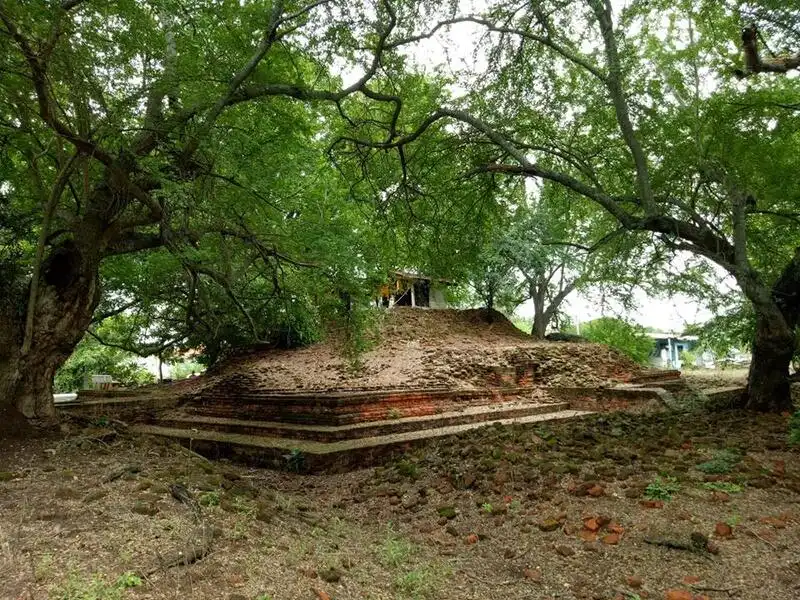
Noen Phra (Noen Yai Hom) is an important archaeological site in Nakhon Pathom Province, quietly hidden amid rice fields in Don Yai Hom Subdistrict. Although its present appearance may seem like nothing more than a peaceful earthen mound, this site is in fact the remnant of an ancient religious complex clearly connected to the Dvaravati civilization. It is also one of the places that helps illustrate the former prosperity of Nakhon Pathom as a major Buddhist center in the past.
Today, the site is known by two names: “Noen Phra” and “Noen Yai Hom.” The first reflects its sacred character and its relationship with an ancient religious place, while the second is tied to the name of the local community and the traditional memory of Don Yai Hom. Because local residents have used this name for generations, the site brings together layers of history, archaeology, and community memory in a single place.
The significance of Noen Phra is not based on legend alone. It is supported by real archaeological evidence. In 1936, Phra Thammavati Khanachan, better known as Luang Pho Ngern, the abbot of Wat Don Yai Hom at the time, dug up bricks from the slope of the mound for the construction of the temple’s ordination hall. That excavation led to the discovery of several highly valuable artifacts, including stone pillars, a crouching deer sculpture, a Dvaravati-style stone Buddha image, and fragments of a Dharmachakra sema stone. These finds became crucial evidence showing that this area was once an ancient temple or a large religious complex in the past.
The most remarkable finds from that excavation were 2 stone pillars, each about 4 meters high. The tops of the pillars bear carved decorative motifs that scholars have compared to the gateway pillars of the Sanchi Stupa in India. This is a form of art associated with early Buddhist visual culture and ancient Indian religious symbolism. Details like these show that Noen Phra is not merely a local archaeological site, but also an important piece of evidence in the history of how Buddhism and Indian artistic influence entered the land of Suvarnabhumi.
Beyond the stone pillars, the discovery of the crouching deer and the Dharmachakra sema further strengthens the interpretation of this place as a Dvaravati-period religious site. The Dharmachakra is a major Buddhist symbol, especially associated with the Buddha’s first sermon, while the deer refers symbolically to the Deer Park at Isipatana. It is therefore no coincidence that these elements appeared together in the same place. The stone pillars, which have forked tops designed to support a Dharmachakra sema, are of the same type found at major archaeological locations in Nakhon Pathom, including the area of Phra Pathom Chedi, Wat Phra Ngam, Wat Phra Prathon, and the Sanam Chan Palace grounds. This connection firmly places Noen Phra within the network of Dvaravati archaeological sites in Nakhon Pathom.
Seen in a broader context, Noen Phra was likely part of an ancient religious community that flourished during the Dvaravati period, and it may even have older foundations beneath that phase. The mound itself is believed to have once formed the base of a large stupa within the grounds of an ancient temple, rather than being a purely natural rise in the land. What remains today as a mound in the middle of the fields may only be the surviving core left behind after the original structures collapsed over time. Yet even if the original architecture no longer stands in full form, the value of the site has not diminished, because the traces that remain still reveal more than what is immediately visible.
Noen Phra is also compelling in terms of landscape and travel experience. It is not located in a busy urban zone, but instead lies amid open rice fields and wide rural land. This creates an atmosphere very different from fully developed historical attractions. Visitors who arrive here often sense the quietness, the openness of the landscape, and the strange feeling of standing at a point where different eras overlap: the agricultural life of the present-day community and the world of an ancient town more than a thousand years ago.
This is exactly what gives Noen Phra its special charm for travelers who appreciate quiet places with a strong sense of story. It is not a destination built around dense activities or extensive tourist facilities. Instead, it is a place suited to standing still, observing the actual terrain, reading the historical traces through the surrounding environment, and understanding that Nakhon Pathom is not defined by Phra Pathom Chedi alone. It is also a province with a wider network of archaeological sites, each of which helps complete the picture of the region’s ancient past.
The relationship between Noen Phra and Wat Don Yai Hom is another point worth noting. Although the archaeological mound itself lies outside the main temple grounds, the history of the discovery, the artifacts unearthed there, and the preservation of some of the stone pillars at the temple all make Wat Don Yai Hom an important reference point for visiting this site. For those who want a fuller understanding of Noen Phra, visiting Wat Don Yai Hom alongside the mound helps complete the picture, both in terms of local history and the beliefs still held by people in the area.
Today, some artifacts from Noen Phra have been transferred to the National Museum for proper preservation, while some of the stone pillars remain associated with Wat Don Yai Hom. This distribution of evidence reflects the fact that the value of Noen Phra does not lie only in the mound itself, but also extends into the study of art history, archaeology, and cultural heritage preservation at both provincial and national levels.
From a tourism perspective, Noen Phra is well suited to those interested in early Thai history, Dvaravati archaeology, or travel routes that go deeper than the usual well-known highlights of Nakhon Pathom. When combined with visits to Wat Don Yai Hom, Wat Phra Prathon Chedi, Wat Phra Pathom Chedi, Sanam Chan Palace, and the Phra Pathom Chedi National Museum, it becomes part of a richly layered route for learning about the ancient civilization of Nakhon Pathom.
The atmosphere of a visit here is best appreciated slowly. Rather than rushing to collect photographs, visitors should walk through the area at an unhurried pace and observe the surroundings carefully. The site’s value does not lie in complete standing monuments, but in the “meaning of the place.” Here, visitors can understand how a mound of earth in the middle of the fields can serve as evidence of religion, settlement, and belief spanning more than a thousand years. This kind of experience is difficult to find at more commercial tourist attractions.
Those planning a visit should go during daylight hours to see the surrounding terrain clearly, and it is wise to allow time for Wat Don Yai Hom as well. The temple is not only an important site in Nakhon Pathom Province, but is also directly linked to the discovery of Noen Phra and the preservation of major evidence from the area. If time allows, continuing on to Wat Phra Prathon Chedi, Wat Phra Pathom Chedi, or the Phra Pathom Chedi National Museum will turn the trip into a fuller journey that combines faith, history, and the viewing of archaeological artifacts in one route.
Travel to Noen Phra or Noen Yai Hom can begin from Nakhon Pathom city. Take Phet Kasem Road toward Bangkok, then turn right onto Setthakit 2 Road, also known as Highway 3097 on the Ban Phaeo–Don Yai Hom route. Continue for about 8 kilometers and you will reach the area of Noen Phra on the left-hand side, with a short distance further in from the main road. This route is most convenient by private car, as it allows easy access to the site and makes it practical to continue on to other important attractions in Nakhon Pathom.
Even though Noen Phra is not a tourist site with large-scale facilities or a full visitor center, its true value lies in its role as an origin point in local history. When visitors look beyond the outward simplicity of the place, they will find one of the sites that helps confirm that Nakhon Pathom was once a major center of Buddhism and art culture more than a thousand years ago.
Noen Phra is therefore a place worthy of serious attention, not simply because it is old, but because it is evidence that connects the past with the present, archaeology with community life, local oral memory with historical proof, and the famous attractions of Nakhon Pathom with a smaller place of great meaning in terms of cultural heritage. For anyone who wants to see a deeper side of Nakhon Pathom, Noen Phra is one of the places that should not be overlooked.
| Place Summary | A Dvaravati-period archaeological site in the form of a large earthen mound in the middle of rice fields, known as Noen Phra or Noen Yai Hom, believed to have been the base of a stupa or an ancient religious structure of major importance to the history of Nakhon Pathom. |
| Highlights | An archaeological site over 1,000 years old, with important discoveries such as stone pillars, a Dharmachakra, a crouching deer sculpture, and a Dvaravati-style Buddha image, all set in a quiet rural atmosphere amid rice fields. |
| History / Period | Believed to date to the Dvaravati period, and possibly even earlier. A major discovery took place in 1936 when Luang Pho Ngern of Wat Don Yai Hom excavated bricks from the slope of the mound and uncovered a number of important artifacts. |
| Address | Near Wat Don Yai Hom, Don Yai Hom Subdistrict, Mueang Nakhon Pathom District, Nakhon Pathom Province, Thailand |
| Travel | From Nakhon Pathom city, take Phet Kasem Road toward Bangkok, then turn onto Setthakit 2 Road (Highway 3097). Continue for about 8 kilometers to the Noen Phra area on the left-hand side, then enter slightly from the main road. Private car travel is the most convenient option. |
| Open Days / Opening Hours | Daily / 07:00 AM - 06:00 PM |
| Facilities | Basic facilities are mainly associated with Wat Don Yai Hom, which serves as the main access point for the area, including parking space, community shops, and temple grounds for a short stop before or after visiting the archaeological site. |
| Nearby Tourist Attractions | 1) Wat Don Khanak — approximately 3.9 km. 2) Wat Phra Prathon Chedi Worawihan — approximately 8.8 km. 3) Wat Phai Lom, Nakhon Pathom — approximately 9.1 km. 4) Wat Phra Pathom Chedi Ratchaworamahawihan — approximately 9.2 km. 5) Phra Pathom Chedi Night Market — approximately 9.4 km. 6) Phra Pathom Chedi — approximately 9.5 km. 7) Sanam Chan Palace — approximately 9.9 km. |
| Popular Restaurants Nearby | 1) Bang Wan Grilled Chicken, Don Yai Hom — approximately 1 km. — Tel. 084-356-5811 2) Salad Roll Don Yai Hom — approximately 1 km. — Tel. 082-248-9086 3) Duckแลนด์ Don Yai Hom — approximately 2 km. — Tel. 065-254-9044, 089-493-3693 4) Pizza Hut Nakhon Pathom — approximately 9.5 km. — Tel. 065-983-3544 5) Krua Ko Tae Nakhon Pathom — approximately 10 km. — Tel. 095-662-2324, 095-516-1793 |
| Popular Accommodations Nearby | 1) Xen Hotel Nakhon Pathom — approximately 10 km. — Tel. 034-900-500, 034-900-505 2) Ratchaphruek Pavilion — approximately 10 km. — Tel. 034-280-299, 084-768-1188 3) Mida Grande Hotel Dhavaravati Nakhon Pathom — approximately 12 km. — Tel. 034-966-700, 093-383-5515 4) B2 Nakhon Pathom Premier Hotel — approximately 11 km. — Tel. 052-009-161, 088-263-2897 5) POSH 39 Nakhon Pathom — approximately 10 km. — Tel. 087-519-5524 |
| Main Contact Number | Wat Don Yai Hom (main reference point for the area) Tel. 034-229-237, 034-229-239-40, 034-229-324 |
Frequently Asked Questions (FAQ)
Q: What is Noen Phra or Noen Yai Hom?
A: Noen Phra, or Noen Yai Hom, is a Dvaravati-period archaeological site in Don Yai Hom Subdistrict, Nakhon Pathom Province. It appears as a large earthen mound that is believed to have once served as the base of a stupa or part of an ancient temple complex.
Q: How old is Noen Phra?
A: Based on archaeological evidence, the site is more than 1,000 years old and is associated with the Dvaravati civilization that once flourished in the Nakhon Pathom area.
Q: What artifacts were found at Noen Phra?
A: Excavations uncovered stone pillars, a Dharmachakra, a crouching deer sculpture, and a Dvaravati-style Buddha image. These are major pieces of evidence confirming that the area was once an ancient religious site.
Q: Is Noen Phra located directly inside Wat Don Yai Hom?
A: The mound lies near Wat Don Yai Hom and is directly connected to the temple in historical terms, especially through the 1936 discovery of the artifacts. However, the mound itself is outside the main temple grounds in the nearby field area.
Q: How do I get to Noen Phra?
A: You can travel from Nakhon Pathom city via Phet Kasem Road, then turn onto Setthakit 2 Road and continue for about 8 kilometers. The Noen Phra area will be on the left-hand side. Traveling by private car is the most convenient option.
Q: What type of travel experience is Noen Phra best suited for?
A: It is best suited to visitors interested in history, archaeology, Thai culture, and quiet travel experiences. The site’s appeal lies in its historical value and its calm setting amid open rice fields.
Q: What other places should I visit after Noen Phra?
A: You can continue your route to Wat Don Yai Hom, Wat Don Khanak, Wat Phra Prathon Chedi, Wat Phra Pathom Chedi, the Phra Pathom Chedi Night Market, and Sanam Chan Palace for a trip that combines historical insight with broader sightseeing in one journey.
 Noen Phra (Noen Yai Hom) Map
 Category:
  Group:
  Last Update: 10 HourAgo
Comment
 Nearby Attractions
| Keyword (Advance) |
 Region
|
 Muang Nakhon Pathom(