
 Home
Home North(
 Chiang Mai(


Rating: 3.8/5 (6 votes)
 |
|  Map
Map 
 Have Map
  No Map
Bangkok attractions
Attractions in Thailand
Open Days: Daily
Opening Hours: 08:00 – 17:00
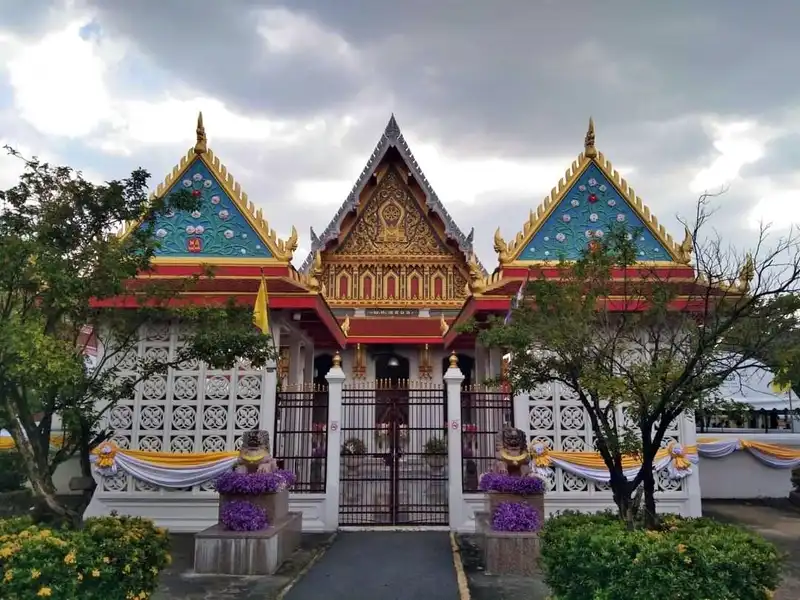
Wat Nuan Noradit Worawihan is a third-class royal temple located on the western bank of Khlong Bangkok Yai, in Pak Khlong Subdistrict, Phasi Charoen District, Bangkok. One simple landmark makes its position easy to remember: the temple sits “directly opposite Wat Pradu Chimphli,” with the canal in between. In local terms, it’s the kind of place where you can literally see the other temple across the water. That setting gives a distinctly Thonburi atmosphere—unhurried, calm, and pleasantly removed from the rush—while the temple’s story connects the Ayutthaya era, early Rattanakosin history, and the legacy of one of Bangkok’s major noble families, letting you read history as you walk through the grounds.
Wat Nuan Noradit Worawihan was originally an ancient temple that had been abandoned for a very long time. It is believed to have been founded during the Ayutthaya period, though there is no definitive evidence to confirm this. The temple’s former name was “Wat Makok Nai,” and it is often mentioned alongside “Wat Makok Nok,” which is known today as Wat Arun Ratchawararam. The reason behind these names is straightforward: the temple stood along the banks of Khlong Bangkok Yai, so the names were closely tied to the geography and canal-side way of life. Once you notice this, it becomes easier to picture how the communities along Khlong Bangkok Yai formed an important network in Bangkok far earlier—and far more deeply—than many people realize.
In the late reign of King Phra Bat Somdet Phra Poraminthra Maha Chakri Borommanat, Chao Khun Phra Ratchaphan (Nuan)—the wife of Chao Phraya Akkramahasena (Bunnag) and the sister of Queen Amarindra Borommarachini—restored the abandoned Wat Makok Nai. She assigned the responsibility to Chao Phraya Phra Khlang (Dis Bunnag), her son. This is what makes Wat Nuan Noradit more than simply “an old temple.” It became a living memorial shaped by faith and stewardship at the highest levels of Bangkok society in that era—showing how a temple can be both a spiritual space and a way of caring for a community by bringing a sacred place back to life.
After Chao Phraya Phra Khlang (Dis Bunnag) carried out the restoration of Wat Makok Nai—with an important point of connection being the period after he completed the restoration of Wat Prayurawongsawas in 2379 BE—the temple later received the royal name “Nuan Noradit Worawihan.” The naming was intended as a tribute to Chao Khun Phra Ratchaphan (Nuan). In that sense, the temple’s name becomes a compact summary of its story: a temple revived by devotion, and a name bestowed as a lasting remembrance of the person whose faith was inseparable from that revival.
In the reigns that followed, Wat Nuan Noradit Worawihan underwent further restorations many times. Records mention at least two notable restoration periods. The first was under the responsibility of Chao Phraya Surawongwaiwat (Wor Bunnag) and Chao Phraya Phatsakornwong (Phon Bunnag). The second was carried out by Phra Satsananurak (Thim Rattanachoti), the abbot at that time, and the restoration details were published in the Royal Gazette as well. In the bigger picture, the temple’s continuity comes from sustained care rather than a single one-time renovation—a pattern of repair, renewal, and ongoing maintenance that kept the religious site strong and functional for the community right up to the present.
If you ask what visitors should “look for” first at Wat Nuan Noradit, the answer starts with the temple’s relationship to the canal. This temple stands on the living line of a canal-side community along Khlong Bangkok Yai—both a historic route of movement and a defining landscape of the area. Walking here tends to feel quiet and community-rooted rather than like a fast-paced sightseeing stop. And once you connect the location to the former name “Wat Makok Nai,” it becomes easier to understand why many Thonburi temples carry an identity that feels different from temples in Bangkok’s inner city districts.
Another reason Wat Nuan Noradit feels compelling is its “layered time.” Even if the Ayutthaya-era origin cannot be proven with hard evidence, the narrative of abandonment and revival in the early Rattanakosin period is clear, and it links directly to historically prominent figures from the Bunnag family—a name familiar to many people interested in Bangkok history. Visiting the temple can therefore feel like touching history without needing to read a thick textbook: you stand in the real place, then gradually connect the former name, the royal name, and the multiple restoration phases into one continuous story.
The overall atmosphere suits anyone who wants a calm place to pay respects, as well as those who appreciate living community temples that still function naturally within Thonburi neighborhoods. On weekdays, the space often feels quiet, open, and easy to explore. On Buddhist holy days or during merit-making events, the number of visitors increases as you would expect at a royal temple. In any case, the essentials remain the same: dress modestly, keep your voice low, and if you take photos, do so respectfully—especially when people are making merit or when ceremonies are in progress.
Getting There If you’re coming by rail transit, the simplest approach is to choose a station that connects conveniently to the Thonburi side, then continue by taxi or motorcycle taxi to the Khlong Bangkok Yai area in Phasi Charoen. It’s recommended to pin “Wat Nuan Noradit Worawihan” in your map app for the most accurate navigation through local lanes and canal-side routes. If you drive, allow extra time because canal-side neighborhoods often have small streets and limited parking depending on the day. As you near the temple, drive slowly for pedestrian safety and to respect the surrounding community.
If you want a satisfying “half-day Thonburi” plan, Wat Nuan Noradit pairs easily with nearby temples and neighborhoods. You can stop by Wat Pradu Chimphli across the canal, then continue to Wat Paknam Phasi Charoen, or head toward the Talat Phlu area for well-known local food. This kind of route works well for people who want a balanced day—paying respects, walking through community spaces, and ending with great food—without having to cross the city in a rush.
| Name | Wat Nuan Noradit Worawihan |
| Type | Third-Class Royal Temple (Worawihan) |
| Location | Pak Khlong Subdistrict, Phasi Charoen District, Bangkok (western bank of Khlong Bangkok Yai) |
| Open Days | Daily |
| Opening Hours | 08:00 – 17:00 |
| Current Abbot | Phra Wachiramuni (Boonmee Intachoto) |
| Highlights | A royal temple on Khlong Bangkok Yai, formerly known as “Wat Makok Nai” paired with “Wat Makok Nok” (now Wat Arun), restored through the Bunnag family patronage and later renamed in remembrance of Chao Khun Phra Ratchaphan (Nuan), a calm canal-side community temple ideal for a quiet visit |
| Nearby Attractions + Distance | Wat Pradu Chimphli – 0.7 km Wat Paknam Phasi Charoen – 2.5 km Wat Khun Chan – 2.4 km Baan Silapin (Khlong Bang Luang) – 3.0 km Talat Phlu Area – 3.5 km Wat Arun Ratchawararam Ratchaworamahawihan – 5.0 km |
| Nearby Restaurants + Distance + Phone | Talat Phlu Chive Cakes (Lee Bo Ngek) – 3.6 km – 081-858-5583 Yong Hui Duck Noodles (Branch 1, Talat Phlu) – 3.7 km – 098-250-0915 Mee Krob Chin Lee – 4.2 km – 02-466-9170 Lek Hong Fish Rice Porridge – 4.0 km – 080-246-8246 |
| Nearby Accommodations + Distance + Phone | Hop Inn Bangkok Krung Thonburi Station – 6.5 km – 02-080-2222 Avani+ Riverside Bangkok Hotel – 6.0 km – 02-431-9100 Amdaeng Bangkok Riverside Hotel – 6.8 km – 02-162-0138 Klean Residence Hotel – 6.3 km – 02-439-0293 |
Frequently Asked Questions (FAQ)
Q: What time does Wat Nuan Noradit Worawihan open?
A: Based on the published information, the temple is open daily from 08:00 – 17:00.
Q: What was Wat Nuan Noradit’s original name?
A: Its former name was “Wat Makok Nai,” often mentioned alongside “Wat Makok Nok,” which is known today as Wat Arun Ratchawararam.
Q: What makes this temple worth visiting?
A: It is a royal temple on Khlong Bangkok Yai with a layered history: an ancient temple that was once abandoned, later restored through the patronage of Chao Khun Phra Ratchaphan (Nuan) and the Bunnag family, and then renamed as a tribute to “Nuan.”
Q: What can I visit near the temple afterward?
A: You can visit Wat Pradu Chimphli across the canal, continue to Wat Paknam Phasi Charoen, or head to the Talat Phlu area for famous local food, and finish with a stroll at Baan Silapin in Khlong Bang Luang.
Q: When is the best time to visit?
A: For a quieter atmosphere, morning shortly after opening is ideal. If you plan to continue to Talat Phlu at a relaxed pace, late morning through afternoon also works well.
 Wat Nuan Noradit Worawihan Map
 Category:
  Group:
  Last Update: 2 MonthAgo
Comment
 Nearby Attractions
| Keyword (Advance) |
 Facebook Fanpage
 Region
 Art, Culture and Heritage
 Historical Sites and Monuments(
 Landmarks and Memorials(
 Royal Palace(
 Art, Craft Centres, Tradition(
 Museums(
 Historical Houses and The Ancient City(
 Art Gallery(
 Educational Places
 Museum for Study(
 Library(
 University
 Church(
 Mosque(
 Other religious and spiritural sites(
 Research and Development
 Royal Project(
 Suburban Living
 Village, Community(
 Local Market(
 Floating Market(
 Nature and Wildlife
 River, Canal(
 Bays and Beaches(
 Other natural attractions(
 Entertainment and Agricultural
 Zoos and Aquariums(
 Animal camps and shows(
 Stadium(
 Farm, Parks, Gardens and Ecotourism(
 Amusement Park(
 Waterpark(
 Theater(
 Cinema(
 Shopping
 Shopping and Night Market(
 Department Store(
 Spas and Wellness
 Spas and Wellness(
 Restaurant
 Michelin Star(
 Accommodation
 Hotel(
 Call Customer Service in Tourism
 Call Customer Service in Tourism(
 Travel Articles, Recipes
 Travel Review, Food Review(
 Royal Thai Desserts, Traditional Dessert, Thai Dessert Recipes(