
 Home
Home North(
 Chiang Mai(


Rating: 4.4/5 (5 votes)
 |
|  Map
Map 
 Have Map
  No Map
Ang Thong attractions
Attractions in Thailand
Open Days: Open Daily
Opening Hours: 08.00 – 17.00
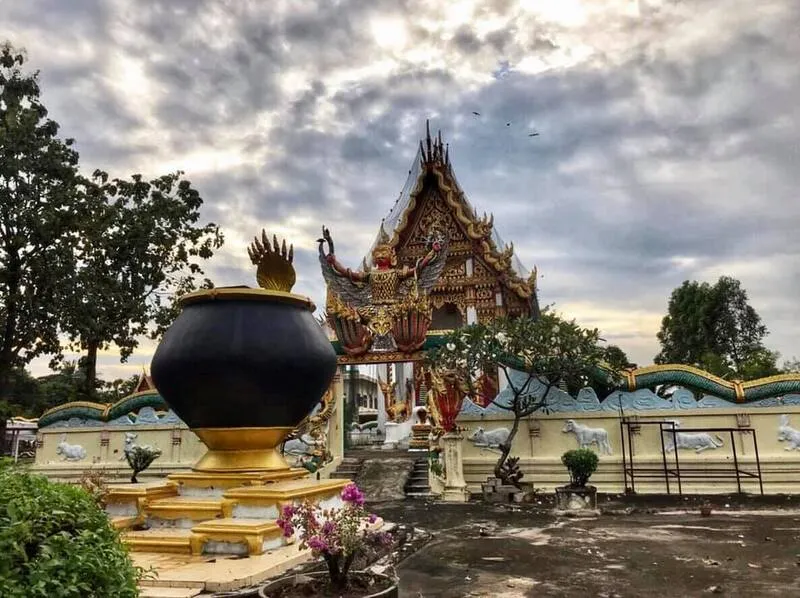
Wat Pho Thong (Kham Yat), Ang Thong is located in Ban Pho Thong, Kham Yat Subdistrict, Pho Thong District, Ang Thong, along the Ang Thong–Pho Thong route (Highway 3064), about 9 km from Ang Thong town. This long-established temple is often remembered by local communities as an “Ayutthaya-era temple” and is closely associated with the area’s royal-layered history through “Tuek Kham Yat” or “Phra Tamnak Kham Yat” — a structure tied in local memory to the late-Ayutthaya period, especially narratives connected to Prince Uthumphon (Khun Luang Ha Wat). The site is also linked to a later historical layer in the Rattanakosin period, notably the royal journey of King Vajiravudh (Rama VI) in 1916. As a result, Wat Pho Thong is not only a local merit-making center, but also a tangible place-based trace that helps visitors see how faith, community life, and major moments in Thai history overlap within one landscape.
The landscape of Kham Yat Subdistrict and Pho Thong District reflects the classic Central Plains setting — lowland terrain shaped by waterways and agriculture over generations. In communities like this, temples typically function as far more than ceremonial spaces. They serve as social anchors for news, merit-making events, funerals, ordinations, and shared learning. Because Wat Pho Thong sits on a route that naturally connects Ang Thong town to Pho Thong communities, it has long felt like a natural “rest point” in everyday movement and travel. That role aligns with its historical significance as a place that once accommodated elite stopovers, while today it remains accessible for visitors who want a meaningful cultural experience without long-distance travel or a complicated itinerary.
Looking deeper into its historical context, Wat Pho Thong is commonly described as having origins in the Ayutthaya period, an era when the lower Chao Phraya basin and connected provinces such as Ang Thong held strategic importance for both agricultural wealth and transportation networks. Temples in such fertile and well-connected areas often emerged alongside settlement expansion, the organization of community life, and the establishment of religious devotion. Religiously, the temple provided a center for learning Buddhist teachings and shaping moral life; politically, many temples also became “special spaces” where royal patronage helped reinforce legitimacy through support of religious institutions.
One of the most discussed historical dimensions of Wat Pho Thong is its association with Prince Uthumphon, widely known as “Khun Luang Ha Wat” — a significant figure in the late Ayutthaya era whose life bridged political power and monastic status. In a period marked by political pressure and external threats, his ordination carried meaning that was simultaneously religious and political. According to enduring local narratives, Wat Pho Thong is connected to that pivotal moment, with “Tuek Kham Yat” remembered as a cool-season residence within the temple grounds. This is why the temple is often recalled as a place that once hosted elite presence at a true turning point in Ayutthaya history.
With that context in mind, “Tuek Kham Yat” is not merely an old building inside a temple compound. It functions as a fragment of a larger historical picture, indicating how Ang Thong and Pho Thong were once within the royal sphere of attention. A royal stopover at a temple mattered: it implied a place that was calm, suitable for residence, and connected to key travel routes. In an era when water travel dominated, structures of this kind become cultural evidence of how journeys were organized, where travelers paused, and how elite mobility was practiced. The building’s location within a temple also reflects the close relationship between the royal court and Buddhism, since temples offered both sanctity and order — qualities especially appropriate for a royal rest stop.
Another layer of time reinforces the site’s significance in the Rattanakosin era. Records commonly cite that in 1916, King Vajiravudh (Rama VI) paused here during a royal journey along the Noi River and the main waterways. Such journeys were not simply “tourism”; they represented a way of “seeing the country” through direct observation of people, settlements, and the water networks that remained central to the Central Plains. Wat Pho Thong’s presence along that route suggests that Pho Thong and Ban Pho Thong were clearly part of the travel map of the early modern Thai state.
Beyond the royal narrative, Wat Pho Thong is also remembered through community history, especially the legacy of Luang Por Som Suchivo (Phra Khru Sophon Siritham), a former abbot noted in local memory for traditional medicine, education, and community development. This image of a monk engaged in public welfare reflects a classic Central Thai temple role: not only ritual, but also a community institution that supports well-being, knowledge, and social resilience. When this community layer is read alongside the story of Tuek Kham Yat, the temple becomes compelling as a place where “national history” and “local history” coexist within the same setting.
For cultural travelers, visiting Wat Pho Thong is best approached by slowing down and “reading the place” rather than simply stopping for a quick photo. Much of the temple’s appeal lies in seeing how state memory and community memory overlap. Visitors can spend time observing architectural details around the Tuek Kham Yat area, then move into the sacred zones to make merit and pay respects. This approach gives the visit more substance — linking what you see on-site to the historical context that shaped it.
In terms of etiquette, a temple that contains historic structures should be visited with extra care. Avoid touching fragile surfaces, climbing, or making loud noise in spaces where people practice religious activities. Dress respectfully in accordance with Thai temple norms. These practices are not only manners; they help preserve cultural heritage in a real, practical way, because historic structures cannot be restored to “new” condition without losing authenticity and historical value.
Getting There is straightforward by private car. From Ang Thong town, follow the Ang Thong–Pho Thong route (Highway 3064) toward Pho Thong District for about 9 km, then look for the entrance to Ban Pho Thong and signage directing you into the temple area in Kham Yat Subdistrict. If traveling by public transport, you can take a van or bus from Bangkok to Ang Thong town first, then continue by local transport or hired vehicle to Pho Thong District and onward to the temple. This option suits travelers who prefer not to drive while still covering key cultural sites in Pho Thong within a day.
Wat Pho Thong is therefore a strong choice for travelers who want Ang Thong with depth and context: it introduces late-Ayutthaya history through the narrative of Prince Uthumphon and the Tuek Kham Yat, reflects Rattanakosin-era royal travel through the 1916 journey, and conveys the living role of a Thai temple through community memory centered on Luang Por Som Suchivo. With a careful walk and attention to details, a temple visit here can become a clear and memorable experience of “reading Thai history through a real place.”
| Place Summary | An Ayutthaya-era temple in Pho Thong District, notable for its association with Tuek Kham Yat (Phra Tamnak Kham Yat) and layered royal-community history. |
| Highlights | Tuek Kham Yat / Phra Tamnak Kham Yat as a historical trace, narratives connected to Prince Uthumphon (Khun Luang Ha Wat), the 1916 royal journey of Rama VI, and the temple’s long-standing role in the Pho Thong community. |
| Address | Mu 9, Ban Pho Thong, Kham Yat Subdistrict, Pho Thong District, Ang Thong 14120, Thailand |
| Open Days | Open Daily |
| Opening Hours | 08.00 – 17.00 |
| Abbot | Luang Por Som Suchivo (Phra Khru Sophon Siritham) – Former Abbot |
| Getting There | From Ang Thong town, take Highway 3064 (Ang Thong–Pho Thong) for about 9 km to Ban Pho Thong, Kham Yat Subdistrict, then follow local signs to the temple. |
| Current Status | Open for visits and merit-making during stated days and hours. |
| Contact Number | 036-770-096 |
| Nearby Attractions (Approx. Distance) | 1) Wat Khun Inthapramun – 12 km 2) Ban Bang Sadej Royal Doll Center – 14 km 3) Wat Muang (Big Buddha) – 25 km 4) Wat Chaiyo Worawihan – 22 km 5) Wat Pa Mok Worawihan – 20 km |
| Popular Restaurants Nearby (Approx. Distance) | 1) Sombat Phochana (Ang Thong Town) – 10 km 2) Krua Mae Waen (Ang Thong) – 10 km 3) Phae Ang Thong (Ang Thong Town) – 10 km 4) Wooden House Ang Thong (Ang Thong Town) – 11 km 5) Ban Loptawan Cafe (Ang Thong Town) – 11 km |
| Popular Accommodations Nearby (Approx. Distance) | 1) Pho Thong Inn (Pho Thong) – 3 km 2) Centerplace Ang Thong (Pho Thong) – 4 km 3) N.J. Resort (Ang Thong) – 12 km 4) Bua Luang Boutique Resort Ang Thong (Ang Thong) – 14 km 5) Ang Thong Hotel (Ang Thong) – 10 km |
Frequently Asked Questions (FAQ)
Q: Where is Wat Pho Thong (Kham Yat) located?
A: It is in Ban Pho Thong, Kham Yat Subdistrict, Pho Thong District, Ang Thong, along Highway 3064.
Q: What makes Wat Pho Thong different from other temples in Ang Thong?
A: Its key distinction is the historical association with Tuek Kham Yat (Phra Tamnak Kham Yat), a place-based trace linked to late-Ayutthaya narratives and later royal travel history.
Q: Who is Tuek Kham Yat associated with in Thai history?
A: Local narratives connect Tuek Kham Yat to Prince Uthumphon (Khun Luang Ha Wat) during the late Ayutthaya period, and it is also discussed in relation to later Rattanakosin-era royal journeys.
Q: How is King Rama VI connected to this area?
A: The site is commonly cited in connection with his 1916 royal journey along the Noi River and major waterways, during which he paused in the region.
Q: What time is the temple open?
A: Open daily from 08.00 – 17.00.
Q: How much time should I plan for a visit?
A: In general, 45 minutes to 1 hour is enough to walk around, observe the historic context, and make merit at a comfortable pace.
Q: What should I wear when visiting?
A: Dress respectfully (covered shoulders, modest-length pants or skirt) and keep noise low in worship areas and around historic structures.
Q: Can I get there by public transport?
A: Yes. Travel from Bangkok to Ang Thong town first by bus or van, then continue by local transport or a hired vehicle to Pho Thong District and Kham Yat Subdistrict.
Q: If I want to continue a temple-hopping day trip, where should I go next?
A: You can continue to Wat Khun Inthapramun, Ban Bang Sadej Royal Doll Center, Wat Chaiyo Worawihan, Wat Pa Mok Worawihan, or Wat Muang in a single day depending on your route.
Q: What type of trip is this temple best suited for?
A: It is well suited for cultural and historical travel combined with merit-making, especially for visitors interested in reading Thai history through an on-site place narrative.
 Wat Pho Thong Map
 Category:
  Group:
  Last Update: 3 WeekAgo
Comment
 Nearby Attractions
| Keyword (Advance) |
 Region
|
 Muang Ang Thong(