

 Home
Home Chiang Mai(










Rating: 4/5 (6 votes)
 |
|  Map
Map 
 Have Map
  No Map
Chiang Mai attractions
Attractions in Thailand
Open Days: Monday–Saturday (Closed on Sunday) (Recommended to call or message the page in advance, as hours may change depending on custom orders or community activities)
Opening Hours: 09.00–16.00
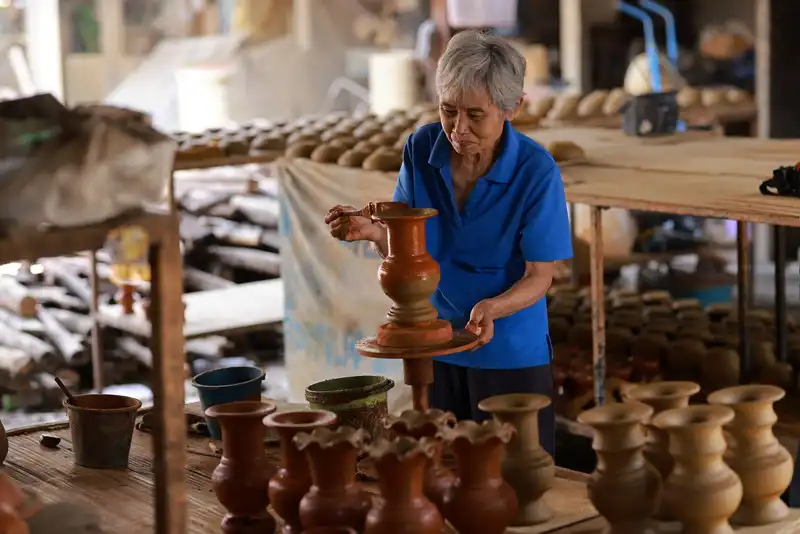
Muang Kung Pottery Village (Chiang Mai travel, Northern Thailand travel) is a handicraft community where “clay” is both a way of life and a living memory of the area. Baan Muang Kung is widely known as a major production hub for the Lanna “nam ton” water jar, or the traditional water container (kontho) used for drinking water. Many people recognize it instantly by its well-balanced rounded shape, a narrow mouth that helps prevent spills, and a form that makes it practical for travelers to carry. The popularity of the nam ton is not only about beauty, but about real function: this type of earthenware helps keep water “cool for longer” thanks to clay that dissipates heat well and has relatively high porosity. The water inside therefore stays cool, making the jar a household essential in the past, and gradually evolving into a decorative item and souvenir in the present day.
Common products from Baan Muang Kung include clay cooking pots, water pots, vases, earthen pots, and various types of earthenware. However, the “nam ton” is often seen as the village’s most representative piece because it tells a story of water storage wisdom, travel, and the fine-grained realities of life in an era before refrigerators and modern materials became everyday options. Another important layer is that Baan Muang Kung has been developed as part of a handicraft village project under the Tourism Authority of Thailand, positioning the community as a cultural learning destination alongside being a place of real production—not merely a “souvenir market” separated from the roots of the makers.
If you look a little deeper, the most fascinating part of Baan Muang Kung is the “ethnic layer” embedded in how the nam ton used to be named. In the past, many locals called this vessel “nam ton ngiaw” because the makers were “Ngi aw,” or Tai Yai (Shan), who were relocated and migrated from Muang Pu and Muang Sat, areas that today lie east of the Salween River in Shan State, Myanmar. Over time, the blending of customs, traditions, culture, and ethnic identities led the art of making nam ton ngiaw to be refined and developed—in form, size, and production methods—until the name gradually shifted into “Chiang Mai nam ton.” The village producing these jars and pots was therefore known as “Baan Nam Ton,” which is the former name of Baan Muang Kung. This reflects Chiang Mai as a city where craftsmanship was not created by a single group, but shaped by travel, settlement, and coexistence among diverse communities.
Technically, the cooling quality of Muang Kung’s nam ton relies on earthenware fired at a relatively low temperature. As a result, the clay body remains fairly coarse, thick, and sufficiently porous. This porosity enables evaporation and some heat transfer, helping the vessel’s surface and the water inside retain coolness (in local words, “naturally cool water”). Because it was a vessel found in nearly every home, the “nam ton” was not merely a utilitarian object; it also became a decorative household piece, an icon of the Lanna kitchen, and a quiet connector between everyday life and family memory.
That said, income from making nam ton jars was once only a secondary occupation, and earnings from both primary and secondary work often did not lead to comfortable living—many households could only “get by.” Later, as demand declined due to the rise of plastic containers, ceramic products, and electrical appliances such as refrigerators and blenders, the need for traditional water vessels decreased further. Nam ton production therefore remained in only a few households. This became a major turning point for the community because it forced Baan Muang Kung to “negotiate with the times” and find a new answer: if the nam ton is no longer a necessity, where should its value be placed?
The answer in the present is to strengthen competitiveness by integrating art and design, enhancing production techniques to achieve higher quality and more eye-catching products, and adapting forms for home decor, modern use, and story-rich souvenirs. As a result, you will see more colorful pieces, wider varieties of patterns, and more diverse forms than before. Yet the work still stands firmly on the same foundation: “the clay must still work.” Many pieces therefore retain the character of handmade craft, the warmth of the surface, and the simple, homey feeling that makes people want to place them in their own spaces.
If you want more than souvenir shopping, give time to “observing the process”—from preparing the clay, shaping, detailing, smoothing out hand marks, and careful drying (without rushing so it doesn’t crack), to firing. All of this reflects the discipline of the artisans and their relationship with Northern Thailand’s climate. Earthenware favors dry air, but drying must be controlled so it doesn’t happen too quickly. The craft is, in a way, a conversation with the seasons. The more you understand the “slowness” of the work, the more you will see why a single piece carries value beyond the price on the tag.
Another reason Baan Muang Kung is worth visiting is its location in the Hang Dong–Nong Khwai area, which connects easily to other Chiang Mai attractions and craft districts. It works well as a stop on a themed “craft day” itinerary: start at Baan Muang Kung to see clay work and choose items for use at home, then continue to the wood-carving and crafts area of Baan Tawai, or visit Wat Intharawat (Wat Ton Kwen) to absorb calm Lanna architecture, and finish with family-friendly attractions such as Chiang Mai Night Safari or Royal Park Rajapruek. These places are close enough to drive between without feeling overly tiring.
If we place Baan Muang Kung alongside other clay-making / kiln-related places in Chiang Mai that people often think of, the village’s distinctive strengths become clearer, as do the expectations you should bring. One reference point is “San Kamphaeng,” which many people know as an area associated with kilns and Lanna ceramics in archaeological narratives (multiple kiln groups, multiple study periods). The San Kamphaeng perspective helps you see ceramics as academic and historical evidence of production, while Baan Muang Kung shows clay as “a real household vessel” and an ethnic story embedded in the naming of the object itself. Another reference point is “Wiang Tha Kan,” known for Lanna ceramics and supported by a local museum as a learning site. Wiang Tha Kan helps open a view into eras and the development of ceramics as a significant production center, while Baan Muang Kung opens a view into “community adaptation”—from necessity to decorative item and souvenir in the age of modern materials. Put simply, Baan Muang Kung helps you understand that craft is not only about beauty; it is household economy, intergenerational skill, ethnic history, and dignified resilience of artisans.
When visiting, it’s best to travel with respect for the community: if you want to take photos in work areas, ask permission first, especially when artisans are shaping or firing; avoid handling pieces that are still drying or being prepared for firing; and if you plan to buy souvenirs, ask about care instructions. Some earthenware does not like long soaking, and some is not suitable for sudden temperature changes. These short conversations help you choose the right piece for real use, and they also let artisans feel that their story is being “heard,” not merely bought as a prop.
Getting There Baan Muang Kung is about 10 km from Chiang Mai city via the Chiang Mai–Hot Road, and about 6 km from the ring road near the airport zone (Highway 11). It is located shortly before the Hang Dong–Samoeng junction. A common approach is to drive from the city toward Hang Dong along the Chiang Mai–Hot / Rajapruek route; once you enter the Nong Khwai area, you will begin to see the community atmosphere and nearby attractions. If you are not familiar with the route, it is recommended to use navigation and pin “Baan Muangkung pottery handicraft บ้านเหมืองกุง.” It should guide you to the correct point, and the area is described as having a handicraft sample/display center near the village entrance based on community-shared information.
| place summary | A traditional handicraft community in Hang Dong, Chiang Mai, best known for Lanna “nam ton” earthenware water jars. Visitors can explore cultural craft heritage shaped by Tai Yai (Shan) influences, see the village’s adaptation from daily-use pottery to contemporary decor/souvenirs, and combine the visit with nearby craft and family attractions in the same area. |
| place name | Baan Muang Kung Pottery Handicraft Village (Muang Kung Pottery Village) |
| location | Nong Khwai Subdistrict, Hang Dong District, Chiang Mai (Chiang Mai–Hot / Rajapruek area, near the Nong Khwai tourism zone) |
| key characteristics | Known for “nam ton” / traditional Lanna water jars (kontho). Porous, relatively coarse earthenware helps keep water naturally cool. Contemporary products feature brighter colors and more varied forms, suitable as functional items, home decor, and souvenirs. |
| period / context | A living craft community continuing Lanna pottery wisdom, with an ethnic Tai Yai (Shan) layer in the historical narrative of nam ton production. |
| key evidence / highlights | A well-known source of nam ton (traditional water jars) with ongoing development of methods and designs to improve quality and modern appeal. |
| name origin / story | Nam ton was once called “nam ton ngiaw,” reflecting Tai Yai (Shan) artisan roots, later becoming known as “Chiang Mai nam ton.” The pottery-producing village was formerly called “Baan Nam Ton” (the earlier name for Baan Muang Kung). |
| open days | Monday–Saturday (Closed Sunday) (recommended to contact before visiting) |
| opening hours | 09.00–16.00 |
| travel | About 10 km from central Chiang Mai via the Chiang Mai–Hot / Rajapruek route; about 6 km from the airport ring-road zone (Highway 11). Use navigation and pin “Baan Muangkung pottery handicraft บ้านเหมืองกุง” to reach the correct entrance. |
| current status | Open (handicraft community and cultural learning destination). Recommended to contact ahead for the most accurate shop/activity timing. |
| contact phone | 084-389-6615 (community/craft group) | 089-552-7082 (museum/learning center per community museum database) | 053-125-070 (Wiang Tha Kan museum per community museum database) |
| facilities | Parking/stop areas depending on village conditions, product shops/sales zones, learning points/sample craft displays (details may vary by zone and time) |
| fees | No standard fee stated (generally accessible as a community visit; workshops or custom activities may have costs depending on conditions). Recommended to ask before joining activities. |
| nearby attractions (approx. distance) | Wat Intharawat (Wat Ton Kwen) – 4 km – Tel. 053-248-604 (or 053-248-607) Chiang Mai Night Safari – 6 km – Tel. 053-999-000 Royal Park Rajapruek – 7 km – Tel. 053-114110-2 Baan Tawai Trade & Tourism Information Center – 5 km – Tel. 081-882-4882 Wiang Tha Kan Museum (San Pa Tong) – 18 km – Tel. 053-481-176, 099-522-2650 |
| popular restaurants nearby (approx. distance) | Khaomao–Khaofang – 5 km – Tel. 053-838-444, 063-665-5838 Thai Tea / Green Tea by HAUS (HAUS@Muang Kung) – 1 km – Tel. 082-659-8744 Seichi Yakiniku (Hang Dong branch) – 6 km – Tel. 083-252-9269 Kneads to Dough – 7 km – Tel. 093-313-7780 MOOH House Hang Dong – 8 km – Tel. 053-936-000 |
| popular accommodations nearby (approx. distance) | North Hill City Resort / North Hill Golf Club – 9 km – Tel. 053-908-999 Veranda High Resort Chiang Mai – 18 km – Tel. 053-365-007 Lanna Resort and Spa (Hang Dong–Samoeng) – 19 km – Tel. 053-365-222 Kantary Hills Hotel, Chiang Mai – 16 km – Tel. 053-222-111, 053-400-877 Thantara Resort Chiang Mai (San Kamphaeng) – 26 km – Tel. 053-215-008 |
Frequently Asked Questions (FAQ)
Q: What is Baan Muang Kung most famous for?
A: It is best known for “nam ton” earthenware water jars (traditional Lanna kontho), which naturally help keep water cool due to the properties of the fired clay, and have long been a signature product of the community.
Q: Why can an earthenware nam ton keep water cool?
A: Because the clay body is relatively coarse and porous, enabling evaporation and some heat transfer, which helps the water inside stay cooler. This is a traditional wisdom of water storage.
Q: How much time should I plan for a visit?
A: For a relaxed stop to explore and shop for crafts, plan about 1–2 hours. If you want a deeper look at the process or to speak with artisans / join activities, plan 2–3 hours so you don’t have to rush.
Q: Is there really a Tai Yai (Shan) connection to Muang Kung’s pottery tradition?
A: In local narratives, the jar was once called “nam ton ngiaw” because earlier makers were Ngi aw / Tai Yai (Shan) migrants. Over time, through cultural blending, it became widely known as “Chiang Mai nam ton.”
Q: If I want a Chiang Mai pottery-themed day trip, where else should I go?
A: Consider adding the Wiang Tha Kan Museum for an archaeological/Lanna ceramics learning angle. If you want broader academic context on kiln groups and ceramic history, San Kamphaeng is also often discussed in cultural and archaeology-related publications.
Q: How should I care for earthenware pottery after purchase?
A: Avoid sudden temperature changes (for example, pouring very hot water into a vessel that is very cold). Ask the artisan about suitable uses for specific foods/drinks and the best cleaning method for each surface type.
 Muang Kung Pottery Village Map
 Category:
  Group:
  Last Update: 8 HourAgo
Comment
 Nearby Attractions
| Keyword (Advance) |
 Region
|
 Muang Chiang Mai(